Annual Report 2025/26
Contents
- Introduction
- The role of the PCC
- Key achievements
- Financial report
- Governance and Accountability
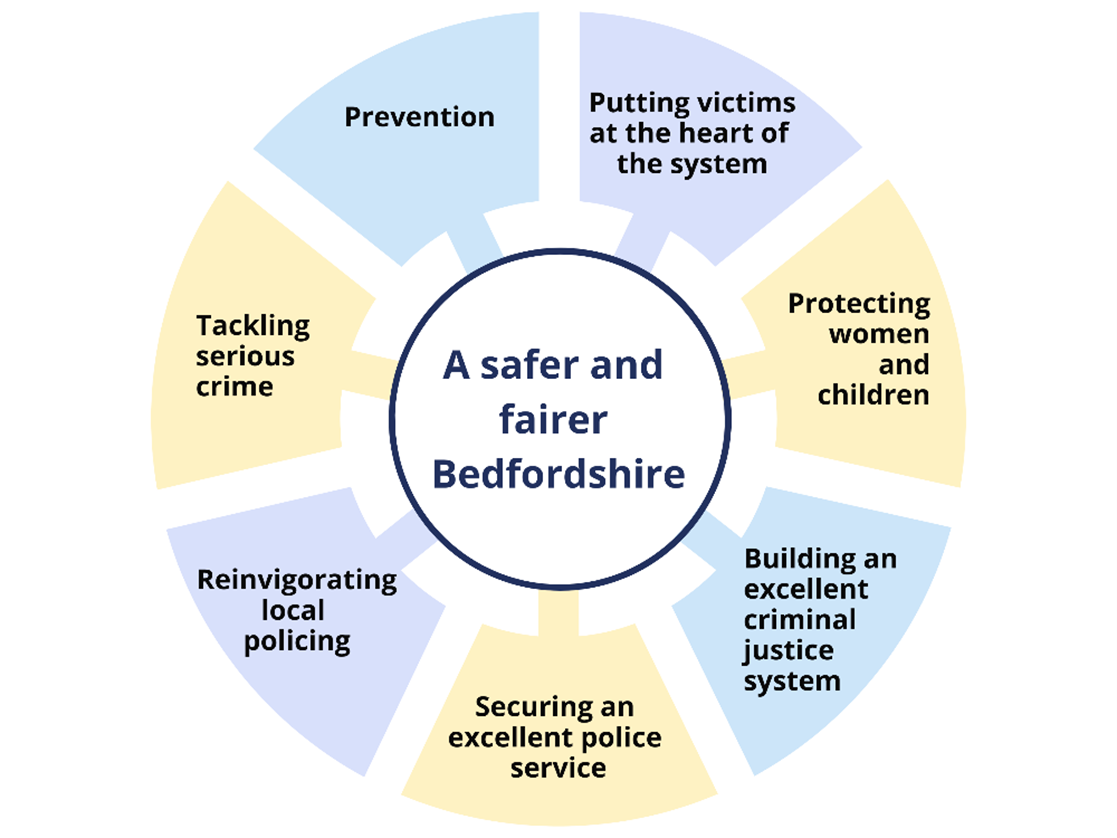
- Police and Crime Plan delivery
- Statutory Responsibilities
- Complaints
- Commissioning and Grant Funding
- Equality, diversity and inclusion
Introduction
I am pleased to present my annual report for 2025/26. This year was the second of my four year tenure.
I now know that I will be the last Police and Crime Commissioner (PCC) in Bedfordshire as the government is introducing new local policing governance. Before this announcement by the government, my personal tenure and electoral mandate were due either to end or be renewed in May 2028.
2024/25 was a foundation year when I had to take a range of necessary steps to ensure that I could fulfil my obligations to the people of Bedfordshire effectively.
This includes strengthening governance to hold the police to account, creating a small professional team to support me and fulfil the legal responsibilities of my office and adopt a Police and Crime Plan and Strategic Direction to clearly set out my ambitions and missions.
I have two more years to continue to make a positive difference, and I intend to take the opportunity.
This mid-point in office provides a great opportunity to reflect on what has been
achieved since being elected. My role is to make our county safer, to address social injustice, to drive improvement in police performance and across the wider criminal justice system, and to prevent crime.
Holding the Chief Constable to account
I have been greatly impressed by the professionalism and commitment of police officers and police staff. I have been equally impressed by the quality of senior leadership in our police service, which is why I am pleased to have extended the Chief Constable, Trevor Rodenhurst’s contract until 2031. The governance arrangements to hold the Chief Constable to account have been refined and used to good effect. Police performance continues to improve, though I recognise that we need to go further.
I have established an independent AI Ethics Advisory Panel and a memorandum of understanding to ensure accountability for the deployment of Live Facial Recognition the latter has been adopted as best practice and promoted nationally for all PCCs and Mayors to adopt.
Convening partners in Bedfordshire
It has become increasingly apparent – even though I had acknowledged this prior to my election in 2024 – that the police alone cannot address the problems that cause crime nor enforce the law alone. There is a need for strong and effective strategic and operational partnership and collaboration. As PCC, I have a role and mandate to convene partners and to drive system change. I intend to up the pace and intensity of this work. Relations and stronger partnerships have been strengthened with the three local authorities, the NHS, education providers and public bodies in the criminal justice system, though more remains to be done to build on these relationships to secure strong outcomes for the benefit of residents and businesses. I have introduced radical change to the way in which I support and grant voluntary and community organisations and promoted their right to advocate and campaign freely even when in receipt of funding from the OPCC. I am pleased to have introduced the Grassroots Innovation Fund to encourage and support innovative and experimental projects from small community groups without them being subject to bureaucratic barriers and hurdles.
Tackling the social and economic causes of crime
The social and economic causes of crime, criminality and people feeling unsafe and insecure need to be more widely understood and addressed. This requires political will and effective collaboration, as well as investment in prevention and early intervention. I have adopted an approach based on what I have called the triangle of hope, where the three sides of the triangle are social justice, criminal justice and human rights. This triangle will guide my policies and activities over the next two years.
In my Police and Crime Plan published in 2024, I quoted the then Chief Inspector of Constabulary and I do so again as Sir Andy Cooke’s words still speak powerfully to us today.
"Cutting poverty and inequality is the best way to reduce crime. There needs to be substantial funding into the infrastructure of our inner cities and our more deprived areas.
"We need to reduce that deprivation and the scale of deprivation that we see in some of our communities, beacause if you give people a viable alternative, not all but a lot will take it.
"If we don't do that, then policing will always be on the back foot".
Her Majesty's Chief Inspector of Constabulary and Fire and Rescue Services;
Andy Cooke QPM DL
I intend to drive more early intervention through the Serious Harm Partnership Board and the Violence and Exploitation Prevention Partnership (VEPP) and in other ways over the next two years.
National reform of the police service in England and Wales
The government has launched a major police reform programme through a White Paper published in February 2026 and has introduced a new police bill in the King’s Speech this May.
The new performance regime will drive performance. The new police officer licences will further professionalise the policing and police officers. The creation of a national police service will enhance and brigade capability in areas such as international crime and terrorism. National procurement, IT systems and data arrangements will improve productivity. Police service mergers could provide greater resilience and capacity but we must retain well resourced, effective and accountable local policing.
These reforms are perhaps the most radical for over sixty years and may be more. They have the potential to make our county safer and better policed. I am involved locally in considering how we can ensure that this reform benefits us. I also carry out national work that is core to my role and detailed in this report.
The role
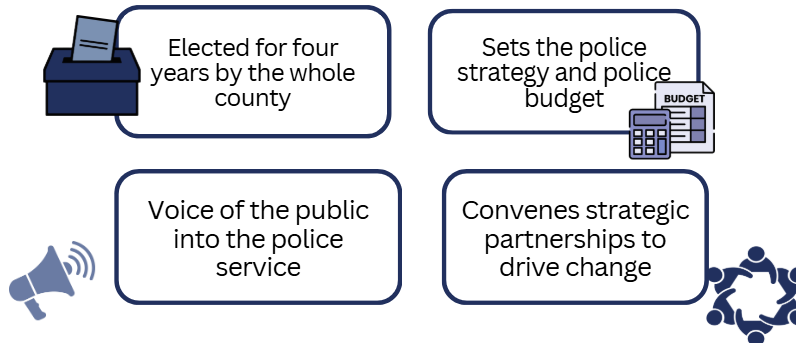
The PCC is the voice of the public into the police. He makes sure the police serve all communities equitably, visibly and with appropriate resources. The PCC advocates for Bedfordshire with the government, championing the interests of residents including victims of crime.
The PCC does not have operational responsibility for Bedfordshire Police. He sets the strategic direction through the Police and Crime Plan, the budget and the council tax. The PCC holds the Chief Constable to account for the delivery of an effective and efficient police service based on the plan and the budget.
The PCC has responsibility to coordinate the wider criminal justice system in Bedfordshire. He chairs the Local Criminal Justice Board which brings together the partners responsible for all elements of the system to develop joint strategies and to deliver joint solutions.
The PCC works with the three unitary local authorities in the county and other public sector agencies to strengthen joint planning, working and resource sharing.
PCC's national responsibilities
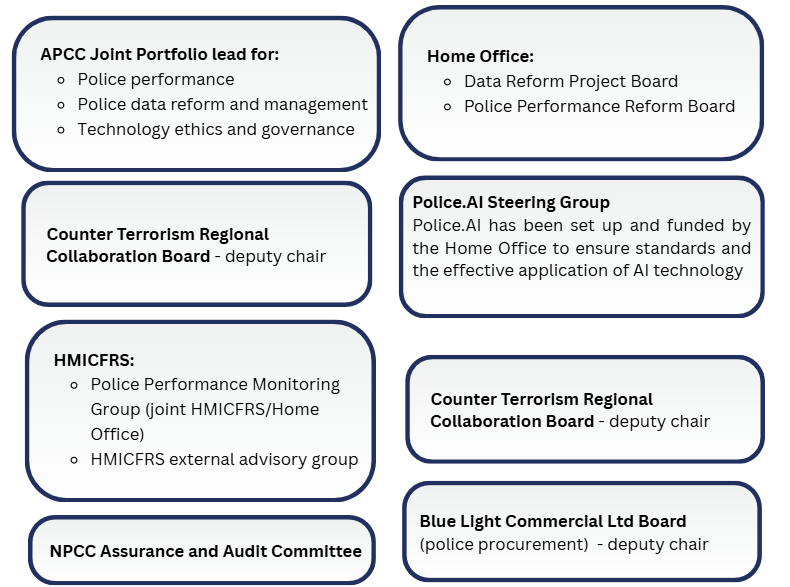
In fulfilling these roles, the PCC has been able to:
- Promote Bedfordshire’s interests nationally and regionally
- Gain a wider understanding of policing and policing bodies across the country; and use this learning to develop policy and strategy, and strengthen local accountability of the Chief Constable and Bedfordshire Police
- Contribute to the development of the elements of the government’s police reform programme including the new Police Performance Framework and Levelling Scheme for police services, the reform of police data policy and systems and the advancement of the use of AI in policing and more
- Represent PCCs and Deputy Mayors (DMs) on the board that monitors the performance of all police services, allocates police services to the category of levels of performance, and scrutinises and supports Chief Constables and PCC/DMs in level three or ENGAGE due to poor performance
- Hold the police to account for the performance of the Eastern Regional Special Operations Unit (ERSOU) and the Bedfordshire, Cambridgeshire and Hertfordshire (BCH) collaboration – though ultimately, he holds the Bedfordshire Chief Constable to account for all aspects of policing in the county
- Influence national police procurement policy, standards and practice
These roles are especially important during a period of major police reform following the publication of the White Paper and the impending Police Reform Bill, when continuous improvement in police performance is required and given the financial challenges. The PCC’s national and regional portfolio includes some specific roles and membership of a number of boards.
Key achievements
Decision log
In line with the Decision Making Framework, decisions made by the PCC and the Office of the Police and Crime Commissioner (OPCC) of significant public interest are published on the PCC website.
53 decisions have been made in the 2025/26 period on issues ranging from spending to governance and documentation, as well as approving new work schemes.
Community cohesion and anti-racism
The PCC is committed to every person living in, working in, or visiting Bedfordshire having the right to be safe and to feel safe, whatever their heritage, gender or faith. The PCC is aware that division and hatred in Britain are rising, and Bedfordshire is not immune from this although it has some well established and effective community cohesion foundations. The PCC has been clear that antisemitism and Islamophobia, and all forms of race and faith-based hatred have no place in Bedfordshire. The PCC has recognised the need to build even stronger community cohesion in the county.
The PCC has regularly met faith and community leaders from across the county and visited places of worship including the synagogue, gurdwaras, mosques, temples and churches. He has developed relations with community groups and community leaders in order to understand their feelings and concerns. He has participated in several community events designed to bring communities together and promote community cohesion.
The PCC has held the Chief Constable to account for maintaining a community cohesion team within the police service, enhancing police protection at places of worship, and providing reassurance for communities.
The PCC has provided funding to the Luton Council of Faiths to support its work of fostering community harmony. He participated in the Luton Peace Walk, spoke at the Luton “No Place for Hate” event, attended other events to promote community solidarity, supported the development of plans for a Peace Walk in Bedford and engaged with other civic leaders on these matters. He has actively supported and contributed to the “We are Luton” community led campaign.
The PCC has introduced and funded a third party “Stop Hate” confidential independent hate crime reporting system. The PCC has also supported groups and communities which are subject to hate crime and divisive attacks including the LGBTQ+ and women’s disability communities.
Promoting community cohesion, calling out those who promote hatred and division and ensuring that the police tackle hate crime with a focus on racial and faith hate will be core to the PCC’s activities over the next two years. The PCC continues to address disproportionality in policing.
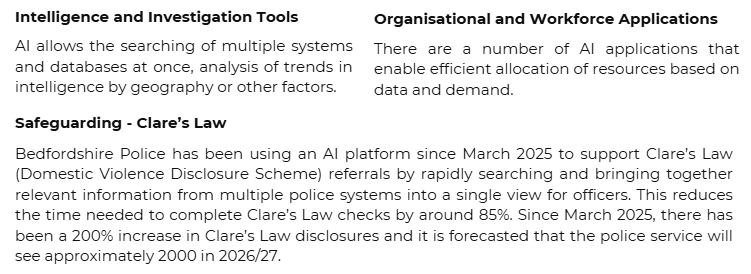
Artificial Intelligience applications
Bedfordshire is pioneering the use of Artificial Intelligence (AI) in operational policing in order to improve its productivity and outcomes and now has over 30 new AI applications. These include:
Continuous police improvement
Following the publication of the PEEL (Police Effectiveness Efficiency and Legitimacy) 2023–25 report in January 2025, the PCC agreed governance arrangements for improvements with the Chief Constable, including an improvement plan with key milestones, resourcing plans, and a RAG assessment framework.
The PCC introduced governance arrangements requiring a quarterly report to the Performance and Governance Board covering all areas for improvement (AFI), identifying the order in which AFIs will be addressed and reporting progress. The PCC also identified where his office can support improvement through partner engagement, commissioning funds, and OPCC staff such as the Violence and Exploitation Prevention Partnership (VEPP). As can be seen in the published minutes of the Board, there have been significant improvements made in many areas, but the pace of some improvement such as in the areas of Patrol response, victim outcomes and detective capacity, has not fully met the PCC’s expectations. The next HMICFRS inspection which is due in 2026 will test whether the improvements made are sustainable.
Financial Report
Financing for Police and OPCC 2025/26
Police Grants £89.9M
Council tax (police precept) £65.9M
Financial outturn 2025/26
The financial outturn for Bedfordshire Police for financial year 2025/26 was £156,327,931.
This was compared to a revenue budget of £155,774,300 thus resulting in an overall overspend of £553,631. The breakdown for this is shown below:

Whilst the outturn position provided an overspend against a budget of £553,631, this was a significant improvement on the position forecasted in July 2025, when the outturn position was forecasted at an overspend of £2.8M. Significant work was undertaken by both the OPCC and police service to introduce controls that reduced expenditure but didn’t impact performance.
These included the use of the Police Property Act funds by the OPCC together with restrictions in both the OPCC and police service on the filling of police staff vacancies. The police service also maximised its use of technology to reduce overtime expenditure and slowed some of its replacement cycles for capital expenditure.
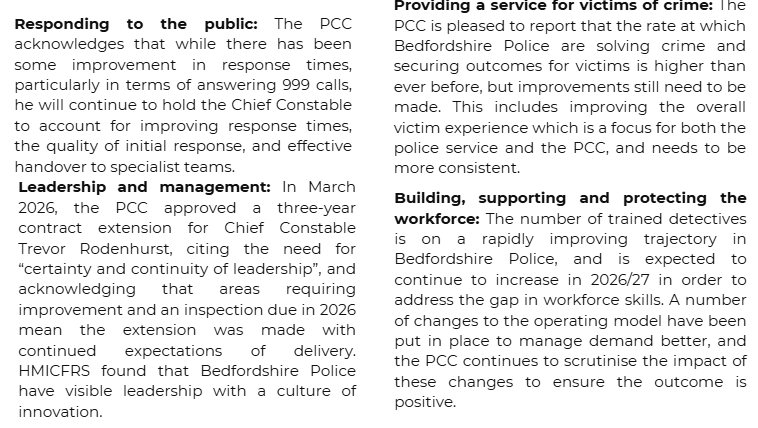
The operational performance of the police service, despite these reductions in expenditure, at the end of 2025/26 in relation to key aspects of policing including responding to the public and solving crime, continued consistently to improve month by month and in both areas of service.
Financially, the reduced overspend has meant that the reserves position for the PCC and Beds Police is improved wih a higher level of both general and earmarked reserve.

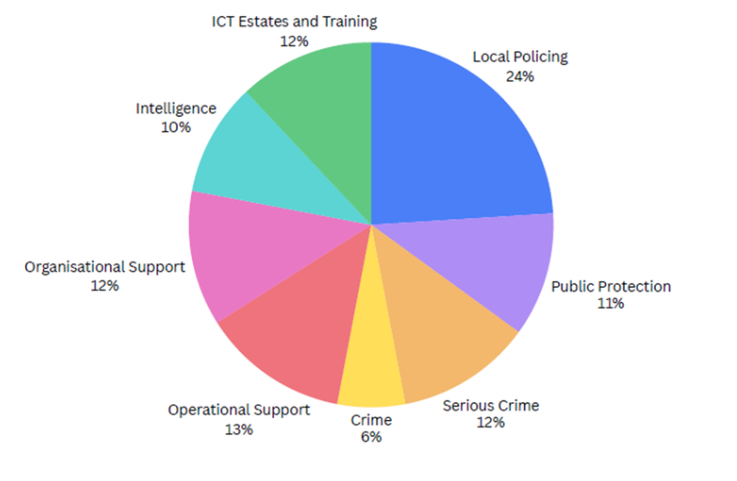
Expenditure by police activities
The PCC was successful in his application to increase Precept by a further £3.50, at Band D, in addition to the national level increase of £15, at Band D, in the setting of the 2026/27 budget. It is expected that this will further sure up the Reserves position for Bedfordshire Police but more importantly provide the Chief Constable with the resources needed to continually enhance the service provided to the public of Bedfordshire.
The PCC is committed to achieving value for money and every departmental budget has been subject to a rigorous Priority Based Budgeting (PBB) process. The Police and Crime Panel have noted the PCC’s budget proposal and approved his recommendation to increase the policing element of council tax by 6.6% for 2026/27, which is £18.50 for Band D households. The budget will allow the police service to spend the maximum available funding of £175m, including prudently increasing the police fund reserve. The overall police and OPCC budget is funded through government grant and through council tax. The PCC was successful in securing additional special grants from the Home Office to fund the tackling of serious and organised crime. He has continued to persuade the government to introduce fairer funding.
Capital expenditure and financing
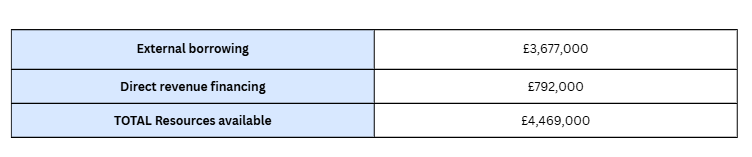
The capital payments in 2025/26 were £4.469M compared to a previously reported estimate of £4.760M. The small reduction in spending relates to some minor movements on the ICT programme as a result of supplier lead in times.
The capital programme is £2.446M lower than the original programme, of this £0.616M is an underspend that can be removed from the programme as savings at the procurement stage have been made or projects have been superseded and are now no longer required.
The remaining £1.830M relates to delays to existing projects that cause an in-year underspend, but this total will need to be carried forward to the 2026/27 capital programme when the projects will be completed.
Governance and Accountability
Performance and Governance Board
The PCC chairs a monthly Performance and Governance Board, through which he holds the Chief Constable to account for the efficient and effective delivery of the Police and Crime Plan. Over the reporting period, 12 meetings were held.
The Board provides oversight and scrutiny across key areas, including:
- Effectiveness and efficiency, including the use of all resources
- Organisational performance
- Financial control and long‑term sustainability
- Risk management
- Delivery of the Police and Crime Plan and compliance with the Strategic Policing Requirement
- Public trust, confidence, and legitimacy.
In addition, the PCC undertakes a quarterly scrutiny of Bedfordshire Police’s overall performance, informed by a comprehensive suite of performance data. This includes monitoring progress against each of the missions set out in the Police and Crime Plan and the PCC’s Strategic Direction. To support this scrutiny, themed Spotlight Reports are submitted either side of the quarterly performance meetings, allowing the PCC to undertake deeper examination of specific areas of policing activity, emerging risks, or priority issues. These reports inform challenge, assurance, and action planning. All papers are published on the PCC’s website unless there are legal, operational, or confidentiality restrictions.
Chief Constable Accountability Meetings
The PCC has weekly meetings with the Chief Constable which form part of the overall accountability and governance arrangements. Once a month he has a minuted meeting and the minutes are published. At these meetings, a range of issues are regularly discussed relating to police strategy and performance, operational updates as well as HR, finance and contemporary policy issues.
Serious Harm Partnership Board
Meeting every quarter of 2025/26, the Serious Harm Partnership Board brings together partners from across the criminal justice system and provides strategic oversight, governance and accountability for preventing and reducing serious violence, exploitation and related harm across Bedfordshire.
More specifically, it exists to bring together all agencies under the Serious Violence Duty and ensure a whole-system approach to delivering the priorities of the VEPP, SVD (Serious Violence Duty), 10-year Drug Strategy and tackling of organised crime and county lines.
BCH Strategic Alliance Summit
The PCC attends the joint strategic committee which oversees the Bedfordshire, Cambridgeshire and Hertfordshire (BCH) constabularies. This quarterly meeting acts as the Joint Strategic Committee for all shared service collaborations between the three police forces and allows all PCCs to hold their respective Chief Constables to account for the efficient and effective delivery on these services. The alliance undertakes financial planning, ensures strategic risks are being managed and mitigated, and considers opportunities for future collaborations.
In 2025/26 a major review of BCH support services was undertaken leading to reconfiguration of these services freeing up funding for front line policing. The Joint Protective Services (JPS) which are the operational collaborative police services including firearms policing, road traffic policing, the dog unit, forensics and the Major Crime Unit were strengthened.
The Firearms and Explosive Licensing service (FEL) has underperformed with unacceptable backlogs and delays for applicants and licence holders, and with unacceptable risks. The HMICFRS on inspection placed this service as one with ‘accelerated causes for concern’.
The PCC together with his counterparts from Cambridgeshire and Hertfordshire have held their Chief Constables to account for the FEL performance and have committed additional resources and enhanced governance ahead of the HMICFRS inspection and following the inspection have put in place further measures, and some progress has been made to improve this position though more is required.
ERSOU Governance Board
Meeting every quarter of 2025/26, the regional board provides the governance for the Eastern Region Special Operations Unit (ERSOU) incorporating Counter Terrorism Policing and the Regional Organised Crime Unit. It provides strategic direction and oversight of ERSOU’s performance and continuous improvement.
The Bedfordshire PCC attends on behalf of the regional PCCs to oversee performance, finances, partnership arrangements and management.
7-Force Summit
Meeting every quarter of 2025/26, the PCC has attended the 7-Force summit which comprises all PCCs and Chief Constables for the seven forces of the region - Bedfordshire, Cambridgeshire, Hertfordshire, Essex, Kent, Norfolk and Suffolk Constabularies. It oversees all collaborative arrangements such as ERSOU and other services such as innovation and procurement.
Joint Audit Committee
The Committee, which oversees an audit and assurance function for Bedfordshire Police and OPCC, is chaired by an Independent Chair. During 2025, the PCC and CC appointed two new members to the Joint Audit Committee following the completion of tenure by two existing members. This ensured continuity of expertise, maintained independence of oversight, and further strengthened the Committee’s capacity to provide effective challenge and assurance. The Committee met four times during the year, with all formal meetings held in public to promote transparency and accountability.
Bedfordshire Police and Crime Panel
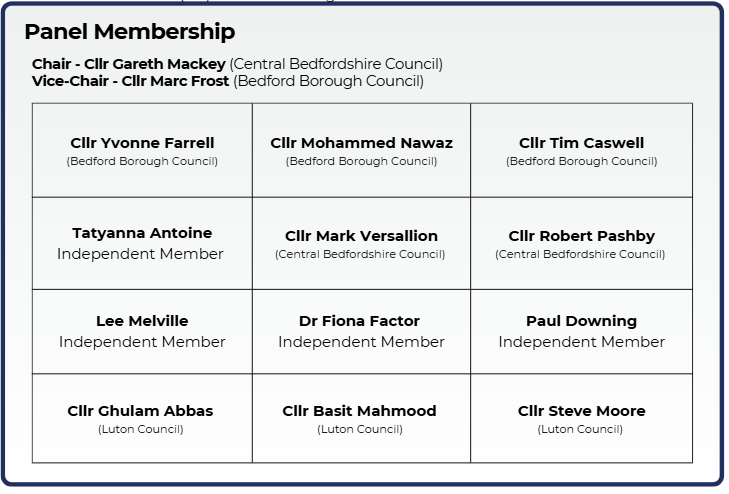
The PCC is scrutinised by the Police and Crime Panel, made up of councillors and independents from across Bedfordshire.
The Panel’s functions are to:
- review and report/make recommendations to the PCC in respect of his draft Police and Crime Plan or any draft variation to their prevailing plan
- review and report/make recommendations to the PCC on his annual report
- review or scrutinise decisions made, or other action taken, by the PCC in connection with the discharge of his/her functions and make reports or recommendations to the PCC with respect to the discharge of those functions
- review and report back to the PCC on appointments he proposes to make to the following posts: the Commissioner’s Chief Executive, the Commissioner’s Chief Finance Officer, the Deputy Police and Crime Commissioner, the Chief Constable
- review and report/make recommendations to the PCC on his proposed precept for the financial year.
- review and report/make recommendations to the PCC on any proposal by him to call on the Chief Constable (CC) to retire or resign.
Police and Crime Plan Delivery
Prevention
Holding the police to account
Through his accountability mechanisms, the PCC holds the Chief Constable to account for tackling the root causes of offending and reducing the demand on policing and other agencies through effective prevention mechanisms.
Performance indicators have been set by the Chief Constable and progress made against these is reported to the PCC at Performance and Governance Board meetings. They include the use of prevention orders across various crime types, improving multi-agency safeguarding in order to make the most impactful early interventions to tackle violence against women and girls as well as child exploitation.
Delivered through problem solving, data sharing and partnership working with local authorities, health services, education and the voluntary and community sector, prevention is one of the PCC’s core priorities for Bedfordshire Police and the wider criminal justice system.
Working in partnership
Working with strategic leaders, the three community safety partnerships (he sits on all the CSP executives boards), the criminal justice board and others, the PCC has secured commitments from leaders across the public, civil and business sectors in Bedfordshire to working together to find and implement solutions to reduce crime and the causes of crime, improve community safety and road safety. The PCC has helped to pivot community safety partnership executives towards developing shared collaborative approaches to crime prevention and community safety.
The PCC’s focus on prevention is shared by the Chief Constable who has set a core mission for policing being to ‘Think Prevention’ with every interaction, be it from the first contact with a member of the public through to the wider engagements with the criminal justice system and preventing repeat experiences for victims.
The VEPP sits in and works in close partnership with the OPCC.
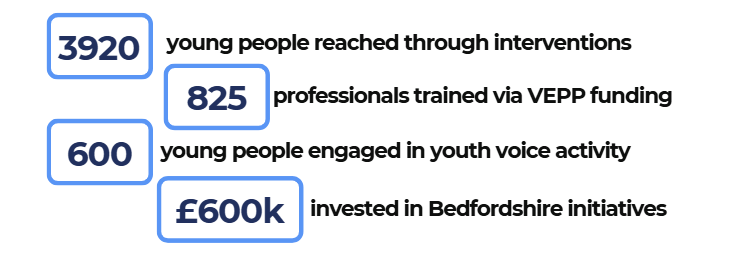
VEPP: Youth Engagement
Power Youth Action (PYA) is Bedfordshire VEPP’s youth voice programme that creates space for young people to share their lived experiences and shape how prevention is designed and delivered across Bedfordshire. At its heart, PYA is about listening - understanding how young people see the world and what they believe needs to change.
We have successfully recruited 24 young people to our PYA panel, who regularly engage with the VEPP team to share their insights on the risks they have faced, and support that would make a meaningful difference. PYA members have contributed to multi‑agency discussions, education sessions and system‑level planning. Over the year, they have influenced practice across our partnership, while also progressing into volunteering and employment opportunities.
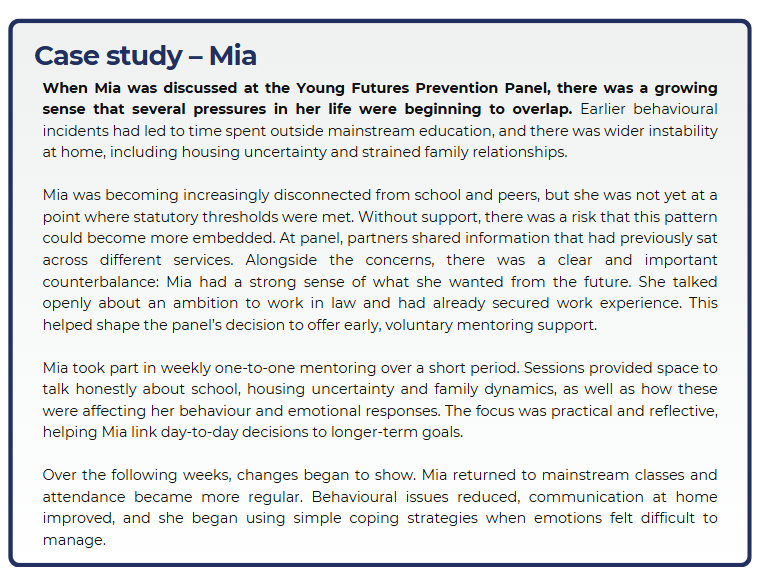
Young Futures Prevention Panels are a key part of Bedfordshire’s preventative approach, bringing agencies together to identify concerns early and coordinate support for children and young people who may be at risk of harm but are otherwise ‘invisible’.
The panels operate across Bedfordshire and provide a structured space for professionals from youth services, education, policing, health, children’s services, and voluntary and community organisations to share information and agree whether early, voluntary support would be helpful. The focus is preventative rather than punitive, and consent from children and parents sits at the heart of the process.
Police and Crime Plan Delivery
Reinvigorating local policing
Working with Communities
In order to ensure the effective delivery of the local policing strategy that the PCC has set out his requirements for, there must be effective relations between the community and the local policing teams. Through advisory groups like the rural crime advisory group and the community cohesion planning group, the PCC hears the biggest concerns and sets priorities for the police service.
A public event organised jointly with the NFU (National Farmers Union) on rural crime is held by the PCC bi-annually, and was attended by over 40 people on each occasion in 2025/26. In April, the PCC held a retail crime conference to engage with retailers, businesses, the police and other agencies.
At parish and town councils as well as the PCC’s local ‘Meet and Challenge’ events attended by the police, the PCC engages with local residents to hear about what their priorities are for policing in their area and to engage with them about ongoing work and progress against the local policing mission.
Governance and improvements
The PCC has put in place governance arrangements to ensure the development and implementation of an action plan from the Chief Constable to address the areas for improvement identified in the report. The PCC will be reviewing progress on a monthly basis at the Performance and Governance Board.
The PCC looks forward to seeing substantial improvements over the next 3 years and these improvements will align with the expectations set out within the PCC’s Police and Crime Plan and Strategic Direction 2025-2028, including improving investigation standards, responding to the public and putting victims at the heart of the criminal justice system.
Antisocial Behaviour
The PCC has committed to reinvigorate local policing including the police response to antisocial behaviour (ASB). This response must be shaped by the community safety partnerships across the county in order to ensure that ASB can be prevented through action taken by local authorities and other agencies. This may include street lighting, closure orders, licensing amendments, interventions by trading standards and the introduction of neighbourhood enforcement officers.
The PCC holds Bedfordshire Police to account for tackling ASB effectively through his accountability and governance mechanisms, including for implementing the new ASB Action Plan launched in 2026 as required by government. The Action Plan highlights the focus on targeting the use of e-scooters, increasing the use of Civil Orders to prevent reoffending, environmental audits and increasing the reporting of shoplifting by retailers in order to map and tackle retail crime effectively as a police force.
Town Centre Safety
Increasing police visibility and footprint across Bedfordshire helps make communities safer, strengthens local relationships, and makes the county a more hostile environment for those intent on causing harm. It supports the focus on prevention, joint problem solving, and the partnership working that lies at the heart of effective policing.
In Summer 2025 and Winter 2025/2026, the Safer Streets Summer Initiative and Winter of Action, both led by the PCC, demonstrated excellent examples of partnership working in town centres across Bedfordshire with increased resources dedicated to the campaigns by both the police and local authorities, working in conjunction with agencies such as British Transport Police, local BIDs, security officers in major shopping centres, local authority neighbourhood enforcement and antisocial behaviour teams and more. This increase in visibility acted as an excellent deterrent to criminals and improved prevention. CCTV plays an important role in deterring crime.
Tackling Serious Crime
Holding the Police to Account
The PCC holds the Chief Constable to account for delivering an efficient and effective police service dedicated to tackling serious and organised crime as well as knife crime. The PCC has scrutinised performance reports including data at the Performance and Governance Board on a quarterly basis on this subject.
At the quarterly performance meetings of the Performance and Governance Board, the PCC reviews performance data relating to the recorded crime rate, solved rate and investigation standards of the teams tackling serious crime, including those tackling organised crime at a regional level as part of the Eastern Region Special Operations Unit (ERSOU). At meetings of the Eastern Region Special Operations Board of which he is the one PCC member, the PCC receives detailed presentations and reports along with data, allowing him to scrutinise performance of the ROCU (Regional Organised Crime Unit) which plays a major role in addressing serious and organised crime.
The PCC continues to ensure that the police service works in collaboration with partners to reduce serious crime and serious violence through diversion and preventative methods. The Serious Harm Partnership Board which is chaired on behalf of the PCC brings together partners to oversee the strategic governance of serious violence and serious and organised crime. The PCC will, through his accountability meetings, ensure that Bedfordshire Police comply with its responsibilities including enforcing the new legislation such as the cracking down on banned knives like zombie knives.
Sale and Exchange of Firearms
The PCC has taken a proactive role in pushing for a review of the sale and exchange of firearms, particularly following a high-profile triple murder in Luton that exposed weaknesses in existing gun laws. He has formally written to the Home Secretary and policing minister on a number of occasions calling for an urgent review of firearms licensing, highlighting how current legislation allows private sellers up to seven days to notify police of a transaction - creating a dangerous gap that can be exploited. Home Office Ministers have initiated a review of the current legislation and regulations with a view to consulting on changes. The PCC has continued to press for the early adoption of such changes.
Combatting Drugs Partnership
Funded by the PCC, the Combatting Drugs Partnership Coordinator drives the delivery of the Drugs Strategy Delivery Plan. September 2025 saw Bedfordshire’s first Recovery Walk, attended by over 50 people, including representatives from Public Health, Office for Health Improvement and Disparities commissioned services, voluntary sector, and people with lived experience. The event showcased recovery, reduced stigma, and strengthened community engagement.
Strategic Policing Requirement
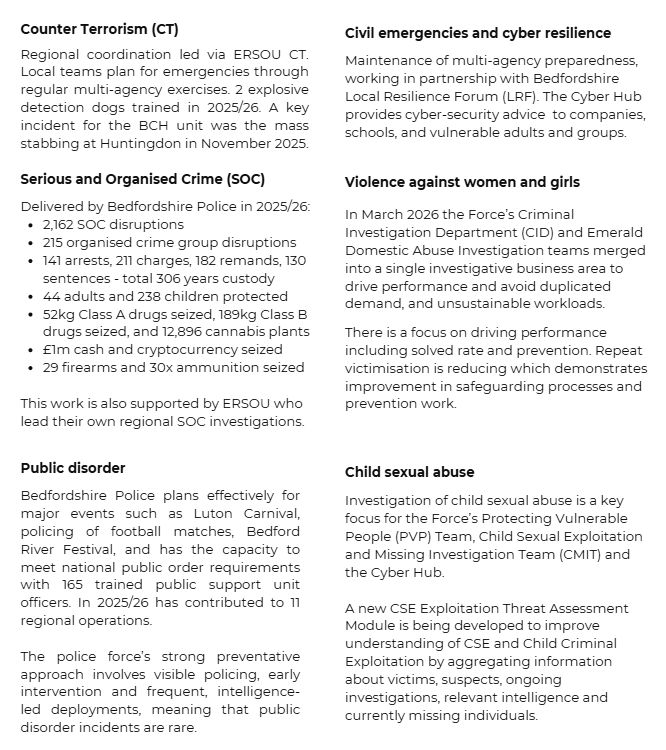
The Strategic Policing Requirement (SPR) sets out what are, in the view of the Home Secretary, the national threats, and the appropriate national capabilities required to counter them. These are:
- Terrorism
- Serious and organised crime
- Civil emergencies
- Cyber resilience
- Public order
- Child sexual abuse
- Violence against women and girls
Protecting Women and Children
Prevention
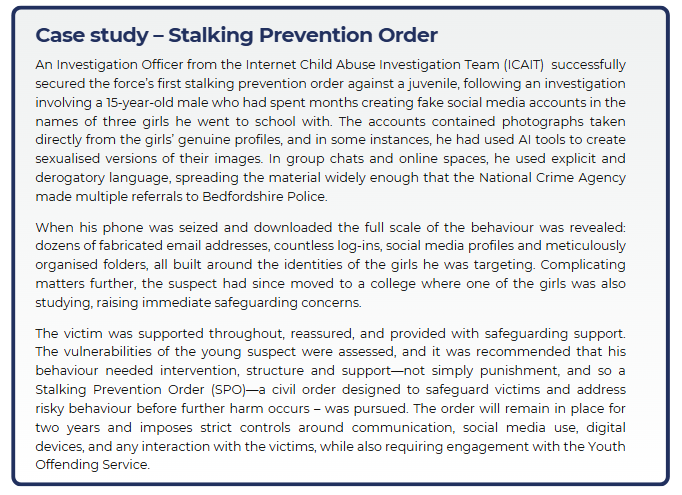
The PCC is committed to tackling the causes of violence against women and children. Significant attention is also given to crimes that are often underreported. Victims of these offences can face complex barriers to coming forward, including fear, stigma, and cultural pressures. To address this, commissioned services play a vital role in reaching and supporting those affected, offering specialist advocacy and building trust within communities. These services not only support victims directly but also provide valuable insight to inform policing responses and improve the overall system.
The PCC also continues to support initiatives that challenge harmful attitudes and behaviours. Campaigns such as the White Ribbon initiative encourage individuals to take personal responsibility in ending violence against women and girls, helping to shift societal norms and promote respectful relationships. This preventative approach is essential in reducing harm before it occurs.
Partnership working remains central to prevention and early intervention efforts. Through collaboration with education providers and programmes such as Pol-Ed, work is underway to engage young people on issues including healthy relationships, consent, and personal safety. Alongside wider partnerships across local authorities and the voluntary sector, this helps to raise awareness, build resilience, and create safer communities across Bedfordshire.
HerSpace Bedfordshire
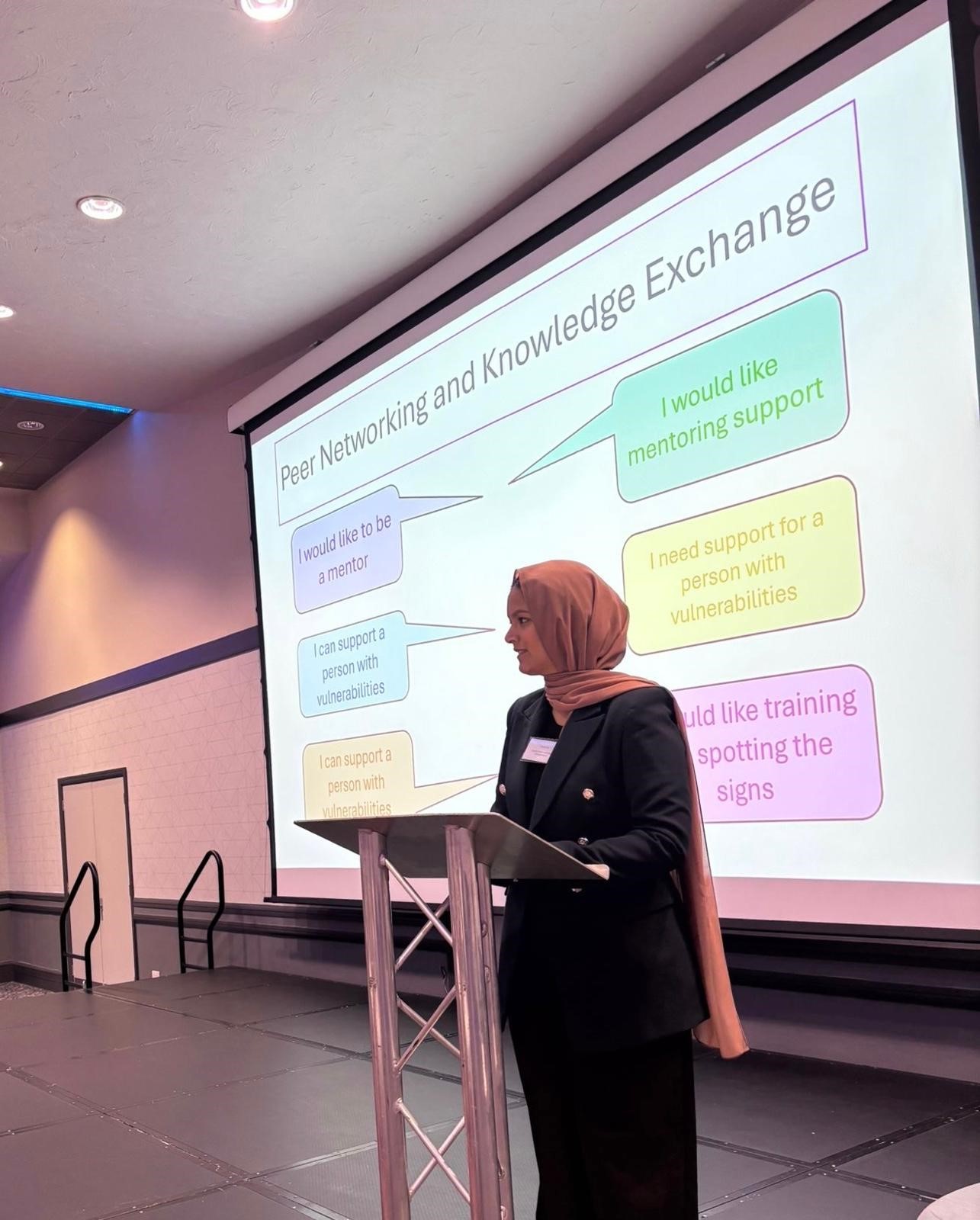
In 2026 Deputy Police and Crime Commissioner Umme Ali launched HerSpace Bedfordshire, a new network designed to bring together organisations supporting women across the county. The initiative aims to strengthen collaboration, improve the visibility of services, and create a more coordinated approach to meeting the needs of women in Bedfordshire.
HerSpace was developed in response to a recognised need for greater collaboration and visibility across the women’s sector, particularly for smaller and emerging organisations whose vital work can go unrecognised. The network provides a space for organisations supporting women to connect, share knowledge, and learn from one another. A key focus is showcasing and amplifying grassroots and “by and for” organisations, recognising the unique expertise and trusted relationships these groups hold within their communities.
The launch event brought together a wide range of organisations, all united by a shared commitment to improving how support for women is delivered, accessed, and understood across Bedfordshire. It provided an opportunity to build new connections, explore potential collaborations, and highlight the breadth of services available to women across the county.

Holding the Police to Account
Holding policing to account remains a core responsibility, with a clear focus on improving outcomes for victims. This includes close scrutiny of performance in tackling Violence Against Women and Girls (VAWG), and supporting evidence-based approaches such as the Soteria model, which is designed to transform investigations into rape and serious sexual offences through a stronger focus on suspects and a more victim-centred response. In addition, since the publication of the Angiolini Inquiry recommendations, Bedfordshire Police has progressed in the areas for which it holds responsibility. Independent national scrutiny by the NPCC has confirmed significant progress across almost all recommendations
The funding allocated to the Raneem’s Law domestic abuse advisor in the Bedfordshire Police control room has been continued and will be carried forward to allow victims of domestic abuse to get specialist support when they call 999. This directly-funded Home Office pilot is expected to be imitated by a number of other police forces in England and Wales.
Putting victims at the heart of the criminal justice system
Upholding Victim Rights
Through formal accountability and scrutiny, the PCC holds the Chief Constable to account for delivery of the Victims’ Code of Practice (VCOP), monitoring how well the police meet their obligations such as keeping victims informed, carrying out needs assessments and making referrals to support services. The PCC seeks to put victims at the heart of the criminal justice system, and ensures the victim voice is central to plans and discussions with the police.
In January 2026, the PCC’s office became the first point of contact for complaints, taking on responsibility for receiving and resolving complaints directly rather than the police. This has already demonstrated a more independent, simpler and more transparent process for victims.
Launched in 2026, the victims’ review will scope the experience of all victims at every stage of the journey from crime to resolution. It will look at all agencies including the police, CPS, courts and voluntary and community sector. The PCC aims to ultimately eliminate discrimination, advancing equality of opportunity and ensuring that every victim has access to services they need to help them cope and recover, regardless of geography, personal characteristics or circumstance. The review has commenced and will be reported on in 2026.
Through the Bedfordshire Criminal Justice Board, the PCC is seeking to understand and overcome barriers within the process to expedite justice for victims. Victims frequently withdraw from the criminal justice process due to several factors such as fear of retaliation, emotional ties, trauma or a lack of confidence. These cases often rely heavily on victim testimony, and the high evidential threshold required for charging decisions means many investigations are closed before reaching court.
Providing Support for Victims
Bedfordshire Police has undertaken a comprehensive programme of improvements to ensure full compliance with the Victims’ Code, following HMICFRS’s earlier finding that the force did not consistently meet victims’ entitlements. The Force Victims Board—now meeting since November 2024—scrutinises compliance across all 12 Victims’ Code rights, drives improvements, and holds departments to account. A dedicated Victims’ tactical lead and trained victim champions have been embedded to provide guidance, deliver training, and ensure consistent quality in victim contact.
The PCC commissions specialist services to support and advocate for victims of all crime including domestic abuse, sexual violence and more. In 2025/26, the PCC has sought to advance the approach of co-commissioning of victim support services with partners across the system, streamlining funding and encouraging innovation.
Recently the PCC has been driving the Trauma Informed Bedfordshire initiative, ensuring services understand the impact of trauma on behaviour and memory and setting expectations for professionals in employing an approach that avoids re-traumatisation.
Securing an excellent police service
Opinion Polling of Trust and Confidence in Policing
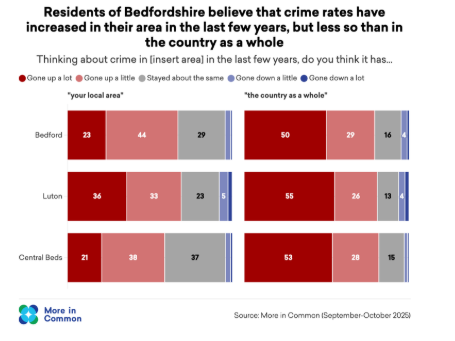
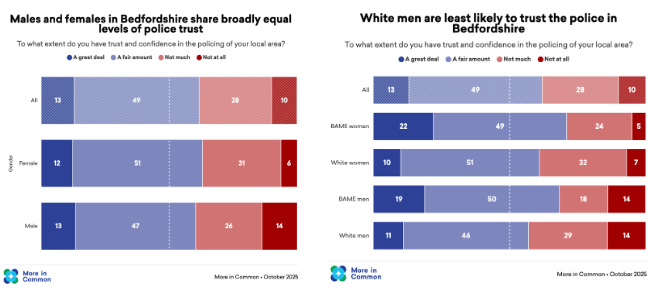
n order to better understand the level of trust and confidence in Bedfordshire Police there is in the county, the PCC commissioned a highly comprehensive public polling service in November 2025. The research examines trust in policing across different demographic groups, feelings of safety in various settings and times of day, experiences and interactions with the police, public priorities for crime reduction, and more.
The polling was jointly commissioned by the PCC and the Chief Constable. The findings will influence the PCC’s policy and strategy development, and policing’s strategy and operational planning.
Holding the Chief Constable to Account
he PCC has maintained rigorous oversight of Bedfordshire Police’s performance and the delivery of the mission for an excellent police service. Through formal accountability meetings, the PCC has consistently challenged the Chief Constable when required and is able to demonstrate measurable improvements across core policing outcomes. The PCC believes this is vital to public trust and confidence.
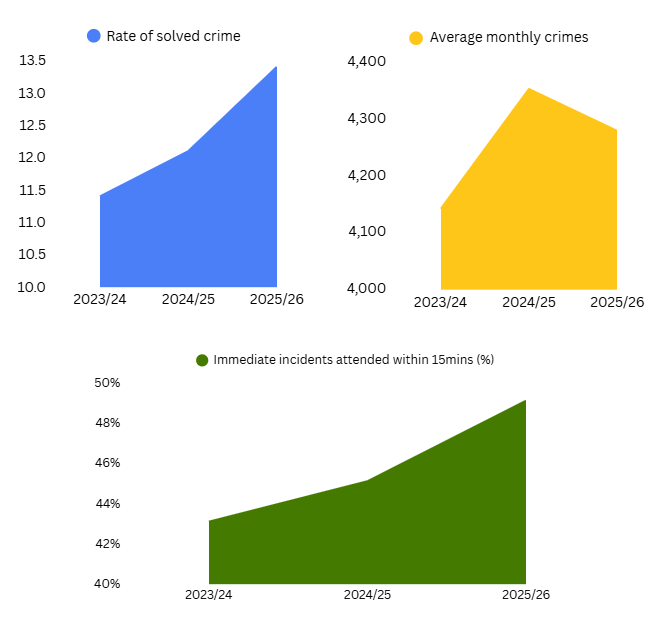
In terms of solved crime, the force recorded a 13.4% solved rate for the year 2025/26, which is a 1.3% improvement on the previous year. The PCC has held the Chief Constable to account for setting out clear plans for improving detection rates, with a particular focus on crime types such as violence against women and girls or antisocial behaviour, where outcomes have been lower. The PCC continues to monitor this and the positive trajectory is promising. One crime type that is particularly notable for its high solved rate is burglary.
When responding to emergencies, the PCC has set an expectation for the arrival at incidents where an immediate response is required to be as quick as possible, but also for the initial contact with the victim or member of the public at the scene to be of an excellent standard. Bedfordshire Police’s performance against its target of 15 minutes for arrival at an ‘immediate’ incident has been improving year on year, and in 2025/26 there was an average of 49% of immediate incidents arrived at within this target, although many weeks in the year saw higher numbers than this.
Artificial Intelligence Ethics Scrutiny Panel
Bedfordshire Police is the leading user of AI in British policing. It applies AI to improve productivity and secure better outcomes with over forty applications including Live Facial Recognition (LFR). The Police and Crime Commissioner is a strong advocate of the responsible use of AI in policing and holds the national portfolio at the APCC for the ethics and governance of AI and new technology.
He has established an Artificial Intelligence Advisory Ethics Panel to provide independent oversight, guidance, and ethical scrutiny of the investment in, use and deployment of AI.
This is one of three first such panels to have been established in the country, and together with the memorandum of understanding agreed between the PCC and Chief Constable regarding the use of LFR, is being promoted as best practice nationally.
Reporting directly to the PCC the panel:
- Advises him on proposed investment in AI technology
- Reviews and advises on proposed application of AI
- Assesses the ethical, legal, and societal implications of AI technologies.
- And to support public trust undertakes independent scrutiny of the use of AI including LFR
The members of the panel are volunteers who bring a range of expertise and experience to ensure professional assessment and advice. The panel includes:
- An independent Chair appointed by the PCC
- Experts in AI, ethics, law, and data governance
- Community representatives to ensure robust scrutiny and oversight of AI initiatives.
Stop and Search Charter
In 2025 the PCC launched a Stop and Search Charter to strengthen public trust in policing and ensure the fair, proportionate and precise use of police powers. The charter sets out the rights of citizens, how and when police powers should be applied, the oversight processes in place, and how to raise concerns if anyone feels those powers have been used inappropriately. The launch follows discussion with the Stop and Search Panel.
The PCC is determined to lead by example and ensure that Stop and Search, along with Use of Force powers, are deployed appropriately, without discrimination, and with full transparency. The initiative builds on national best practice, but is tailored to reflect the needs, concerns, and priorities of Bedfordshire communities. The Stop and Search Charter is designed to strengthen accountability, rebuild trust, and give our residents the knowledge and confidence to challenge the police when necessary.
The Charter also forms part of the PCC’s wider commitment, set out in the Police and Crime Plan, to make Bedfordshire a safer place through openness, accountability, and stronger community engagement.
As part of ongoing work, the Stop and Search Panel will be expanded – with a focus on including more young people and representatives from communities most likely to be affected by Stop and Search – ensuring that those scrutinising these powers reflect the communities served.
Building an excellent criminal justice system
Bedfordshire Criminal Justice Board
The PCC has continued his focus on strengthening the Local Criminal Justice Board (LCJB) within his term, focusing on one of the key expectations of its members within the national guidance, which is to ‘work with local, regional and national counterparts as necessary to identify and overcome barriers to improving the delivery of justice’.
This included encouraging and brokering collaborative approaches to addressing social and economic causes of injustice and crime.
The LCJB have agreed to focus on reducing reoffending- especially youth reoffending, victims’ experience and data sharing, including data sets needed to shape the work of the Board effectively. In 2025/26, a considerable improvement has been seen at the Board meetings each quarter, with notable efforts made to overcome the key barriers to these issues in Bedfordshire.
Victim Personal Statements
Victim Personal Statements (VPS) allow victims to explain in their own words the impact a crime has had on them. They are read or heard at the sentencing stage and form part of the court record. Through the Criminal Justice Board, the PCC has successfully encouraged the Crown Prosecution Service, the Courts Service and the police to agree to pilot a tracking function of Victim Personal Statements used in the court process. This joint approach reflects strong partnership commitment, and is a unique opportunity for Bedfordshire as is not being piloted elsewhere.
This approach is designed to improve the use of VPS’ in court by tracking uptake, reducing missed opportunities, and enhancing visibility, accuracy, and victim experience through a consistent, end‑to‑end, multi‑agency tracking process. The pilot launched on 1 April 2026 with strong multi-agency cooperation.
Reducing Reoffending
The PCC funded a new six-week training programme to help rehabilitate ex-offenders into work, rebuild their lives, and break the cycle of reoffending.
Delivered by local charity YouTurn Futures, the course will support up to eight participants and will focus on CV writing, job search skills, job applications, and practical preparation for employment. Each participant will also receive accredited modules and tailored guidance on how to lawfully disclose their history to future employers - the first accredited offer of its kind in Bedfordshire. The training breaks down the basics, what work looks like, employer expectations, and how to prepare for an interview, with continued support alongside Bedfordshire Police and Probation to help take positive next steps.
Restorative Justice in Bedfordshire
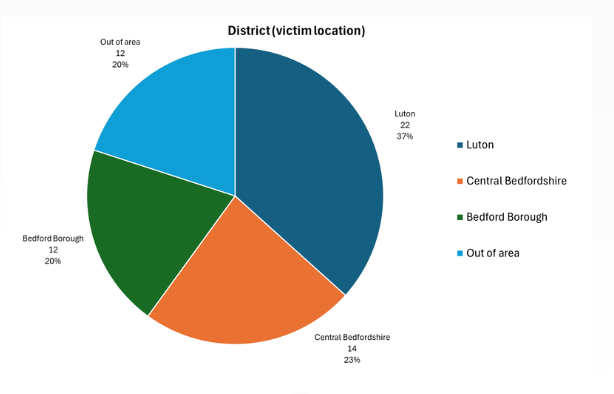
Restorative Justice is a safe and supportive way for victims and offenders to communicate about a crime or incident. It gives participants the opportunity to talk about what happened, share how they have been affected, ask questions, and listen to each other's experiences. Communication can take place in a face-to-face meeting or indirectly (letters, videos, or questions). It is a voluntary process that usually takes place after the investigation or court process has finished. Victims are informed about Restorative Justice by the police as part of the Victims' Code, and other support services. The service is available for all crime types, and anyone can contact the service directly or request a referral.
The Bedfordshire Restorative Justice Service, runs from the PCC’s office, received 60 referrals this year, representing a significant increase from 2024/25 and almost doubling the previous year’s total.
A Restorative Justice Champion scheme has been established within Bedfordshire Police to complement ongoing awareness-raising activity and the work of the RJ service. This has improved both access for victims and offenders and awareness of the service among officers. As a result, 65% of referrals were received from police departments, leading to the completion of 11 restorative processes.
In collaboration with the Local Authorities, restorative workshops have been delivered to staff across education and inclusion services. To date, these sessions have been attended by over 30 representatives from schools, nurseries, alternative provisions, and children’s services.
The Coordinators have successfully maintained their Advanced Registered Practitioner status with the Restorative Justice Council, demonstrating continued adherence to nationally recognised standards, ensuring the service delivers high‑quality, safe, and effective restorative practice.
New collaborative initiatives and referral pathways are being developed and strengthened through the Eastern Region RJ partnership, alongside enhanced links with youth justice services, probation, prisons, and victim support services.
Community Scrutiny
The PCC holds the responsibility for ensuring that community scrutiny panels are in place, supported and contribute to holding the police to account and as a way of overseeing the police service’s use of powers and treatment of those detained.
Stop and Search, Use of Force and Section 163
The Police and Crime Commissioner holds Bedfordshire Police to account for their use of Stop and Search and Use of Force powers. The PCC recently launched a new Stop and Search Charter to strengthen public trust in policing and ensure the fair, proportionate and precise use of police powers. The Stop and Search and Use of Force Scrutiny Panel consists of 30 members from a wide range of backgrounds and age groups across Bedfordshire. The panel reviews the data, outcomes and body‑worn video of three policing areas: Stop and Search, Use of Force, and Section 163 (vehicle) stops. Since April 2025 – April 2026, the panel have reviewed 102 cases, providing scrutiny and strengthening oversight across these powers.
A recent review of the panel’s membership highlighted a lack of younger representatives. Ensuring the panel remains diverse and reflective of Bedfordshire’s communities is vital so that police powers are assessed fairly and all perspectives are considered. In response, the OPCC increased recruitment efforts and introduced Stop and Search Youth Engagement sessions to raise awareness of the panel’s work. Before this campaign, only 7% of panel members were from the younger demographic. Following targeted recruitment, this has risen to 27%, representing a 20% increase. This positive development supports the PCC’s commitment to enhancing youth involvement in policing scrutiny processes.
Independent Custody Visiting
Independent Custody Visitors (ICV’s) are volunteers from the local community who visit people being detained in custody by the police and ensure that detainees are receiving their rights and entitlements and that the conditions that detainees are being held in are satisfactory.
The panel has 25 members who visit both Kempston and Luton custody suites and over the last year ICVs have checked the welfare of 439 detainees. Issues raised by ICVs were escalated to the Custody Inspector and resolved promptly, contributing to a safer, more transparent custody environment. A key focus has been completing the third iteration of the Quality Assurance Framework (QAF) for 2025–26 and the ICV scheme manager has been working towards achieving Platinum status.
The Independent Custody Detention Scrutiny Panel (ICDSP), which comprises volunteers selected from across Bedfordshire, reviews the environment in which detainees are held within the custody suites and has regular conversations with the officers and staff involved. The panel has 12 active members (3 have lived experience and other members are students of psychology, former magistrates, school governors, mental health experts). The panel have reviewed 40 records over the last nine months focusing on juveniles, uses of force and strip searches.
Independent Custody Detention Scrutiny Panel
The Independent Custody Detention Scrutiny Panel (ICDSP), which comprises volunteers selected from across Bedfordshire, reviews the environment in which detainees are held within the custody suites and has regular conversations with the officers and staff involved. The panel has 12 active members (3 have lived experience and other members are students of psychology, former magistrates, school governors, mental health experts). The panel have reviewed 45 records over the year focusing on treatment of female detainees and juveniles, uses of force and strip searches.
Statutory Responsibilities
Complaints
Complaints Against Bedfordshire Police
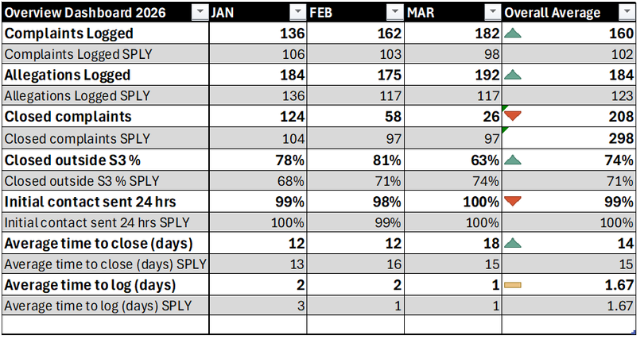
In January 2026, the PCC transferred from the police responsibility for initial complaints and has established a Complaints Resolution Team (CRT) within his office. This change is designed to make the complaints process simpler, more transparent, and independent from the police. If you’ve had an experience with Bedfordshire Police that you’re unhappy about, this service will give you a clear way to raise your concerns and ensure you receive a timely response.
The team acts as the first point of contact for concerns raised by members of the public and working to ensure that all complaints are recorded, assessed, and resolved in a timely and proportionate manner. By monitoring complaint activity and identifying areas where service can be improved, the CRT supports the wider policing environment in strengthening public trust and confidence.
The Complaints Resolution Team:
- Assesses complaints fairly and proportionately.
- Follows relevant legislation and guidance from the Independent Office for Police Conduct (IOPC).
- Contacts the complainant to explain how the complaint will be managed.
Depending on the seriousness, a complaint may be referred to Bedfordshire Police Professional Standards Department (PSD), or the Independent Office for Police Conduct (IOPC).
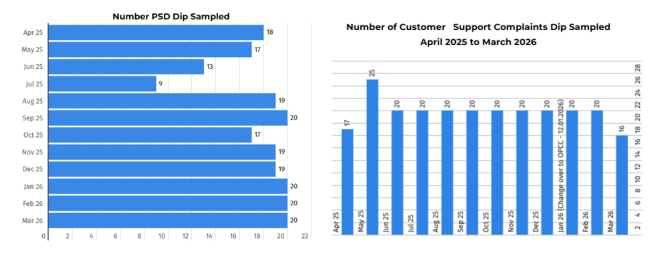
So far since November 2025, the Complaints Resolution Team has seen a significant rise in demand and their work has led to a number of positive changes within Bedfordshire Police including a policy change in Custody, 21 individuals being advised of learning required, a reduction in the demand in the Professional Standards team and various additional training mechanisms.
On average, allegations have risen by approximately 50% compared to the same period last year, reflecting more thorough scrutiny and a greater level of detail in how complaints are being recorded and addressed.
Complaints Against the Chief Constable
Complaint reviews
Complaint Dip Sampling
Commissioning and Grant Funding
Core Activity 2025/26
PCC-Funded Projects
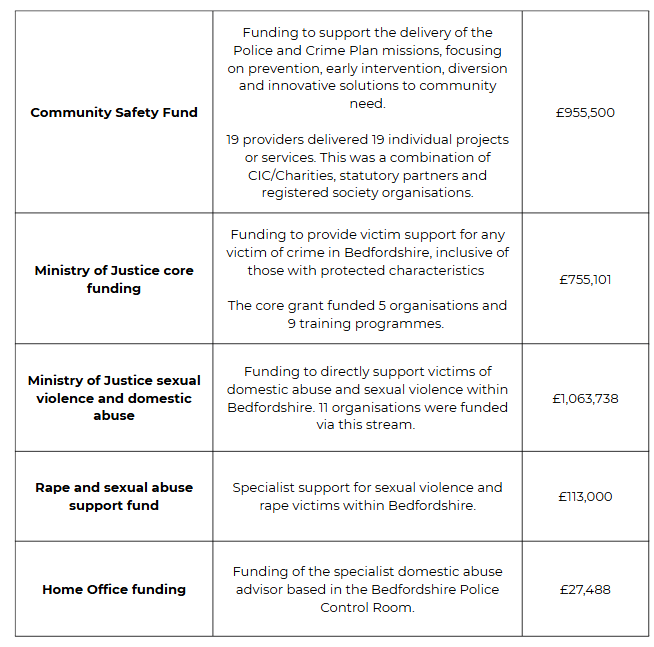
Using Home Office and Ministry of Justice funding to the PCC and Community Safety Funding from his own budget, the PCC has funded 84 projects in 2025/26.
All programmes directly supported delivery of the Police and Crime Plan, in accordance with the Police and Crime Commissioner’s strategy of supporting the voluntary and community sector to grow sustainable projects.
A total of £200,000 was available to local community organisations to bid for funding for projects that support the PCC’s missions, as part of the Grassroots Innovation Fund for 2025/26.
Grassroots Innovation Fund
Launched in 2025/26
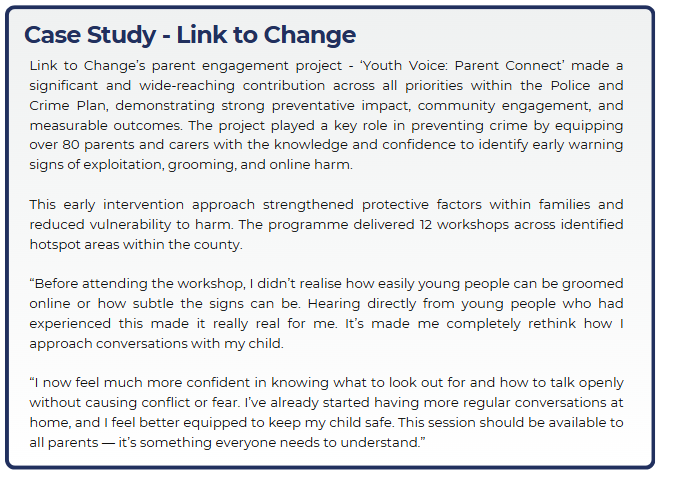
The PCC aims to shift power towards local communities by supporting small, creative projects that tackle crime and safety issues at their roots. Instead of relying on large, top-down commissioning, the fund invites grassroots organisations to propose their own ideas, with a simple, accessible application process and modest grants that enable quick, community-led action. It prioritises early intervention, prevention, and reaching underrepresented groups, aligning with wider goals to reduce violence, support victims, and build trust in policing.
In terms of impact, the fund has enabled over 40 community groups to pilot innovative approaches that might not otherwise receive funding, helping to uncover what works at a neighbourhood level. By backing smaller organisations, it strengthens community capacity, fosters collaboration, and brings new voices into the local safety landscape.
Collectively, these projects contribute to longer-term outcomes such as reduced harm, improved community cohesion, and more responsive, inclusive approaches to crime prevention across Bedfordshire.
69 applications were received via the GIF, after independent evaluation and group moderation, 42 organisations were awarded funding equating to £201,522.00
Equality, Diversity and Inclusion
The PCC supports and complies with the public sector equality duty:
The PCC ensures that he and the police service meet their statutory obligations in relation to equality, diversity and inclusion. In line with legislation, the PCC:
- Ensures that every victim has access to services they need to help them cope and recover, regardless of geography, personal characteristics, or circumstance.
- Ensures representation of all demographics and communities across Bedfordshire in plans for victim services, acknowledging their needs and challenges.
- Is visible and accessible to all communities in Bedfordshire.
- Ensures all individuals and communities who contact us are dealt with fairly, equally and respectfully.
- Attracts and retains staff and volunteers that reflect our diverse communities.
- Ensures equality of opportunity for all staff and volunteers throughout every stage of employment; from recruitment, retention and promotion, to exit.
- Recognises the needs of diverse groups within our workforce and ensure appropriate support is available for all staff and volunteers.
- Recognises, challenges and effectively addresses any inappropriate behaviour, language or dignity at work issues that may arise.
- Maximises transparency to ensure our activities and decisions can be scrutinised and uses feedback to improve the service provided to the public.
The PCC has attended many events over the last year that have promoted equality and met many representatives to hear about the work they do and support they give. Mechanisms are in place to measure progress against equality objectives, and this is monitored by the PCC on a regular basis.
Contact Us