
Complaints handling (Specified Information Order)
The Specified Information Order states that the Office of the Police and Crime Commissioner must publish the most up to data. Please see below for information surrounding the Complaints Handling Function.
The complaints function explained:
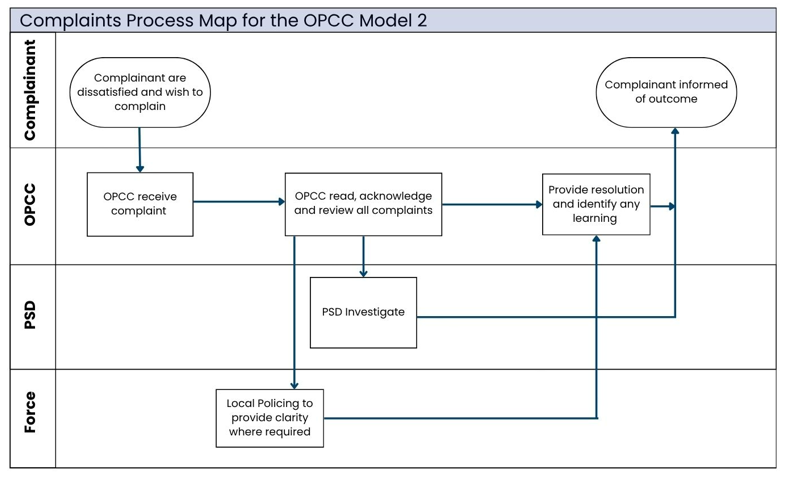

This page contains information on the process for complaints that relate to Bedfordshire Police or our office, and the role of the Commissioner’s Office in monitoring, handling and reviewing complaints about policing.
In Bedfordshire the Police and Crime Commissioner has given notice to the Chief Constable that Model 2 (from 12th January 2026) will be adopted in accordance with para 13A of the Policing and Crime Act 2017.
The Office of the Police and Crime Commissioner (OPCC) will now handle complaints about Bedfordshire Police.
This change is designed to make the complaints process simpler, more transparent, and independent from the police. If you’ve had an experience with Bedfordshire Police that you’re unhappy about, this service will give you a clear way to raise your concerns and ensure you receive a timely response.
The OPCC will deal with complaints that do not require a formal investigation under national police regulations (Outside Schedule 3 of the Police Reform Act).
Our dedicated team will:
- Resolve complaints quickly and effectively wherever possible.
- Support and guide you through the process, explaining what happens at each stage.
- Keep you informed until your complaint is closed.
If your complaint cannot be resolved by us, we will if required pass it to the Professional Standards Department (PSD) or refer you to the Independent Office for Police Conduct (IOPC) for further investigation.
You can read the Service Level Agreement for Model 2 Complaints Handling here.
It is recommended that the assessment should include:
The role of the Police and Crime Commissioner
The Police and Crime Commissioner has three main duties in relation to police complaints.
They are: -
- Appropriate Authority to consider complaints about the Chief Constable,
- Duty to hold the Chief Constable to account in providing an effective and efficient complaints process, and
- Relevant Review Body of police complaints outside Schedule 3.
The PCC delegates the function of complaints to the Complaint Resoution Team within his office and will not have any personal involvement in the function of complaints.
In terms of reviews, the PCC has delegated this function to the Head of Governance and Transparency to complete this function and make decisions.
Chief Constable Complaints
Under the Police Reform Act 2002 this office is only the appropriate authority for dealing with complaints that are about the personal conduct of the Chief Constable. The Act does not permit us to deal with complaints made about Bedfordshire Police or the actions of others as these are currently dealt with by the Forces customer support team, in line with police complaint’s legislation.
As the Chief Constable represents Bedfordshire Police, we understand that these complaints are often made in good faith. However, it is important to understand that the Chief Constable is not usually involved in front-line policing and should not be included in complaints that are made about the police force more generally.
It is important to note, that the Chief Constable delegates responsibilities under Part 2 to the Police Reform Act so there will be times where a complaint names the chief officer or acting chief officer, but the complaint is about something where authority has been delegated to another officer or staff member within the force. When this occurs, the complaint must be referred to the Customer Support Team in the first instance.
Full update on the number of reviews received can be seen within the Quarterly Transparency Reports.
Duty to hold the CC to account in providing an effective and efficient complaints system
The OPCC monitors Bedfordshire Police Force Professional Standards Department complaints (inside Schedule 3) handling by completing dip sampling monthly. Currently each month the Transparency team pick a theme of complaints that they wish to review which have been completed in the last month for example Stop and Search, Incivility or Custody.
The OPCC then review the complaint in full as an independent dip sampler to ensure that process has been followed and that a reasonable and proportionate outcome has been reached. The OPCC also review learning and if they believe there should have been learning this can be raised either directly to Professional Standards Department or to the Force Executive Team via the Performance and Governance Board.
The following areas are reviewed:
- Timelines – how long the complaint has taken to complete
- Has process been followed
- Themes and trends
- Have all allegations been investigated
- Learning identified
- Has the outcome been clearly explained to the complainant
Lower dissatisfaction complaints which have not met the Schedule 3 threshold are also dip sampled. Monthly meetings are held to review learning identified.
Full update on the number of reviews received can be seen within the Quarterly Transparency Reports.
Reviews
If you have already submitted a complaint to Bedfordshire Police’s complaints system (schedule 3) and remain dissatisfied after you have received a formal outcome of your complaint from the Professional Standards Department, you can make a request to your Commissioner’s Office to review it (if they have been identified as the relevant review body).
Details of which review functions the PCC has delegated and what measures they have taken to ensure quality, integrity and impartiality
The Head of Governance and Compliance in the Bedfordshire OPCC is the delegated Reviews Officer. The OPCC is a separate organisation to Bedfordshire Police. They will remain impartial whilst considering whether the outcome of your complaint was reasonable and proportionate and identify any learning or recommendations that are relevant for Bedfordshire PSD.
If the review outcome is not being upheld, in line with the requirements of the complaints legislation and IOPC statutory guidance, the only right of further review is for the complainant to submit a Judicial Review.
Bedfordshire OPCC have not received any notices regarding decisions that have made following a review outcome.
The timeliness of complaint reviews e.g. the average time taken to complete reviews
The average time taken to complete a review and send the final response to the complainant within the Office of the Police and Crime Commissioner for Bedfordshire (January 2025 to December 2025) is 21 days compared to 22 days the previous year.
Quality Assurance mechanisms the PCC has established to ensure that review decisions are sound and in line with the requirements of the complaint’s legislation and IOPC statutory guidance
All reviews are Quality Assured by the Chief Executive before finalising and sending out to the complainant. Any learning following a review decision is also taken to Delivery and Beating Crime Board for the Force Executive Team to be informed and for it to be formally recorded.
Any learning following a review decision is presented at the Performance and Governance Board for the Force Executive Team to be informed and for it to be formally minuted.
To find out more on reviews, please review our Complaints Reform Reviews page on the website using the following link: Complaints Reform Reviews – Bedfordshire PCC
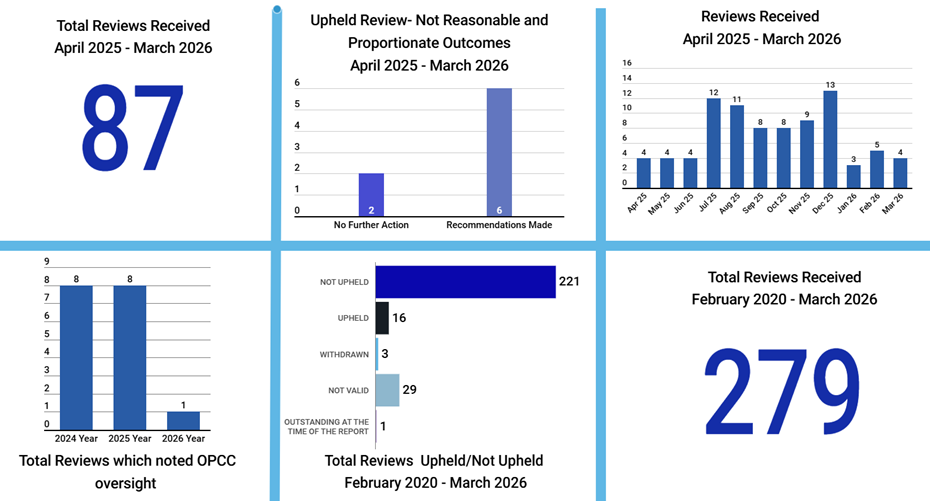
How the PCC assesses complainant satisfaction with the way in which they have dealt with complaints
The PCC will not have any personal involvement in the function of complaints and delegates the function of complaints to his office. In terms of reviews, the PCC has delegated this function to the Head of Governance and Compliance to complete this function and make decisions.
To find out more on reviews, please review our Complaints Reform Reviews page on the website using the following link: Complaints Reform Reviews – Bedfordshire PCC
Measuring complainant satisfaction in relation to complaint reviews is inherently challenging. Typically, individuals approach the Office of the Police and Crime Commissioner (OPCC) to request a review because they are dissatisfied with the outcome of their original complaint.
The role of the Review Officer is to assess whether the outcome of the complaint was reasonable and proportionate. This means evaluating whether the decision was appropriate given the specific circumstances, facts, and context of the complaint, and whether it aligns with relevant legislation and guidance.
It is important to note that the OPCC does not have the authority to reinvestigate the complaint. Instead, the review focuses solely on the fairness and proportionality of the original outcome. If a review is upheld, the OPCC may make recommendations to the Professional Standards Department (PSD).
However, when a complaint outcome is deemed reasonable and proportionate, and the review is not upheld, the complainant may remain dissatisfied, often due to a belief that the original decision was incorrect. In such cases, the only further avenue available to the complainant is to pursue a Judicial Review.
To date, Bedfordshire OPCC has not received any notifications indicating that decisions made following a review have been subject to Judicial Review.
Police and Crime Commissioner (PCC) Complaints – John Tizard
Up to June 2025, there haven’t been any complaints received by the Police and Crime Panel.
Further information about Police and Crime Commissioner complaints can be found on the Police and Crime Panel website.
Independent Office for Police Conduct (IOPC) Quarterly Data
The most recent IOPC quarterly data reports are available to read on the IOPC website.
IOPC recommendations for Bedfordshire Police can be found on the IOPC website and further information can also be found here on the Bedfordshire Police website.
Legally, Bedfordshire Police must provide the IOPC with their response to a recommendation within 56 days – unless there are valid reasons not to.
Bedfordshire Police Professional Standards Department (PSD) Reports
The Professional Standards Department for Bedfordshire, Cambridgeshire and Hertfordshire (BCH) complete quarterly reports which are provided to the Office of the Police and Crime Commissioners. The reports for Bedfordshire are provided below in a PDF format. It provides an overview of the number and type of allegations in recorded public complaint and conduct cases, and the outcomes of finalised public complaint and conduct cases. It also provides data on the number and outcome of public complaint reviews.
PSD - Data Pack - Q1-Q4 2025-2026
PSD - Data Pack - Q1-Q4 2024-2025