
Quarterly transparency/compliance report
The Governance and Compliance department within the Office of the Police and Crime Commissioner for Bedfordshire complete Transparency Reports on a quarterly basis which provide an update on the number of complaints reviews received, freedom of information requests, subject access requests, the Independent Custody Visiting Scheme and much more. They are available below in a PDF format however please contact us if you would like to request the reports in an alternative format.
Quarterly Transparency/Compliance Report Q1 April - June 2026
This report is to inform the reader of the governance obligations of the Office of the Police and Crime Commissioner (OPCC). The OPCC will publish this information on a quarterly basis, to ensure that the public can review the functions of the OPCC. The areas of focus for this report are:
- Professional Standards Department (PSD) Dip Sampling
- Customer Services/Lower Dissatisfaction Dip Sampling
- Chief Constable Complaints
- Reviews
- Independent Custody Visitors (ICVs)
- Legally Qualified Chairs (LQCs)
- Freedom of Information / Subject Access Requests
- Trends/Patterns received by the OPCC.
Dip Sampling – Schedule 3 complaints – Professional Standards Department
The purpose of the OPCC Dip Sampling Schedule 3 complaints it that it is a critical function to the reputation of Bedfordshire Police that the public has confidence in the complaints system. To this end, both the Chief Constable and the Police and Crime Commissioner have arranged for ‘dip sampling’ to be undertaken of complaints. On a monthly basis, the OPCC will request categories of complaints from the Professional Standards Department and when the files have been received will review them in full.
The categories of complaint are:
|
Complaint Categories & Subcategories
|
|
|
A |
Delivery of Duties and Service |
|
A1 Police action following contact / A2 Decisions / A3 Information / A4 General level of service.
|
|
|
B |
Police powers, policies, and procedures |
|
B1 Stops, & stop & search / B2 Searches of premises & seizure of property / B3 Power to arrest & detain /
B4 Use of force / B5 Detention in police custody / B6 Bail, identification, and interview procedures /
B7 Evidential procedures / B8 Out of Court disposals / B9 Other policies and procedures
|
|
|
C |
Handling of or damage to property / premises |
|
D |
Access and / or disclosure of information |
|
D1 Use of police systems / D2 Disclosure of information / D3 Handling of information /
D4 Accessing and handling of information from other sources.
|
|
|
E |
Use of Police Vehicles |
|
F |
Discriminatory behaviour |
|
F1 Age / F2 Disability / F3 Gender Reassignment / F4 Pregnancy & Maternity / F5 Marriage & Civil Partnership /
F6 Race / F7 Religion or Belief / F8 Sex / F9 Sexual Orientation / F10 Other
|
|
|
G |
Abuse of Position / Corruption |
|
G1 Organisational corruption / G2 Abuse of position for sexual purpose /
G3 Abuse of position for the purpose of pursuing an inappropriate emotional relationship / G4 Abuse of position for financial purpose / G5 Obstruction of justice / G6 Abuse of position for other purpose
|
|
|
H |
Individual Behaviours |
|
H1 Impolite language or tone / H2 Impolite and intolerant actions / H3 Unprofessional attitude and disrespect
H4 Lack of fairness and impartiality / H5 Overbearing or harassing behaviours
|
|
|
J |
Sexual Conduct |
|
K |
Discreditable Conduct |
|
L |
Other |
The OPCC will consider such aspects when completing the Dip Sampling:
- Timescales for completion of investigations
- Learning Identified
- Were all allegations covered fully and appropriately?
- Satisfaction
- Was Body Worn Video (BWV) used and was it useful to the complaint?
- Other aspects are considered throughout the process.
The process relates only to the Dip Sampling of closed complaints cases and does not cover either the duty to oversee ongoing complaints or the new wider power of direction of the handling of complaints against the police.
The purpose of Dip Sampling is not to interfere with the review process and decisions made by the Relevant Review Body can only be overturned by the courts through the Judicial Review Process.
Q1 – PSD Dip Sample
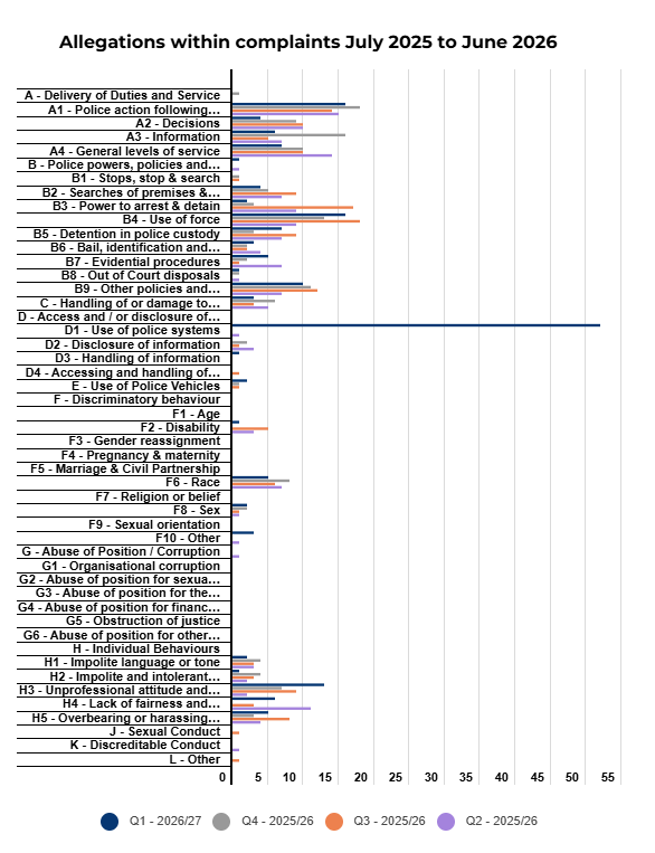
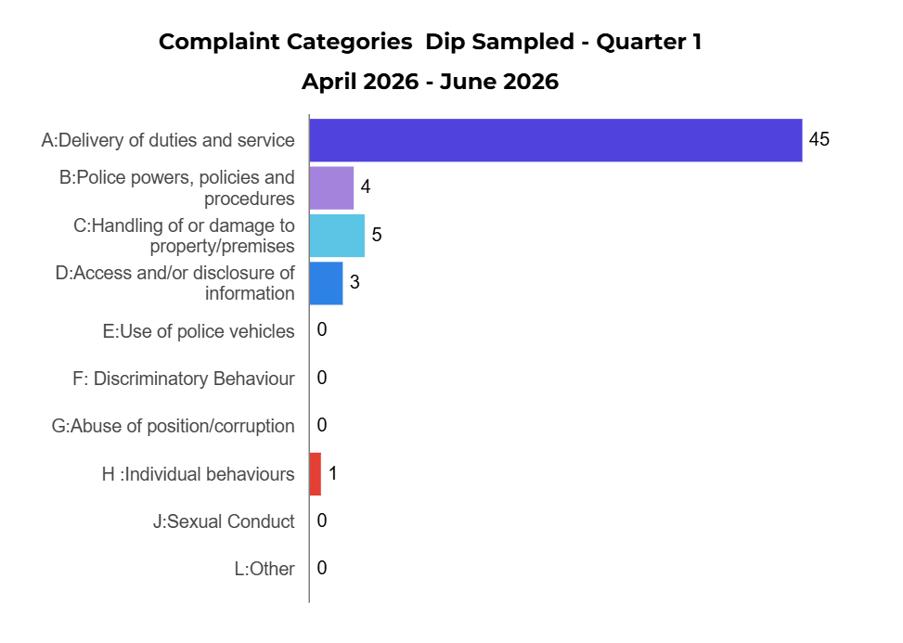
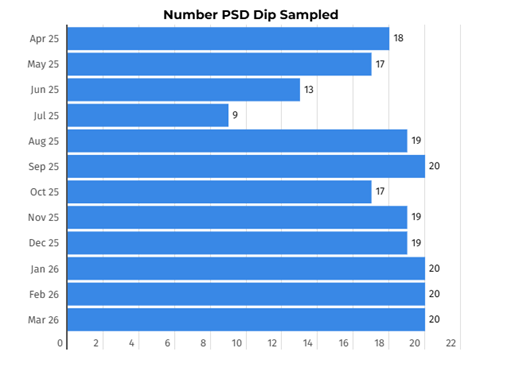
During April 2026 to June 2026, 58 were dip sampled with a total of 122 allegations made. This is two less complaints than the last quarter, and a decrease of 10 allegations made.
Bedfordshire OPCC dip sampled 19 complaints in April 2026. Within the 19 complaints, 34 allegations were covered.
Bedfordshire OPCC dip sampled 20 complaints in May 2026. Within the 20 complaints, 53 allegations were covered.
Bedfordshire OPCC dip sampled 19 complaints in March 2026. Within the 19 complaints, 35 allegations were covered.
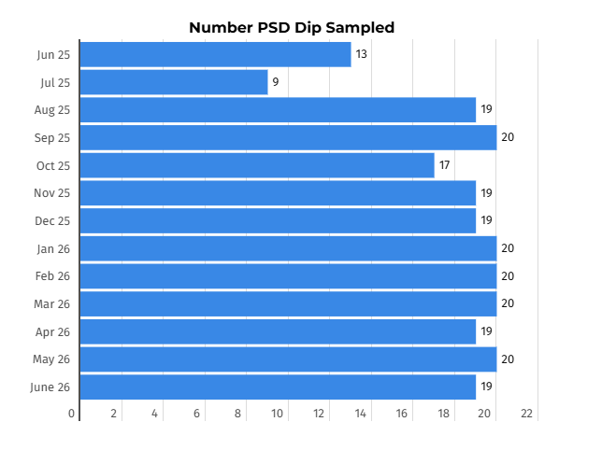
Bedfordshire OPCC believe that all PSD complaints dip sampled have been dealt with in a reasonable and proportionate manner, however additional learning has been passed back to the Professional Standards Department to consider.
Clarification or further information was required on 10 of the 58 PSD dip sampled.
60% of those sampled found service to be acceptable.
19% of those sampled found Service was not/partially not acceptable for all allegations.
2% of those sampled found no further action was required.
5% of those sampled found unable to determine for all allegations.
The top three categories respectively (remaining same as the previous quarter):
- A1 - Police action following contact
- B4 - Use of Force
- H3 – Unprofessional Attitude H3 - Unprofessional attitude and disrespect
The Office of the Police and Crime Commissioner’s Office (OPCC) agreed with any learning identified within the complaint reports and identified additional points for PSDs consideration.
CRT/Lower Dissatisfaction – Dip Sample
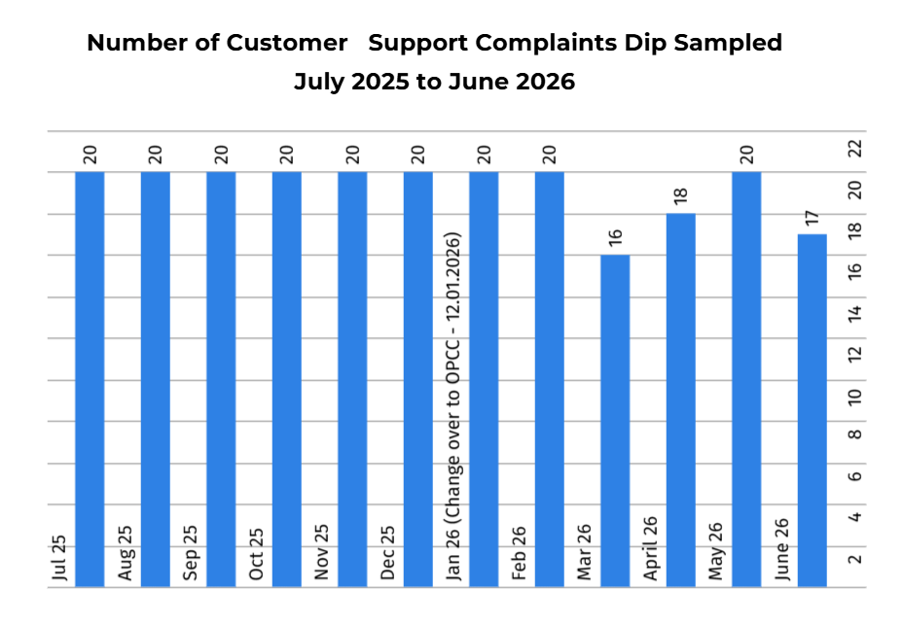
The Compliance Officers within the Governance and Compliance team continue to undertake monthly dip‑sampling of lower‑level dissatisfaction complaints. This activity has always been carried out by the OPCC and has remained independent throughout. The Compliance Officers have no operational involvement in the handling of complaints, and their role is limited to assurance and oversight; dip‑sampling therefore continues to be fully independent of the complaints‑handling process.
Customer support and dissatisfaction dip‑sampling has been in place since August 2021, undertaken by the OPCC while Bedfordshire Police retained responsibility for the handling of all complaints. In January 2026, operating arrangements changed in line with the statutory model 2 (National guidance), with responsibility for handling lower‑level dissatisfaction complaints transferring to the OPCC Complaints Team. Despite this change in operational delivery, the OPCC’s independent dip‑sampling function has been maintained, ensuring continuity of assurance, compliance with statutory guidance, and clear separation between complaint handling and quality oversight.
The OPCC will consider such aspects when completing the Dip Sampling:
- Complaint
- Allegations
- Victims Code of Practice
- Recommendations or actions
- Timescales
The process relates only to the Dip Sampling of closed complaints cases and does not cover those that remain an enquiry.
Transfer of Initial Complaint Handling to the OPCC – January 2026
From January 2026, the Bedfordshire Police and Crime Commissioner (PCC), John Tizard, assumes responsibility for the initial local stage of receiving and managing police complaints.
Previously, this stage of the complaints process was managed within the police service. Under the new arrangements, it will be delivered by a specialist team within the Office of the Police and Crime Commissioner (OPCC).
This new approach introduces a dedicated service designed to:
- Resolve complaints quickly and effectively.
- Provide support and guidance to complainants, ensuring they understand the process and are kept informed at every stage.
- Deliver a process that is more effective, transparent, and independent.
The PCC’s decision should not be interpreted as criticism of the team previously delivering this service within the police; rather, it reflects a commitment to improving accessibility and impartiality.
Key Features of the New Service
- Clearer routes for the public to raise concerns.
- Acknowledgement of complaints within two working days.
- Focus on learning and improvement, with complaints managed to achieve resolution wherever possible.
- Crucial decisions made outside the police service, increasing public confidence that complaints are handled fairly and impartially.
Escalation Process
If a complaint: Cannot be resolved locally, or falls outside the scope of local resolution, it will be referred to:
- The Professional Standards Department (PSD) for Bedfordshire, Hertfordshire, and Cambridgeshire, or
- The Independent Office for Police Conduct (IOPC), as per current statutory requirements.
Complaints data
The below dashboard shows continued growth in complaint demand between April and June 2026 compared to the same period last year. Complaints increased by 23%, whilst allegations rose by 66%. The average number of allegations per complaint increased from 1.20 to 1.61 (+34%), indicating that complaints are becoming increasingly complex, with a greater number of concerns being raised within each complaint.
Performance in resolving complaints outside Schedule 3 processes improved from 61% to 71%. Although monthly performance varied throughout the quarter, this is largely reflective of the profile of complaints received rather than operational performance and demonstrates continued use of local resolution where appropriate.
Table 1: Complaints Performance Dashboard
|
Apr-26 |
May-26 |
Jun-26 |
Average |
Y.O.Y Change |
|
|
Complaints Logged |
133 |
151 |
147 |
144 |
↑ 23% |
|
Complaints Logged SPLY |
115 |
122 |
113 |
117 |
|
|
Allegations Logged |
201 |
264 |
230 |
232 |
↑ 66% |
|
Allegations Logged SPLY |
136 |
149 |
134 |
140 |
|
|
Closed outside S3 % |
89% |
63% |
62% |
71% |
↑ 17% |
|
Closed outside S3 % SPLY |
62% |
63% |
58% |
61% |
Same Period Last Year – SPLY / Year on Year Y.O.Y
Table 2: Quarter-on-Quarter Performance Comparison (2026)
|
Q1 Avg. |
Q2 Avg. |
Change |
|
|
Complaints Logged |
161 |
144 |
↓ -11% |
|
Allegations Logged |
220 |
232 |
↑ 5% |
|
Closed Complaints |
129 |
66 |
↓ -49% |
|
Closed outside S3 % |
84% |
71% |
↓ -15% |
|
Initial Contact sent 24hrs % |
99% |
98% |
↓ -1% |
|
Average time to close (Days) |
19 |
22 |
↑ 16% |
|
Average time to log (days) |
2 |
2 |
→ 0% |
Compared to the previous reporting period, complaint volumes reduced by 11%; however, allegations increased by 5%, indicating that complaint complexity continues to increase despite a reduction in overall complaint demand. The average number of allegations per complaint increased from 1.29 in Q1 to 1.61 in Q2 (+25%), reinforcing the trend towards more complex complaints.
Complaint closures reduced by 49% compared to Q1, whilst average closure times increased from 19 to 22 days (+16%). The proportion of complaints resolved outside Schedule 3 processes also reduced from 84% to 71%. This suggests that whilst complaint demand has moderated compared to the previous quarter, complaint complexity and case handling pressures remain significant challenges.
Allegations by Category of all complaints
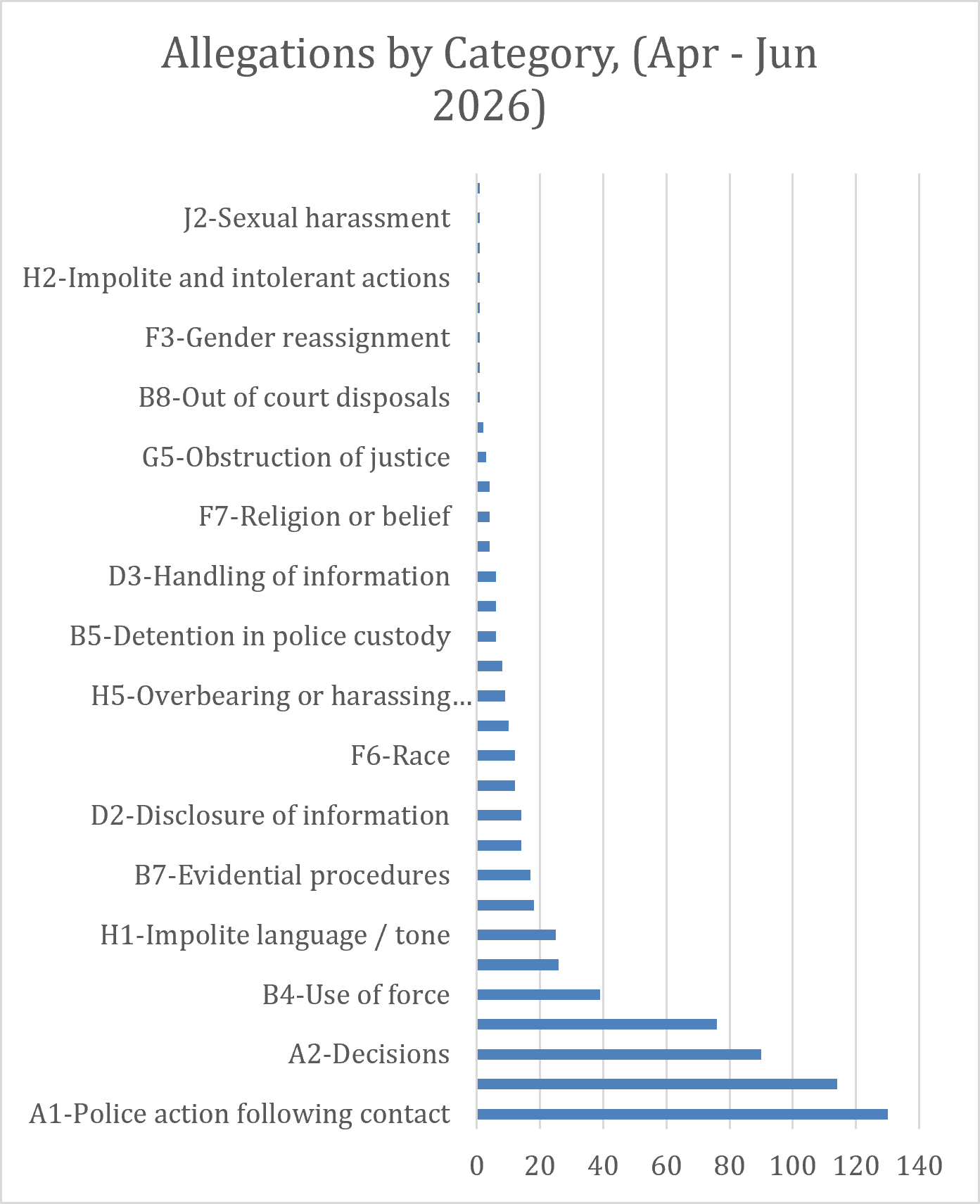
The data shows a clear concentration of complaint allegations within four key categories:
- A1 – Police Action Following Contact (130 allegations)
- A3 – Information (114 allegations)
- A2 – Decisions (90 allegations)
- A4 – General Level of Service (76 allegations)
Table 4: Allegations by Category (Excerpt)
|
Allegation Type |
2025 |
2026 |
YOY Change |
|
A3 - Information |
20 |
114 |
↑ 470% |
|
A2 - Decisions |
25 |
90 |
↑ 260% |
|
D2 - Disclosure of Information |
4 |
14 |
↑ 250% |
|
D3 - Handling of Information |
2 |
6 |
↑ 200% |
|
B7 - Evidential Procedures |
6 |
17 |
↑ 183% |
|
H4 - Lack of Fairness & Impartiality |
4 |
10 |
↑ 150% |
|
B4 - Use of Force |
16 |
39 |
↑ 144% |
Dip Sampling will continue for the new OPCC complaints team to ensure that learning is captured, documented, and applied effectively. This process will support continuous improvement and help deliver the highest standard of service to the public in Bedfordshire.
Chief Constable Complaints
There have been no Chief Constable complaints recorded within the last quarter April 2026 – June 2026.
The OPCC has received complaints from individuals who believe they are submitting a complaint against the Chief Constable. However, unless the complaint relates directly to the personal conduct of the Chief Constable, it is not classified as a complaint against the Chief Constable.
Complainants often assume that, because the Chief Constable holds overall responsibility for the Force, they can be held personally accountable for operational decisions or actions taken by others. In practice, many responsibilities are delegated to other officers or staff within the organisation.
When the OPCC reviews such complaints, if it is immediately clear that:
- The allegations do not concern the Chief Constable’s conduct, and
- The Chief Constable has had no personal involvement in the matter,
then the complaint will not be recorded as a complaint against the Chief Constable.
Statutory Guidance
The IOPC statutory guidance (Section A.7) states:
“There will be times where a complaint names the chief officer or acting chief officer, but the complaint is about something where authority has been delegated to another officer or staff member within the force. Where the local policing body receives a complaint for which it is not the appropriate authority, they must forward the complaint to the appropriate authority. Therefore, where it is immediately clear that the chief officer or acting chief officer has not been involved, the local policing body must take the steps outlined in paragraphs 6.5 – 6.7. They should explain the reasons for this to the complainant.”
In line with this guidance:
Complaints of this nature are forwarded to OPCC Complaints team, this team assesses the matter and allocates it to the appropriate individual or department within the Force for handling.
Reviews
The statutory framework for complaint reviews, introduced on 1 February 2020, remains unchanged. The governance team continues to play a critical role in ensuring compliance, transparency, and continuous improvement. This section provides an overview of review outcomes, key learning points, and governance actions taken during the reporting period.
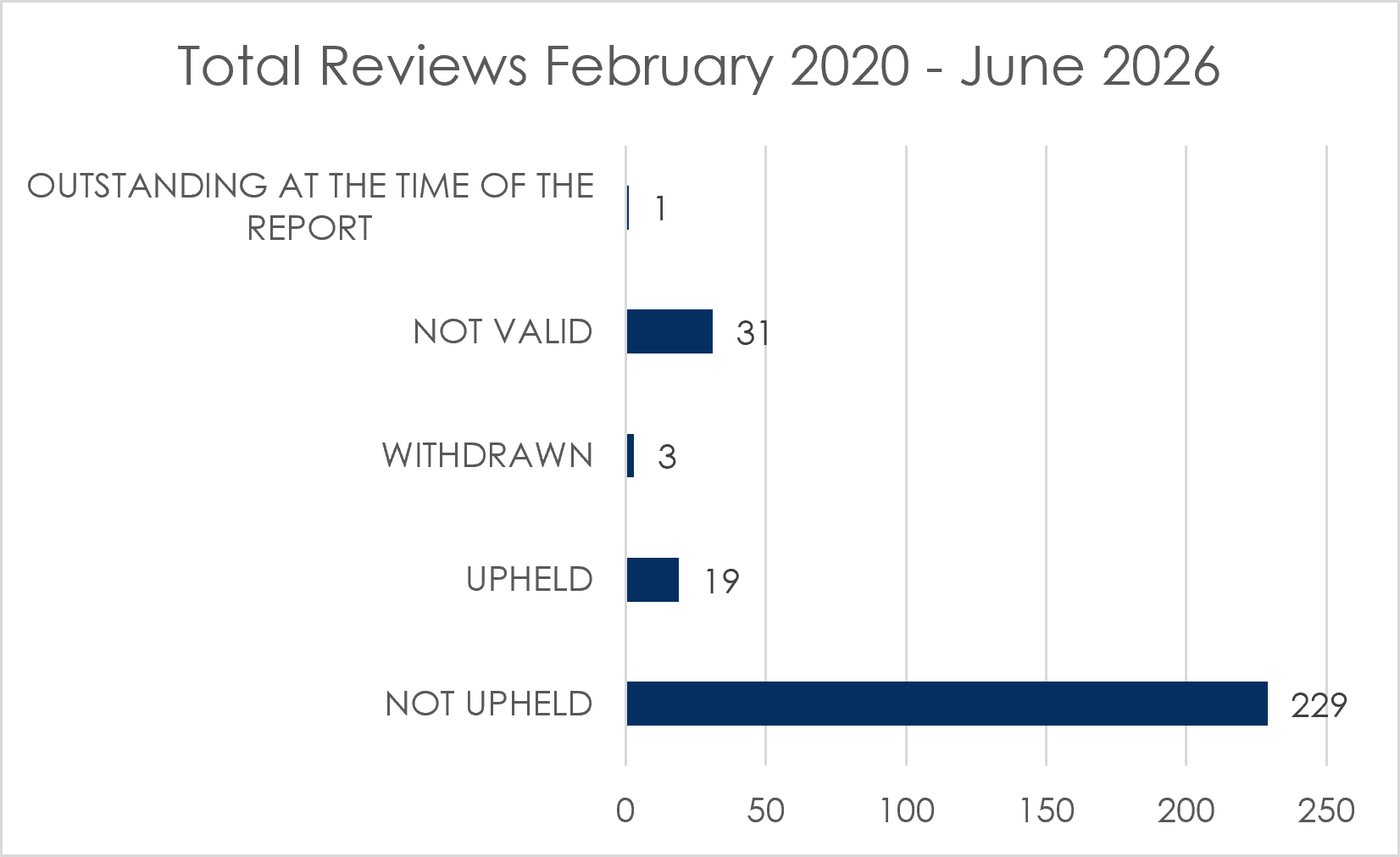
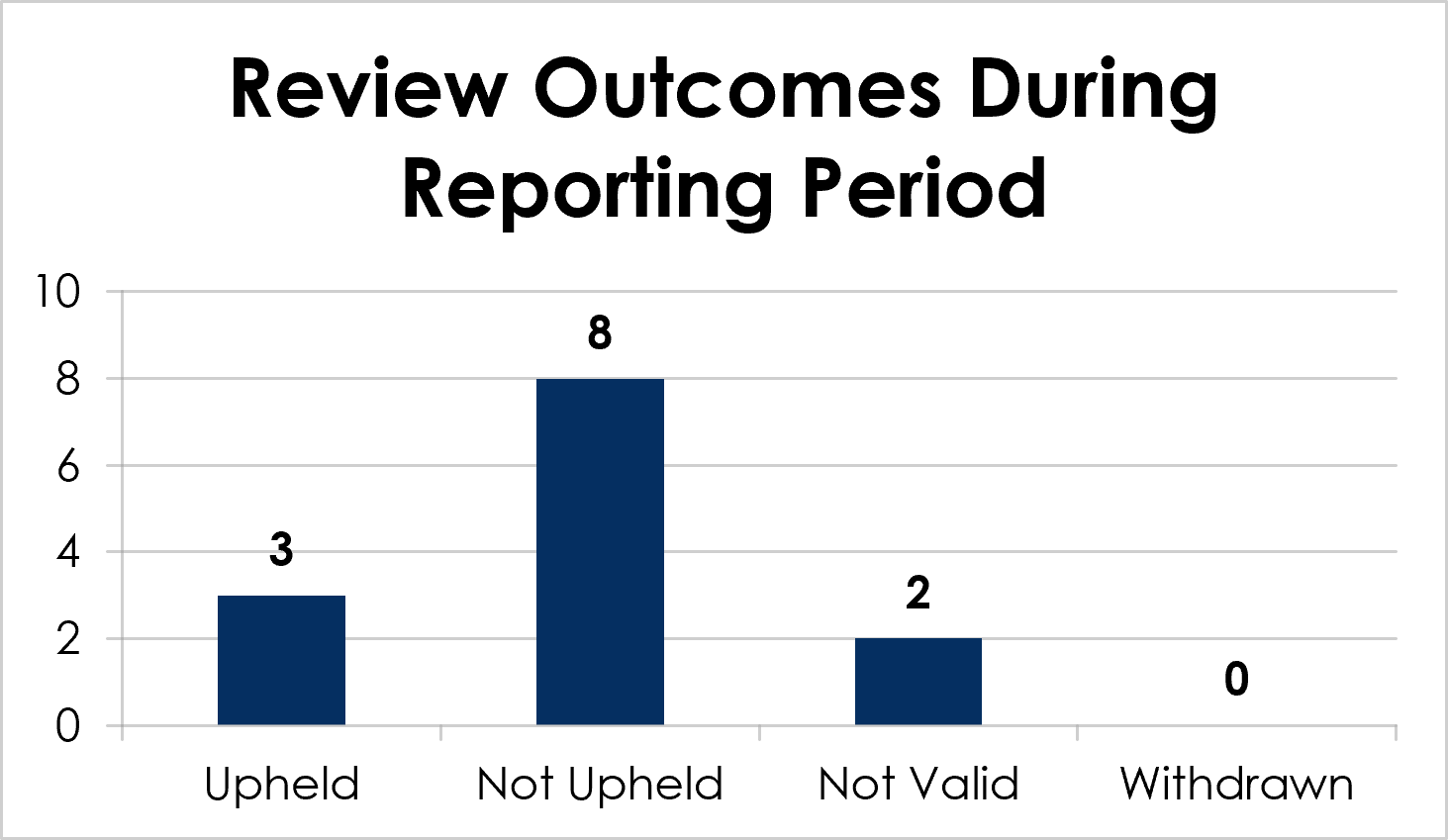
The chart below illustrates data on completed reviews. In addition, key findings and actions taken by the Review Officer in Bedfordshire are summarised below:
Quarter One Information
Key Outcomes and Actions
Upheld Reviews
- Identified shortcomings in the handling of communication, officer conduct and decision-making during an arrest, while another identified inadequately reasoned complaint findings requiring reconsideration by Bedfordshire Police.
- Recommendations were made for officers to undertake reflective practice, review Body Worn Video footage, and consider opportunities for improved communication, de-escalation and professional standards.
- Organisational learning was identified and shared with PSD to improve future complaint handling and operational practice.
OPCC Oversight and Learning
- The OPCC continued to provide oversight in reviews where outcomes were assessed as reasonable and proportionate but learning opportunities were identified.
- Oversight focused on communication with complainants, follow-up arrangements, complaint recording practices, rationale for decision-making and maintaining transparent audit trails.
- Learning and feedback were provided to PSD to support continual improvement and strengthen public confidence in the complaints process.
- The OPCC highlighted opportunities to improve contact with complainants, document decision-making more effectively and ensure lessons learned are embedded into future practice.
Learning Themes identified within Reviews
- Communication and complainant engagement – ensuring meaningful contact is maintained with complainants and that efforts to communicate are appropriately documented.
- Use of force and de-escalation – reinforcing proportionality, communication, leadership and the continuous assessment of tactical options during incidents involving restraint.
- Professional standards and conduct – maintaining professional language, behaviour and decision-making during challenging interactions.
- Complaint recording and transparency – ensuring concerns raised by complainants about complaint wording, scope and accuracy are clearly documented with supporting rationale.
- Supervision and reflective practice – using Body Worn Video reviews, reflective learning and supervisory oversight to improve future performance.
- Decision-making and rationale – ensuring complaint outcomes clearly explain findings and provide robust reasoning where service failures are or are not identified.
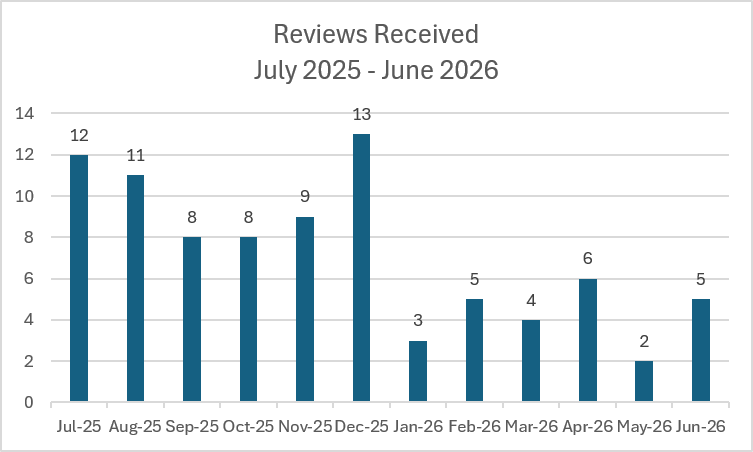
The average time taken to complete a review and send the final response to the complainant within the Office of the Police and Crime Commissioner for Bedfordshire July 2025 - June 2026 - 19.64 (20) days average.
Legally Qualified Persons and Independent Members
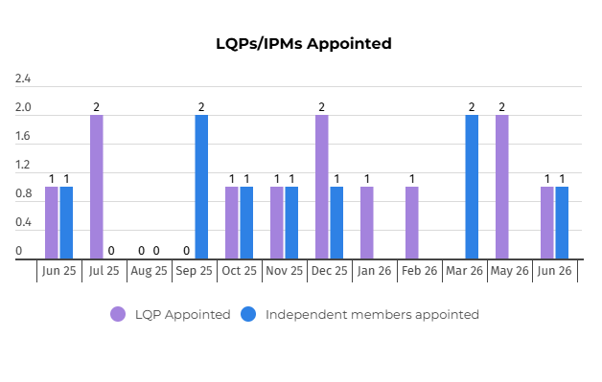
Hearings are governed by the Police (Conduct) Regulations 2020, although cases initiated before 1 February 2020 follow earlier regulations. For hearings commenced after 7 May 2024, panels include a Chair (Chief Constable or delegated senior officer), two Independent Panel Members (IPMs), and a Legally Qualified Advisor (LQA) who provides guidance but does not make decisions. Hearings formed before this date, during the transition period, consist of a Legally Qualified Chair (LQC), a police officer of at least Superintendent rank, and an Independent Member (IM).
Police Appeals Tribunals
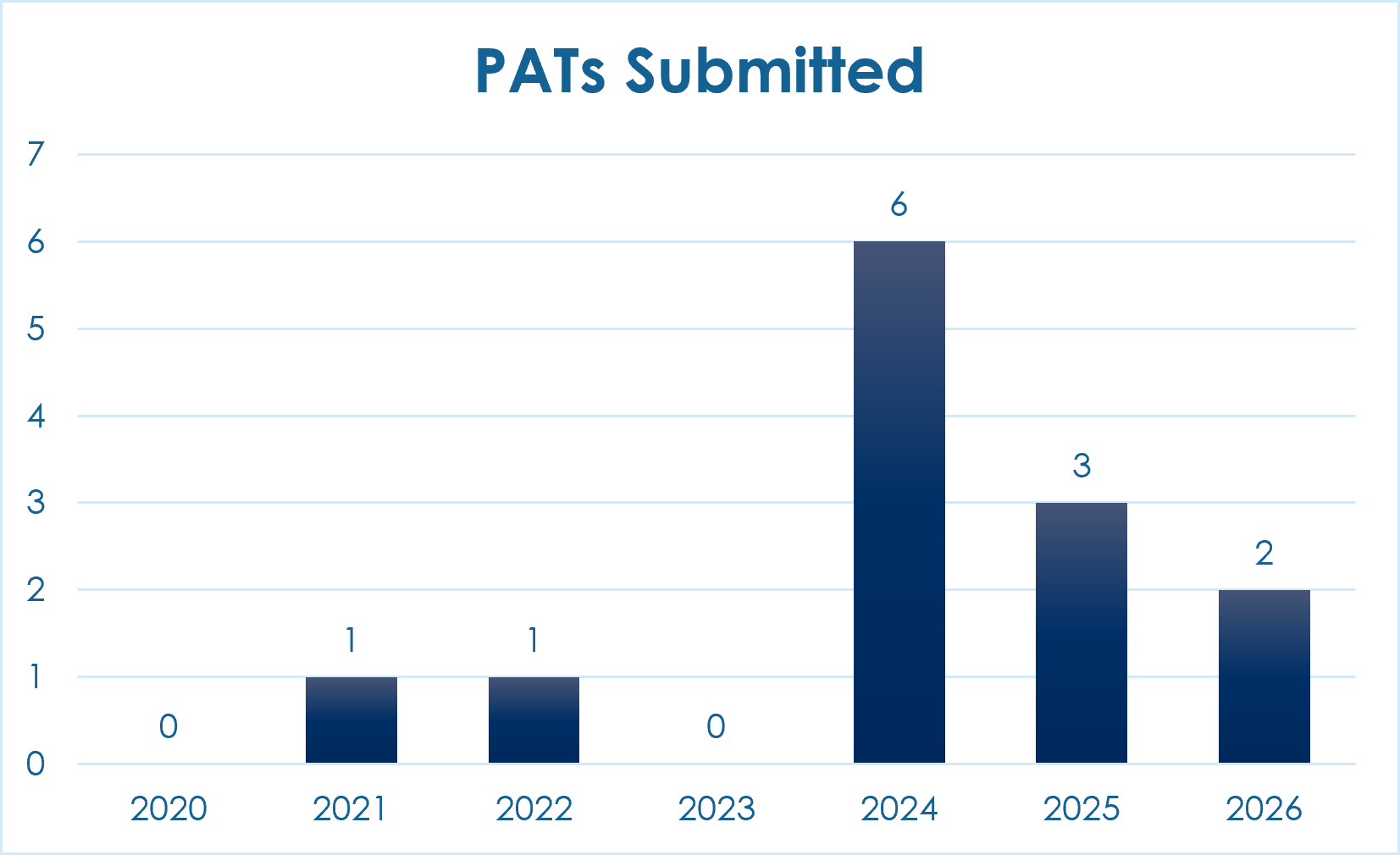
Police Appeals Tribunals are chaired by individuals appointed by the Home Secretary and include a senior officer or former senior officer and a senior police staff member. The OPCC is responsible for appointing LQCs and IMs, and in line with the PCC’s transparency pledge, appointment figures are published regularly.
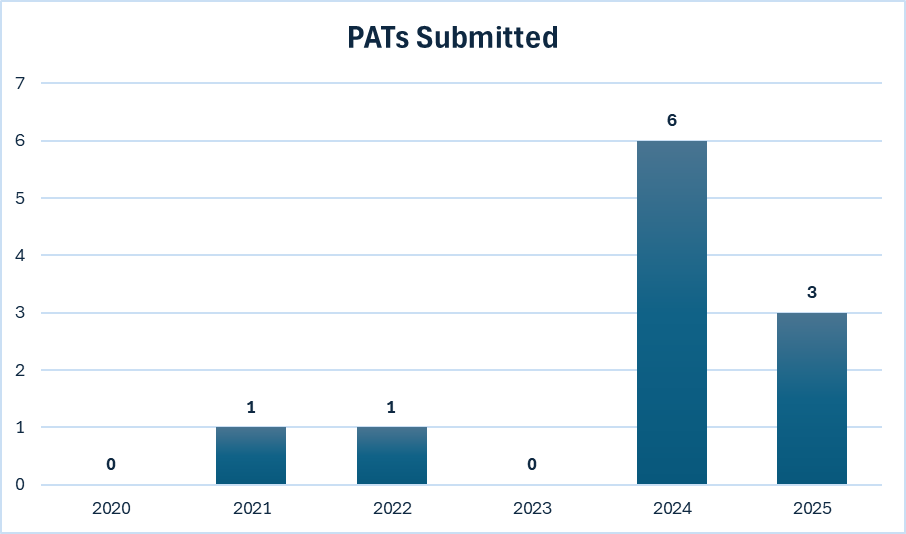
Due to a national issue, PAT Chairs are not currently taking on cases. Unfortunately, this will result in considerable delays in the handling and resolution of police appeal tribunals. This matter has been escalated both locally and nationally, including to the Home Secretary, to seek a resolution as quickly as possible.
Freedom of Information/Subject Access Requests
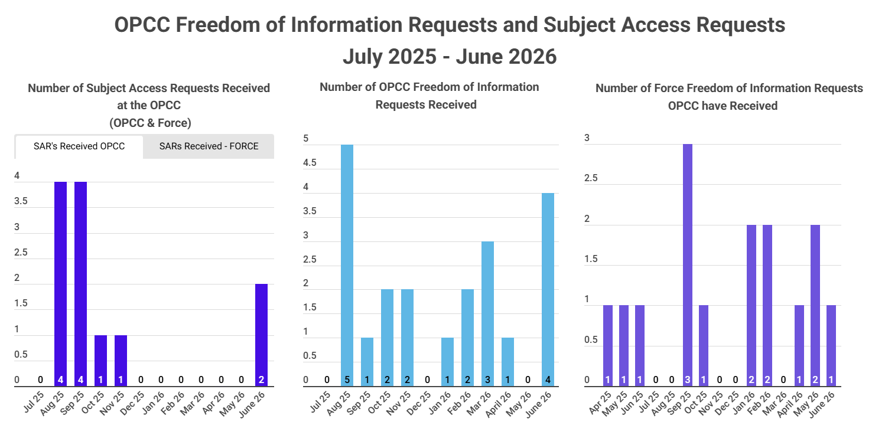
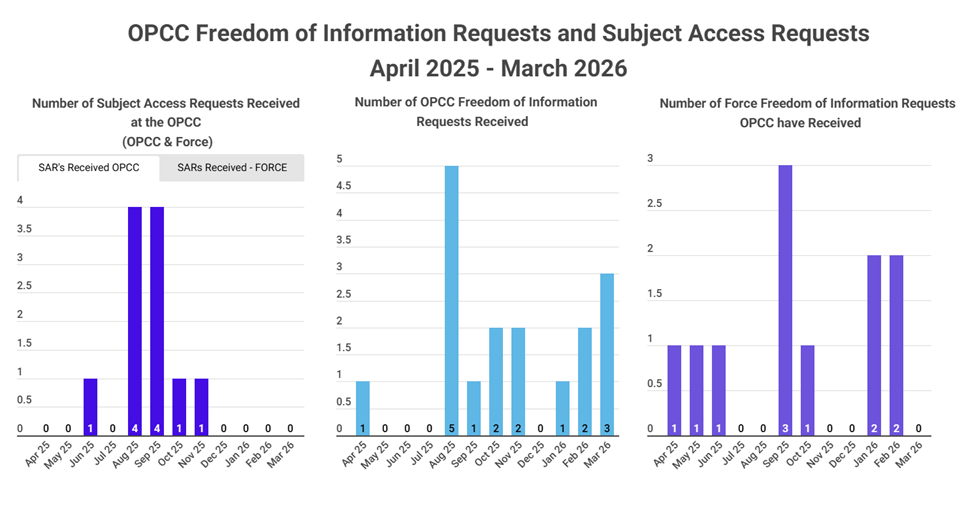
The OPCC has received several Freedom of Information (FOI) and Subject Access Requests (SARs that were intended for Bedfordshire Police. In these cases, the Governance and Transparency team responds by confirming that the OPCC does not hold the requested information, advising that the request should be directed to the Force, and providing the appropriate contact details.
The OPCC also receives FOI and SAR requests that relate specifically to the PCC’s office and completes these in line with statutory requirements. The OPCC is fully aware of its obligations under Data Protection legislation and the Freedom of Information Act, and ensures compliance at all times.
Quarterly Transparency/Compliance Report Q4 January - March 2026
This report is to inform the reader of the governance obligations of the Office of the Police and Crime Commissioner (OPCC). The OPCC will publish this information on a quarterly basis, to ensure that the public can review the functions of the OPCC. The areas of focus for this report are:
- Professional Standards Department (PSD) Dip Sampling
- Customer Services/Lower Dissatisfaction Dip Sampling
- Chief Constable Complaints
- Reviews
- Independent Custody Visitors (ICVs)
- Legally Qualified Chairs (LQCs)
- Freedom of Information / Subject Access Requests
- Trends/Patterns received by the OPCC.
Dip Sampling – Schedule 3 complaints – Professional Standards Department
The purpose of the OPCC Dip Sampling Schedule 3 complaints it that it is a critical function to the reputation of Bedfordshire Police that the public has confidence in the complaints system. To this end, both the Chief Constable and the Police and Crime Commissioner have arranged for ‘dip sampling’ to be undertaken of complaints. On a monthly basis, the OPCC will request categories of complaints from the Professional Standards Department and when the files have been received will review them in full.
The categories of complaint are:
|
Complaint Categories & Subcategories
|
|
|
A |
Delivery of Duties and Service |
|
A1 Police action following contact / A2 Decisions / A3 Information / A4 General level of service.
|
|
|
B |
Police powers, policies, and procedures |
|
B1 Stops, & stop & search / B2 Searches of premises & seizure of property / B3 Power to arrest & detain /
B4 Use of force / B5 Detention in police custody / B6 Bail, identification, and interview procedures /
B7 Evidential procedures / B8 Out of Court disposals / B9 Other policies and procedures
|
|
|
C |
Handling of or damage to property / premises |
|
D |
Access and / or disclosure of information |
|
D1 Use of police systems / D2 Disclosure of information / D3 Handling of information /
D4 Accessing and handling of information from other sources.
|
|
|
E |
Use of Police Vehicles |
|
F |
Discriminatory behaviour |
|
F1 Age / F2 Disability / F3 Gender Reassignment / F4 Pregnancy & Maternity / F5 Marriage & Civil Partnership /
F6 Race / F7 Religion or Belief / F8 Sex / F9 Sexual Orientation / F10 Other
|
|
|
G |
Abuse of Position / Corruption |
|
G1 Organisational corruption / G2 Abuse of position for sexual purpose /
G3 Abuse of position for the purpose of pursuing an inappropriate emotional relationship / G4 Abuse of position for financial purpose / G5 Obstruction of justice / G6 Abuse of position for other purpose
|
|
|
H |
Individual Behaviours |
|
H1 Impolite language or tone / H2 Impolite and intolerant actions / H3 Unprofessional attitude and disrespect
H4 Lack of fairness and impartiality / H5 Overbearing or harassing behaviours
|
|
|
J |
Sexual Conduct |
|
K |
Discreditable Conduct |
|
L |
Other |
The OPCC will consider such aspects when completing the Dip Sampling:
- Timescales for completion of investigations
- Learning Identified
- Were all allegations covered fully and appropriately?
- Satisfaction
- Was Body Worn Video (BWV) used and was it useful to the complaint?
- Other aspects are considered throughout the process.
The process relates only to the Dip Sampling of closed complaints cases and does not cover either the duty to oversee ongoing complaints or the new wider power of direction of the handling of complaints against the police.
The purpose of Dip Sampling is not to interfere with the review process and decisions made by the Relevant Review Body can only be overturned by the courts through the Judicial Review Process.
Q3 – PSD Dip Sample
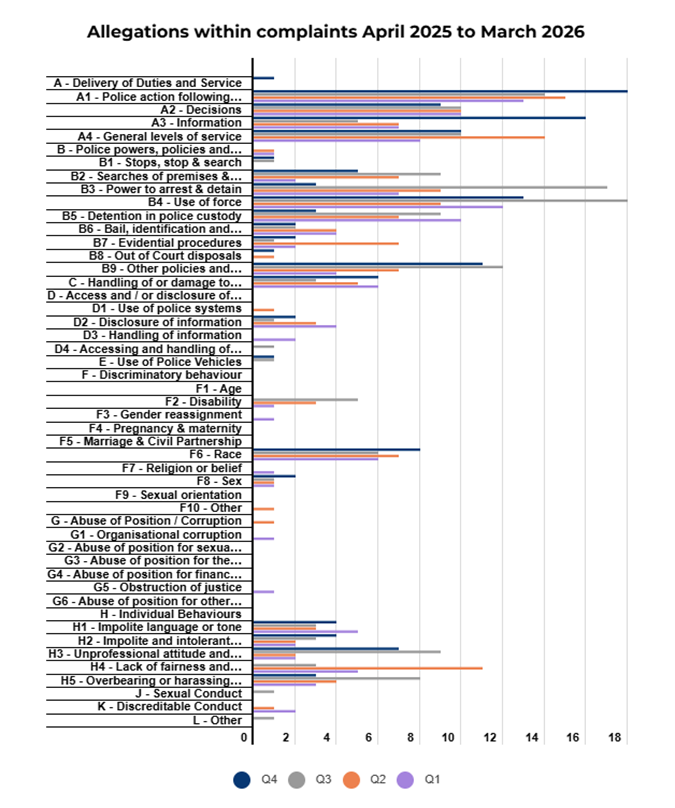
During January 2026 to March 2026, 60 were dip sampled with a total of 132 allegations made. This is five more complaints than the last quarter, and a decrease of 22 allegations made.
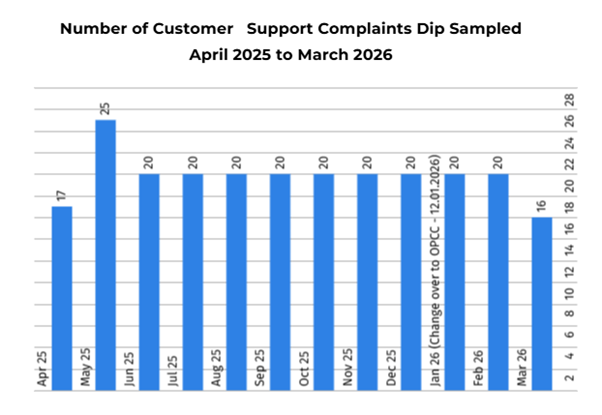
Bedfordshire OPCC dip sampled 20 complaints in January 2026. Within the 20 complaints, 52 allegations were covered.
Bedfordshire OPCC dip sampled 20 complaints in February 2026. Within the 20 complaints, 41 allegations were covered.
Bedfordshire OPCC dip sampled 20 complaints in March 2026. Within the 20 complaints, 39 allegations were covered.
Bedfordshire OPCC believe that all PSD complaints dip sampled have been dealt with in a reasonable and proportionate manner, however additional learning has been passed back to the Professional Standards Department to consider.
Clarification or further information was required on 16 of the 60 PSD dip sampled.
68% of those sampled found service to be acceptable.
25% of those sampled found Service was not/partially not acceptable for all allegations.
The top three categories respectively (remaining same as the previous quarter):
- A1 - Police action following contact
- B4 - Use of Force
- A3 - Information
The Office of the Police and Crime Commissioner’s Office (OPCC) agreed with any learning identified within the complaint reports and identified additional points for PSDs consideration.
CRT/Lower Dissatisfaction – Dip Sample
The Compliance Officers within the Governance and Compliance team continue to undertake monthly dip‑sampling of lower‑level dissatisfaction complaints. This activity has always been carried out by the OPCC and has remained independent throughout. The Compliance Officers have no operational involvement in the handling of complaints, and their role is limited to assurance and oversight; dip‑sampling therefore continues to be fully independent of the complaints‑handling process.
Customer support and dissatisfaction dip‑sampling has been in place since August 2021, undertaken by the OPCC while Bedfordshire Police retained responsibility for the handling of all complaints. In January 2026, operating arrangements changed in line with the statutory model 2 (National guidance), with responsibility for handling lower‑level dissatisfaction complaints transferring to the OPCC Complaints Team. Despite this change in operational delivery, the OPCC’s independent dip‑sampling function has been maintained, ensuring continuity of assurance, compliance with statutory guidance, and clear separation between complaint handling and quality oversight.
The OPCC will consider such aspects when completing the Dip Sampling:
- Complaint
- Allegations
- Victims Code of Practice
- Recommendations or actions
- Timescales
The process relates only to the Dip Sampling of closed complaints cases and does not cover those that remain an enquiry.
Transfer of Initial Complaint Handling to the OPCC – January 2026
From January 2026, the Bedfordshire Police and Crime Commissioner (PCC), John Tizard, assumes responsibility for the initial local stage of receiving and managing police complaints.
Previously, this stage of the complaints process was managed within the police service. Under the new arrangements, it will be delivered by a specialist team within the Office of the Police and Crime Commissioner (OPCC).
This new approach introduces a dedicated service designed to:
- Resolve complaints quickly and effectively.
- Provide support and guidance to complainants, ensuring they understand the process and are kept informed at every stage.
- Deliver a process that is more effective, transparent, and independent.
The PCC’s decision should not be interpreted as criticism of the team previously delivering this service within the police; rather, it reflects a commitment to improving accessibility and impartiality.
Key Features of the New Service
- Clearer routes for the public to raise concerns.
- Acknowledgement of complaints within two working days.
- Focus on learning and improvement, with complaints managed to achieve resolution wherever possible.
- Crucial decisions made outside the police service, increasing public confidence that complaints are handled fairly and impartially.
Escalation Process
If a complaint:
Cannot be resolved locally, or falls outside the scope of local resolution, it will be referred to:
- The Professional Standards Department (PSD) for Bedfordshire, Hertfordshire, and Cambridgeshire, or
- The Independent Office for Police Conduct (IOPC), as per current statutory requirements.
Dip Sampling will continue for the new OPCC complaints team to ensure that learning is captured, documented, and applied effectively. This process will support continuous improvement and help deliver the highest standard of service to the public in Bedfordshire.
Chief Constable Complaints
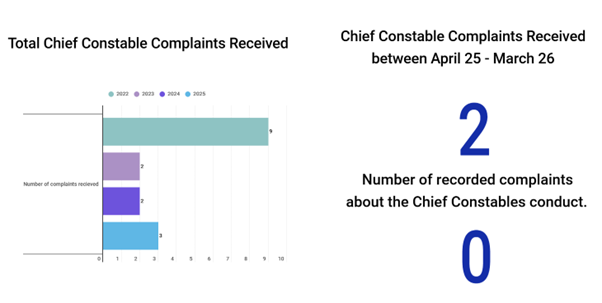
There have been no Chief Constable complaints recorded within the last quarter January 2026 – March 2026.
The OPCC has received complaints from individuals who believe they are submitting a complaint against the Chief Constable. However, unless the complaint relates directly to the personal conduct of the Chief Constable, it is not classified as a complaint against the Chief Constable.
Complainants often assume that, because the Chief Constable holds overall responsibility for the Force, they can be held personally accountable for operational decisions or actions taken by others. In practice, many responsibilities are delegated to other officers or staff within the organisation.
When the OPCC reviews such complaints, if it is immediately clear that:
- The allegations do not concern the Chief Constable’s conduct, and
- The Chief Constable has had no personal involvement in the matter,
then the complaint will not be recorded as a complaint against the Chief Constable.
Statutory Guidance
The IOPC statutory guidance (Section A.7) states:
“There will be times where a complaint names the chief officer or acting chief officer, but the complaint is about something where authority has been delegated to another officer or staff member within the force. Where the local policing body receives a complaint for which it is not the appropriate authority, they must forward the complaint to the appropriate authority. Therefore, where it is immediately clear that the chief officer or acting chief officer has not been involved, the local policing body must take the steps outlined in paragraphs 6.5 – 6.7. They should explain the reasons for this to the complainant.”
In line with this guidance:
Complaints of this nature are forwarded to OPCC Complaints team, this team assesses the matter and allocates it to the appropriate individual or department within the Force for handling.
Reviews
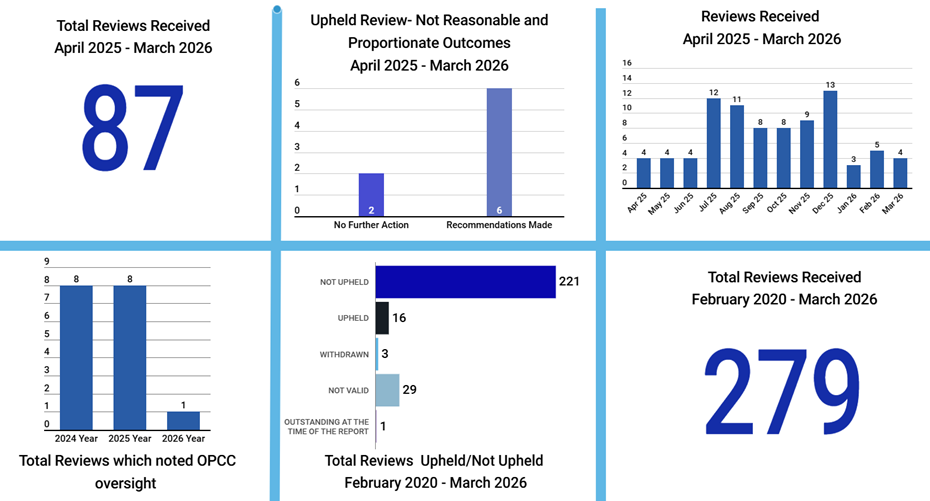
The statutory framework for complaint reviews, introduced on 1 February 2020, remains unchanged. The governance team continues to play a critical role in ensuring compliance, transparency, and continuous improvement. This section provides an overview of review outcomes, key learning points, and governance actions taken during the reporting period.
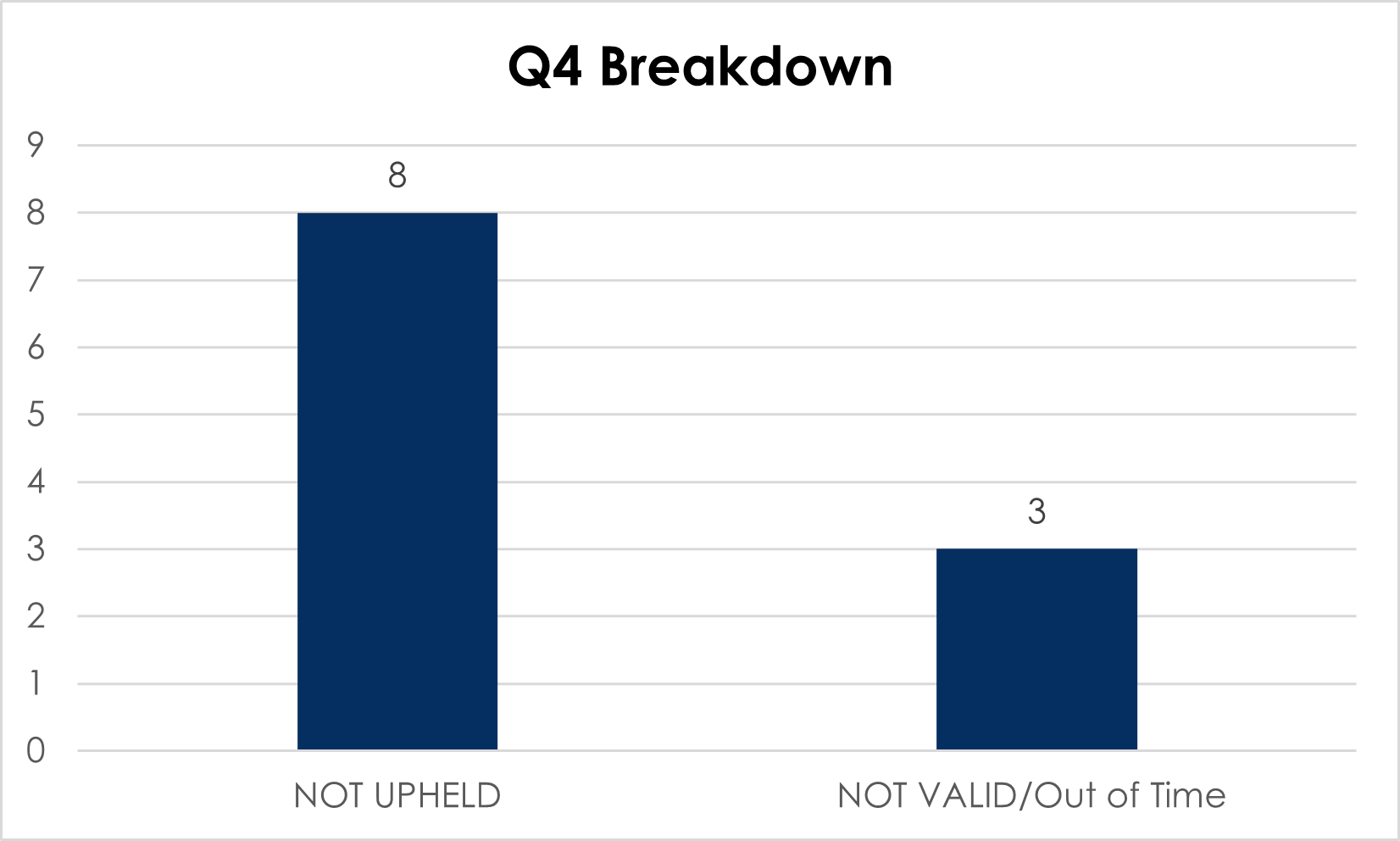
The chart below illustrates data on completed reviews. In addition, key findings and actions taken by the Review Officer in Bedfordshire are summarised below:
Key Outcomes and Actions
Upheld Reviews
- Additional information required – Complaint upheld due to missing or incomplete details.
- Outcome adjustment – Failings were addressed during the complaint process; however, the original outcome required amendment from “acceptable” to “not acceptable,” with no further action.
- Service not acceptable – Outcome changed to reflect that the service provided was not acceptable; an apology issued to the complainant.
- Recommendations to PSD - Amend outcome to state: “Aspects of your complaint were not acceptable.”
- Recommendations to PSD - Provide developmental feedback to the officer, including a reflective debrief on how the incident could have been managed differently, with this noted on file.
OPCC Oversight and Learning
- Positive feedback provided to an officer who demonstrated professionalism and calmness, successfully de-escalating a situation.
- Officers asked to reflect on incidents and consider alternative approaches.
- Reflection requested on language used during interactions to ensure professionalism.
- Guidance issued on handling email bounce-back notifications:
- Do not delete bounce-back messages.
- Retain in inbox until corrective action is taken (e.g., verify recipient details, correct errors, inform complainant/victim of resolution).
- Learning shared with the officer to support future improvements.
- Communication and interaction skills identified as a development area - Officer asked to review recorded calls and reflect on handling of challenging conversations.
Learning Themes identified within Reviews
- Importance of clear communication and professional language.
- Need for proactive error handling in correspondence.
- Value of reflective practice and debriefing for continuous improvement.
The average time taken to complete a review and send the final response to the complainant within the Office of the Police and Crime Commissioner for Bedfordshire (January 2025 to December 2025) is 10 days compared to 21 days the previous year.
Quarter Four Information
Legally Qualified Persons and Independent Members
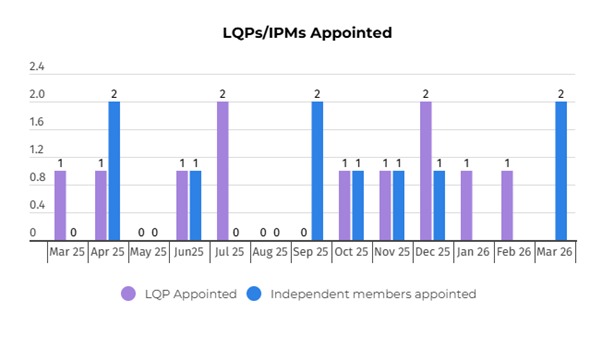
Hearings are governed by the Police (Conduct) Regulations 2020, although cases initiated before 1 February 2020 follow earlier regulations. For hearings commenced after 7 May 2024, panels include a Chair (Chief Constable or delegated senior officer), two Independent Panel Members (IPMs), and a Legally Qualified Advisor (LQA) who provides guidance but does not make decisions. Hearings formed before this date, during the transition period, consist of a Legally Qualified Chair (LQC), a police officer of at least Superintendent rank, and an Independent Member (IM).
 Police Appeals Tribunals
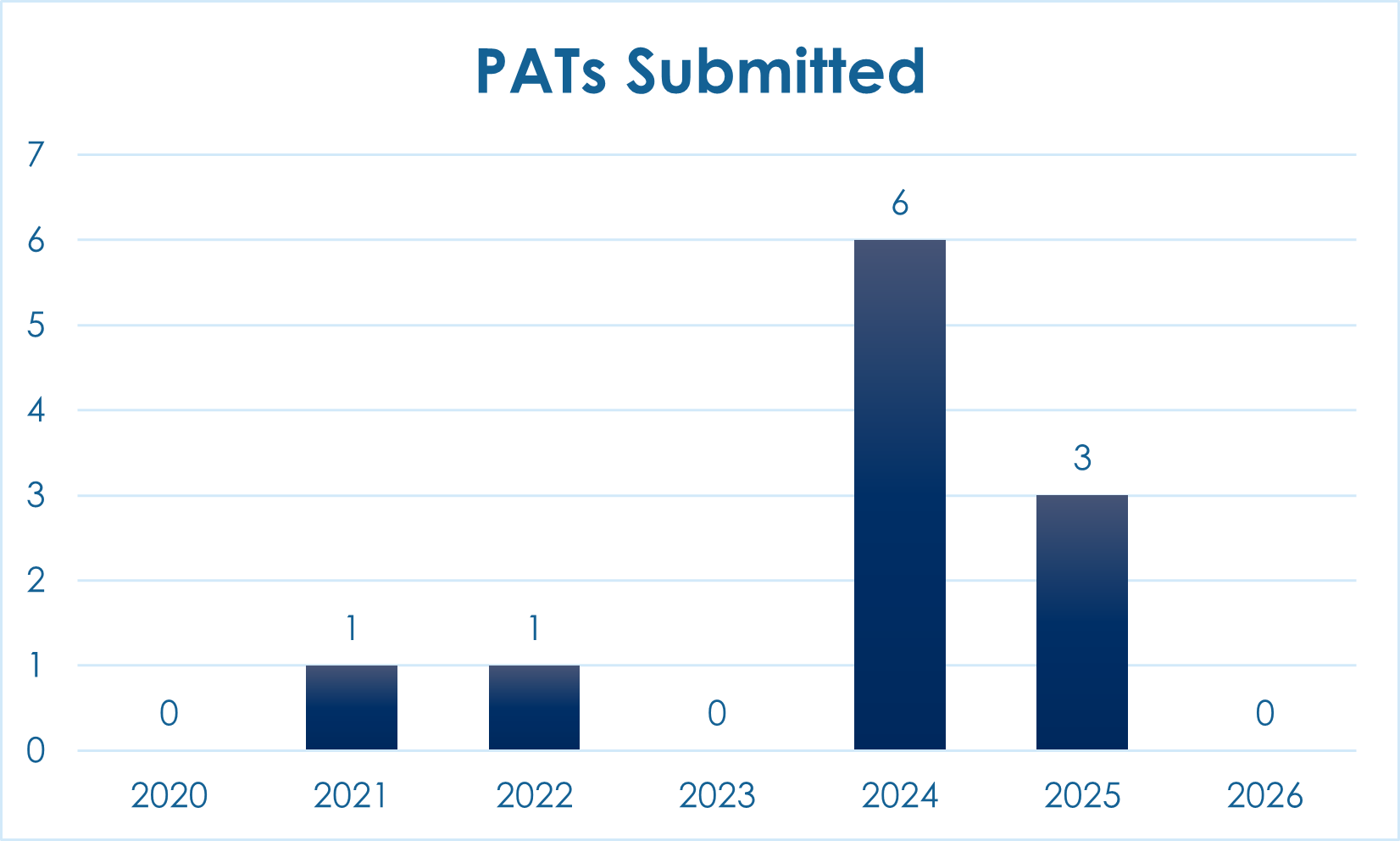
Police Appeals Tribunals are chaired by individuals appointed by the Home Secretary and include a senior officer or former senior officer and a senior police staff member. The OPCC is responsible for appointing LQCs and IMs, and in line with the PCC’s transparency pledge, appointment figures are published regularly.
Due to a national issue, PAT Chairs are not currently taking on cases. Unfortunately, this will result in considerable delays in the handling and resolution of police appeal tribunals. This matter has been escalated both locally and nationally, including to the Home Secretary, to seek a resolution as quickly as possible.
Freedom of Information/Subject Access Requests
The OPCC has received several Freedom of Information (FOI) and Subject Access Requests (SARs that were intended for Bedfordshire Police. In these cases, the Governance and Transparency team responds by confirming that the OPCC does not hold the requested information, advising that the request should be directed to the Force, and providing the appropriate contact details.
The OPCC also receives FOI and SAR requests that relate specifically to the PCC’s office and completes these in line with statutory requirements. The OPCC is fully aware of its obligations under Data Protection legislation and the Freedom of Information Act, and ensures compliance at all times.
Quarterly Transparency/Compliance Report Q3 October - December 2025
This report is to inform the reader of the governance obligations of the Office of the Police and Crime Commissioner (OPCC). The OPCC will publish this information on a quarterly basis, to ensure that the public can review the functions of the OPCC. The areas of focus for this report are:
- Professional Standards Department (PSD) Dip Sampling
- Customer Services/Lower Dissatisfaction Dip Sampling
- Chief Constable Complaints
- Reviews
- Independent Custody Visitors (ICVs)
- Legally Qualified Chairs (LQCs)
- Freedom of Information / Subject Access Requests
- Trends/Patterns received by the OPCC.
Dip Sampling – Schedule 3 complaints – Professional Standards Department
The purpose of the OPCC Dip Sampling Schedule 3 complaints it that it is a critical function to the reputation of Bedfordshire Police that the public has confidence in the complaints system. To this end, both the Chief Constable and the Police and Crime Commissioner have arranged for ‘dip sampling’ to be undertaken of complaints. On a monthly basis, the OPCC will request categories of complaints from the Professional Standards Department and when the files have been received will review them in full.
The categories of complaint are:
|
Complaint Categories & Subcategories
|
|
|
A |
Delivery of Duties and Service |
|
A1 Police action following contact / A2 Decisions / A3 Information / A4 General level of service.
|
|
|
B |
Police powers, policies, and procedures |
|
B1 Stops, & stop & search / B2 Searches of premises & seizure of property / B3 Power to arrest & detain / B4 Use of force / B5 Detention in police custody / B6 Bail, identification, and interview procedures / B7 Evidential procedures / B8 Out of Court disposals / B9 Other policies and procedures |
|
|
C |
Handling of or damage to property / premises |
|
D |
Access and / or disclosure of information |
|
D1 Use of police systems / D2 Disclosure of information / D3 Handling of information / D4 Accessing and handling of information from other sources. |
|
|
E |
Use of Police Vehicles |
|
F |
Discriminatory behaviour |
|
F1 Age / F2 Disability / F3 Gender Reassignment / F4 Pregnancy & Maternity / F5 Marriage & Civil Partnership / F6 Race / F7 Religion or Belief / F8 Sex / F9 Sexual Orientation / F10 Other |
|
|
G |
Abuse of Position / Corruption |
|
G1 Organisational corruption / G2 Abuse of position for sexual purpose / G3 Abuse of position for the purpose of pursuing an inappropriate emotional relationship / G4 Abuse of position for financial purpose / G5 Obstruction of justice / G6 Abuse of position for other purpose |
|
|
H |
Individual Behaviours |
|
H1 Impolite language or tone / H2 Impolite and intolerant actions / H3 Unprofessional attitude and disrespect H4 Lack of fairness and impartiality / H5 Overbearing or harassing behaviours |
|
|
J |
Sexual Conduct |
|
K |
Discreditable Conduct |
|
L |
Other |
The OPCC will consider such aspects when completing the Dip Sampling:
- Timescales for completion of investigations
- Learning Identified
- Were all allegations covered fully and appropriately?
- Satisfaction
- Was Body Worn Video (BWV) used and was it useful to the complaint?
- Other aspects are considered throughout the process.
The process relates only to the Dip Sampling of closed complaints cases and does not cover either the duty to oversee ongoing complaints or the new wider power of direction of the handling of complaints against the police.
The purpose of Dip Sampling is not to interfere with the review process and decisions made by the Relevant Review Body can only be overturned by the courts through the Judicial Review Process.
Q3 – PSD Dip Sample
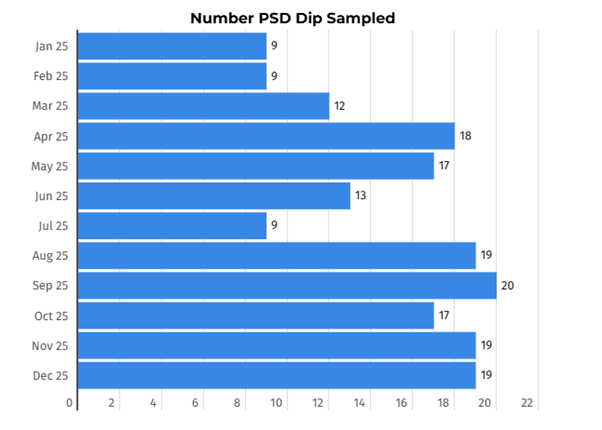
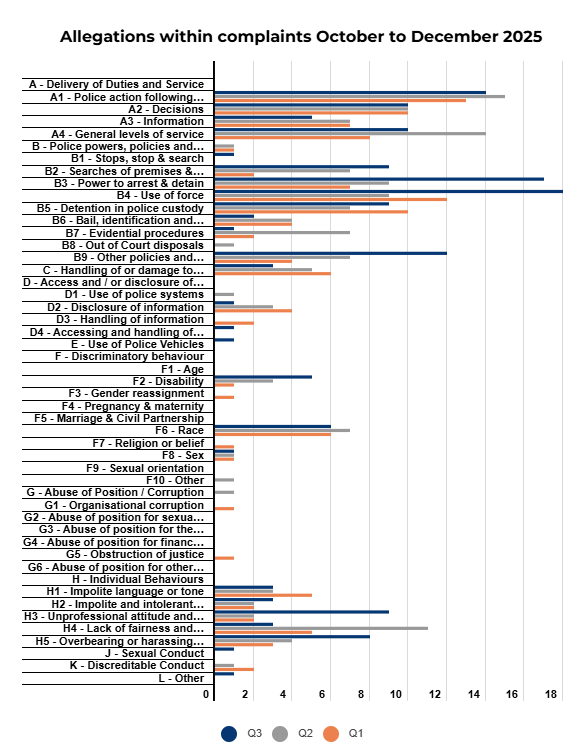
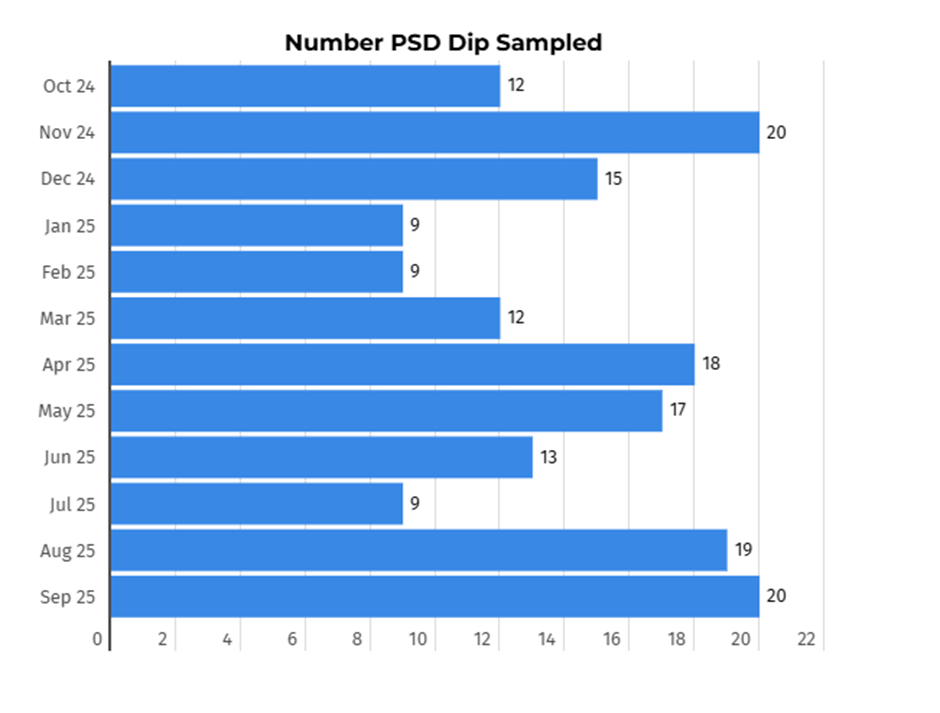
During October to December 2025, 55 were dip sampled with a total of 154 allegations made. This is twelve more complaints than the last quarter, and an increase of 24 allegations made.
Bedfordshire OPCC dip sampled 17 complaints in October 2025. Within the 17 complaints, 51 allegations were covered.
Bedfordshire OPCC dip sampled 19 complaints in November 2025. Within the 19 complaints, 51 allegations were covered.
Bedfordshire OPCC dip sampled 19 complaints in December 2025. Within the 20 complaints, 52 allegations were covered.
Bedfordshire OPCC believe that all PSD complaints dip sampled have been dealt with in a reasonable and proportionate manner, however additional learning has been passed back to the Professional Standards Department to consider.
Clarification or further information was required on 9 of the 55 PSD dip sampled.
61% of those sampled found service to be acceptable.
29% of those sampled found Service was not/partially not acceptable for all allegations.
The top three categories respectively (remaining same as the previous quarter):
- A1 - Police action following contact
- B4 - Use of Force
- B3 - Power to arrest & detain
The Office of the Police and Crime Commissioner’s Office (OPCC) agreed with any learning identified within the complaint reports and identified additional points for PSDs consideration.
CRT/Lower Dissatisfaction – Dip Sample
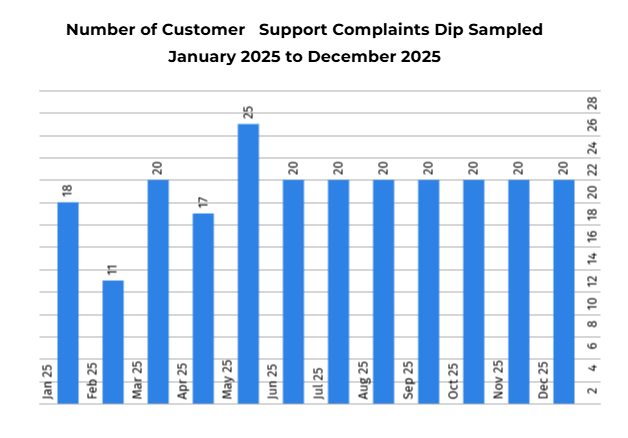
The Governance and Transparency team conduct monthly dip sampling of lower dissatisfaction complaints and hold a monthly meeting with the Bedfordshire Police Customer Support Management team to discuss findings, to ensure feedback is given and fed into future learning.
The Customer Support and dissatisfaction dip sampling commenced in August 2021 and is completed monthly via access to the police force framework.
The OPCC will consider such aspects when completing the Dip Sampling:
- Complaint
- Allegations
- Victims Code of Practice
- Recommendations or actions
- Timescales
The process relates only to the Dip Sampling of closed complaints cases and does not cover those that remain an enquiry.
Transfer of Initial Complaint Handling to the OPCC – January 2026
From January 2026, the Bedfordshire Police and Crime Commissioner (PCC), John Tizard, assumes responsibility for the initial local stage of receiving and managing police complaints.
Previously, this stage of the complaints process was managed within the police service. Under the new arrangements, it will be delivered by a specialist team within the Office of the Police and Crime Commissioner (OPCC).
This new approach introduces a dedicated service designed to:
- Resolve complaints quickly and effectively.
- Provide support and guidance to complainants, ensuring they understand the process and are kept informed at every stage.
- Deliver a process that is more effective, transparent, and independent.
The PCC’s decision should not be interpreted as criticism of the team previously delivering this service within the police; rather, it reflects a commitment to improving accessibility and impartiality.
Key Features of the New Service
- Clearer routes for the public to raise concerns.
- Acknowledgement of complaints within two working days.
- Focus on learning and improvement, with complaints managed to achieve resolution wherever possible.
- Crucial decisions made outside the police service, increasing public confidence that complaints are handled fairly and impartially.
Escalation Process
If a complaint:
Cannot be resolved locally, or falls outside the scope of local resolution, it will be referred to:
- The Professional Standards Department (PSD) for Bedfordshire, Hertfordshire, and Cambridgeshire, or
- The Independent Office for Police Conduct (IOPC), as per current statutory requirements.
Dip Sampling will continue for the new OPCC complaints team to ensure that learning is captured, documented, and applied effectively. This process will support continuous improvement and help deliver the highest standard of service to the public in Bedfordshire.
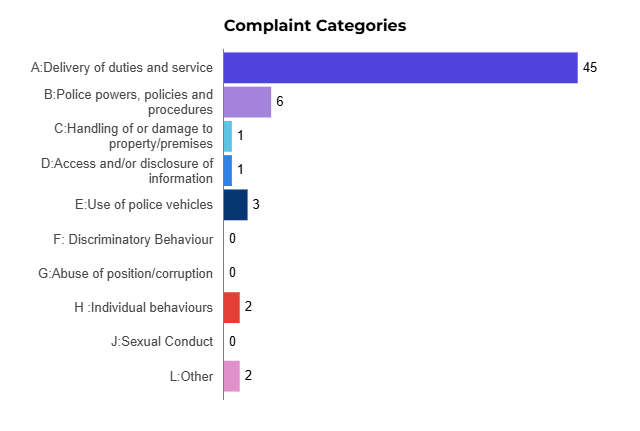
Chief Constable Complaints
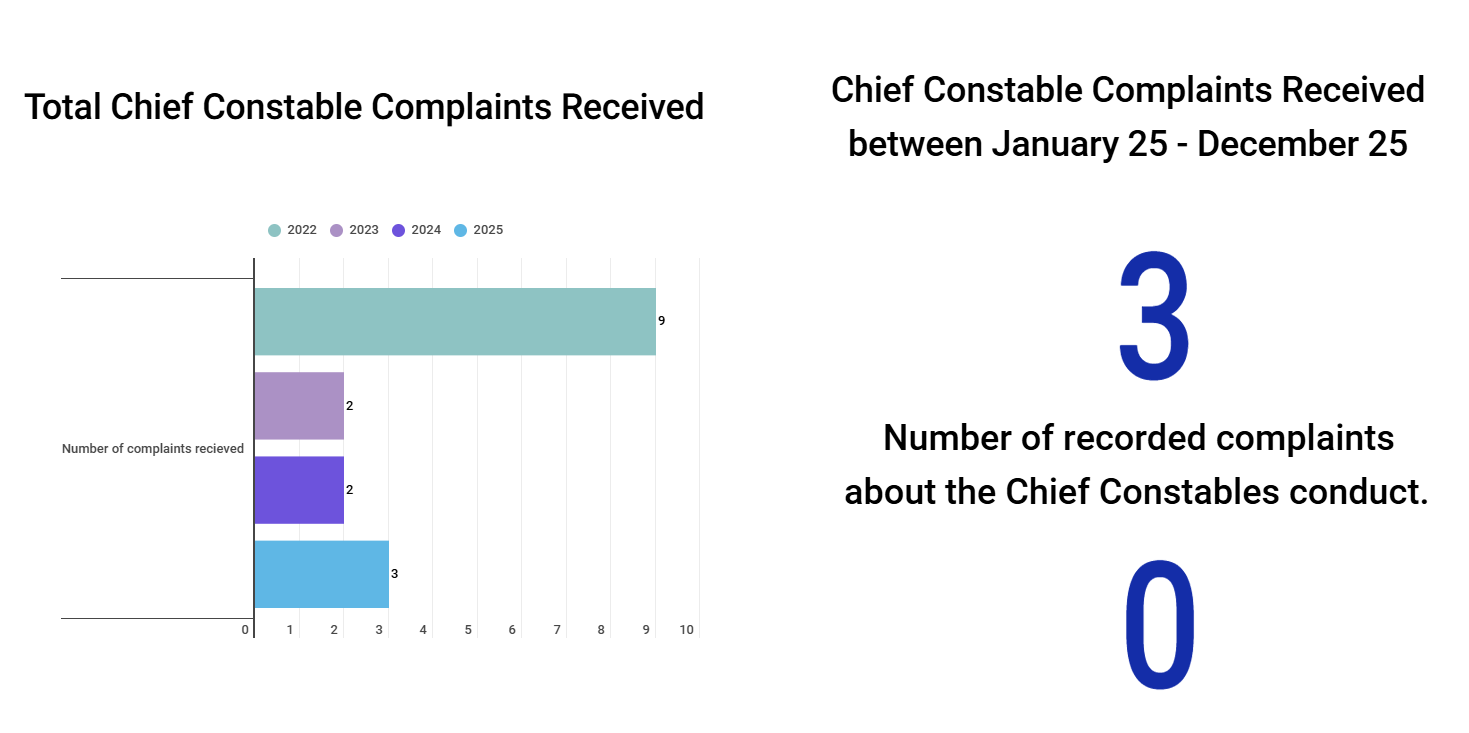
There have been no Chief Constable complaints recorded within the last quarter October to December 2025.
The OPCC has received complaints from individuals who believe they are submitting a complaint against the Chief Constable. However, unless the complaint relates directly to the personal conduct of the Chief Constable, it is not classified as a complaint against the Chief Constable.
Complainants often assume that, because the Chief Constable holds overall responsibility for the Force, they can be held personally accountable for operational decisions or actions taken by others. In practice, many responsibilities are delegated to other officers or staff within the organisation.
When the OPCC reviews such complaints, if it is immediately clear that:
- The allegations do not concern the Chief Constable’s conduct, and
- The Chief Constable has had no personal involvement in the matter,
then the complaint will not be recorded as a complaint against the Chief Constable.
Statutory Guidance
The IOPC statutory guidance (Section A.7) states:
“There will be times where a complaint names the chief officer or acting chief officer, but the complaint is about something where authority has been delegated to another officer or staff member within the force. Where the local policing body receives a complaint for which it is not the appropriate authority, they must forward the complaint to the appropriate authority. Therefore, where it is immediately clear that the chief officer or acting chief officer has not been involved, the local policing body must take the steps outlined in paragraphs 6.5 – 6.7. They should explain the reasons for this to the complainant.”
In line with this guidance:
Complaints of this nature are forwarded to OPCC Complaints team, this team assesses the matter and allocates it to the appropriate individual or department within the Force for handling.
Reviews
The statutory framework for complaint reviews, introduced on 1 February 2020, remains unchanged. The governance team continues to play a critical role in ensuring compliance, transparency, and continuous improvement. This section provides an overview of review outcomes, key learning points, and governance actions taken during the reporting period.
The chart below illustrates data on completed reviews. In addition, key findings and actions taken by the Review Officer in Bedfordshire are summarised below:
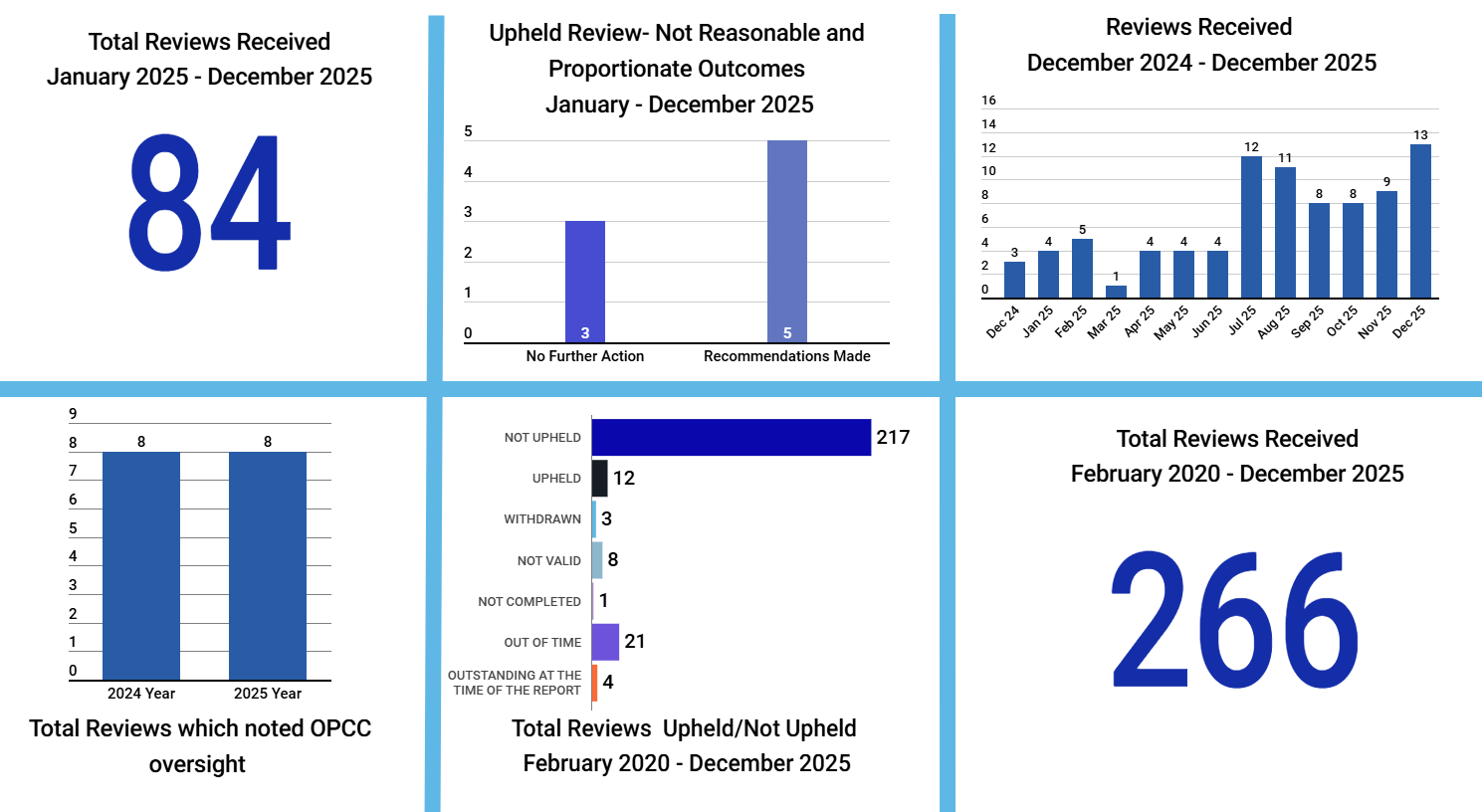
Key Outcomes and Actions
Upheld Reviews
- Additional information required – Complaint upheld due to missing or incomplete details.
- Outcome adjustment – Failings were addressed during the complaint process; however, the original outcome required amendment from “acceptable” to “not acceptable,” with no further action.
- Service not acceptable – Outcome changed to reflect that the service provided was not acceptable; an apology issued to the complainant.
- Recommendations to PSD - Amend outcome to state: “Aspects of your complaint were not acceptable.”
- Recommendations to PSD - Provide developmental feedback to the officer, including a reflective debrief on how the incident could have been managed differently, with this noted on file.
OPCC Oversight and Learning
- Positive feedback provided to an officer who demonstrated professionalism and calmness, successfully de-escalating a situation.
- Officers asked to reflect on incidents and consider alternative approaches.
- Reflection requested on language used during interactions to ensure professionalism.
- Guidance issued on handling email bounce-back notifications:
- Do not delete bounce-back messages.
- Retain in inbox until corrective action is taken (e.g., verify recipient details, correct errors, inform complainant/victim of resolution).
- Learning shared with the officer to support future improvements.
- Communication and interaction skills identified as a development area - Officer asked to review recorded calls and reflect on handling of challenging conversations.
Learning Themes identified within Reviews
- Importance of clear communication and professional language.
- Need for proactive error handling in correspondence.
- Value of reflective practice and debriefing for continuous improvement.
The average time taken to complete a review and send the final response to the complainant within the Office of the Police and Crime Commissioner for Bedfordshire (January 2025 to December 2025) is 21 days compared to 22 days the previous year.
Legally Qualified Persons and Independent Members
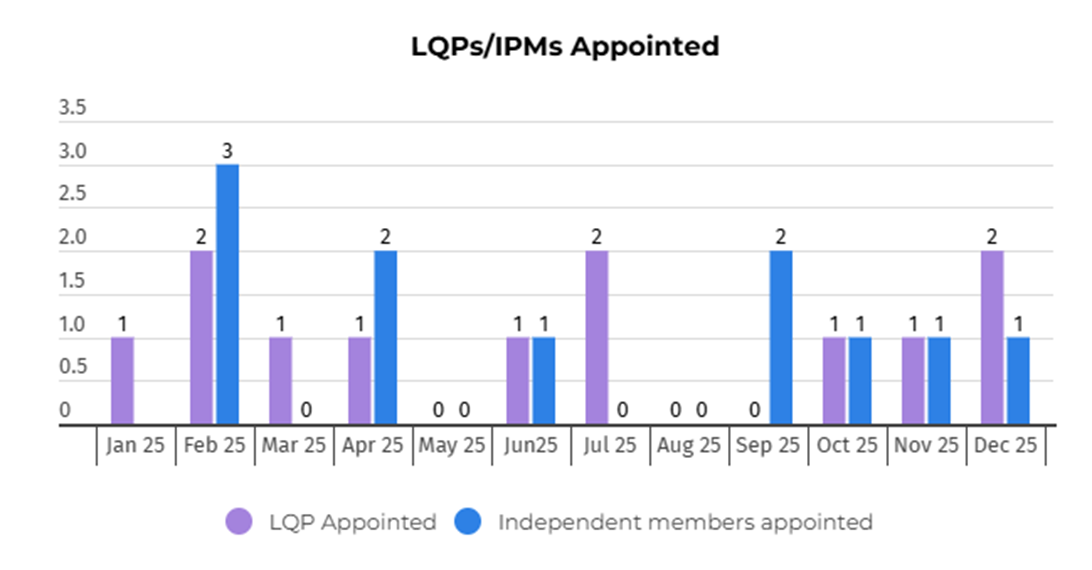
Hearings are governed by the Police (Conduct) Regulations 2020, although cases initiated before 1 February 2020 follow earlier regulations. For hearings commenced after 7 May 2024, panels include a Chair (Chief Constable or delegated senior officer), two Independent Panel Members (IPMs), and a Legally Qualified Advisor (LQA) who provides guidance but does not make decisions. Hearings formed before this date, during the transition period, consist of a Legally Qualified Chair (LQC), a police officer of at least Superintendent rank, and an Independent Member (IM).
Police Appeals Tribunals
Police Appeals Tribunals are chaired by individuals appointed by the Home Secretary and include a senior officer or former senior officer and a senior police staff member. The OPCC is responsible for appointing LQCs and IMs, and in line with the PCC’s transparency pledge, appointment figures are published regularly.
Due to a national issue, PAT Chairs are not currently taking on cases. Unfortunately, this will result in considerable delays in the handling and resolution of police appeal tribunals. This matter has been escalated both locally and nationally, including to the Home Secretary, to seek a resolution as quickly as possible.
Freedom of Information/Subject Access Requests
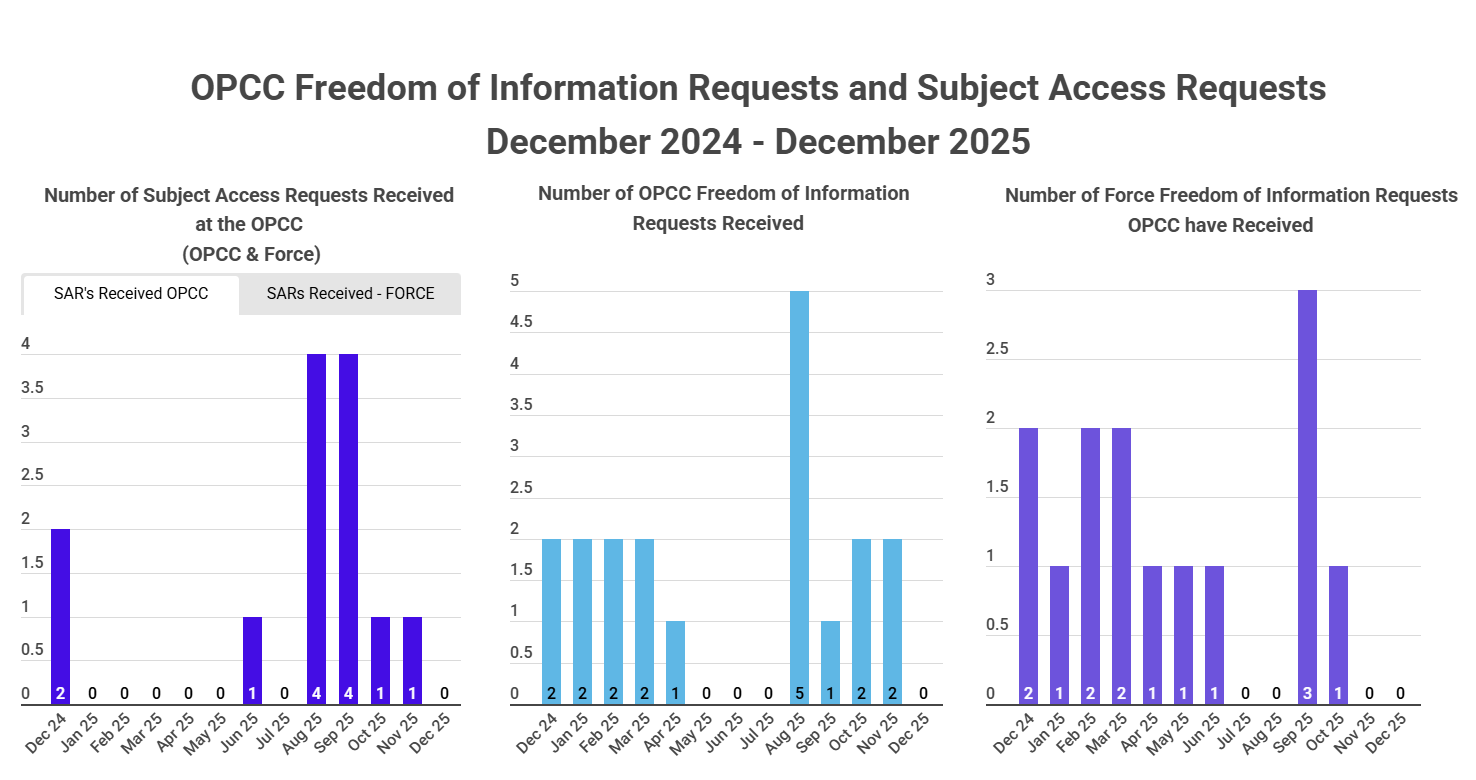
The OPCC has received several Freedom of Information (FOI) and Subject Access Requests (SARs that were intended for Bedfordshire Police. In these cases, the Governance and Transparency team responds by confirming that the OPCC does not hold the requested information, advising that the request should be directed to the Force, and providing the appropriate contact details.
The OPCC also receives FOI and SAR requests that relate specifically to the PCC’s office and completes these in line with statutory requirements. The OPCC is fully aware of its obligations under Data Protection legislation and the Freedom of Information Act, and ensures compliance at all times.
Trends/Patterns
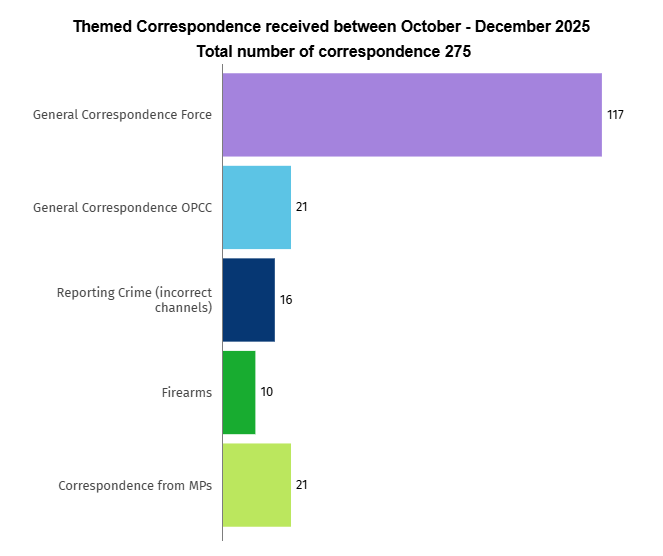
The OPCC had a total of 275 pieces of correspondence which were logged in the last quarter October to December 2025 which is 27 more from the previous quarter.
There have been overarching themes within the correspondence and a breakdown of most frequent contact trends/themes is shown below (excluding SAR/FOI/general correspondence requests).
Quarterly Transparency/Compliance Report Q2 July - September 2025
This report is to inform the reader of the Transparency/Governance obligations of the Office of the Police and Crime Commissioner (OPCC). The OPCC will publish this information on a quarterly basis, to ensure that the public can review the functions of the OPCC. The areas of focus for this report are:
- Professional Standards Department (PSD) Dip Sampling
- Customer Services/Lower Dissatisfaction Dip Sampling
- Chief Constable Complaints
- Reviews
- Independent Custody Visitors (ICVs)
- Legally Qualified Person (LQPs)
- Freedom of Information / Subject Access Requests
- Trends/Patterns received by the OPCC.
Dip Sampling – Schedule 3 complaints – Professional Standards Department
The purpose of the OPCC Dip Sampling Schedule 3 complaints it that it is a critical function to the reputation of Bedfordshire Police that the public has confidence in the complaints system. To this end, both the Chief Constable and the Police and Crime Commissioner have arranged for ‘dip sampling’ to be undertaken of complaints. On a monthly basis, the OPCC will request categories of complaints from the Professional Standards Department and when the files have been received will review them in full.
The categories of complaint are:
|
Complaint Categories & Subcategories |
|
|
A |
Delivery of Duties and Service |
|
A1 Police action following contact / A2 Decisions / A3 Information / A4 General level of service. |
|
|
B |
Police powers, policies, and procedures |
|
B1 Stops, & stop & search / B2 Searches of premises & seizure of property / B3 Power to arrest & detain / B4 Use of force / B5 Detention in police custody / B6 Bail, identification, and interview procedures / B7 Evidential procedures / B8 Out of Court disposals / B9 Other policies and procedures |
|
|
C |
Handling of or damage to property / premises |
|
D |
Access and / or disclosure of information |
|
D1 Use of police systems / D2 Disclosure of information / D3 Handling of information / D4 Accessing and handling of information from other sources. |
|
|
E |
Use of Police Vehicles |
|
F |
Discriminatory behaviour |
|
F1 Age / F2 Disability / F3 Gender Reassignment / F4 Pregnancy & Maternity / F5 Marriage & Civil Partnership / F6 Race / F7 Religion or Belief / F8 Sex / F9 Sexual Orientation / F10 Other
|
|
|
G |
Abuse of Position / Corruption |
|
G1 Organisational corruption / G2 Abuse of position for sexual purpose / G3 Abuse of position for the purpose of pursuing an inappropriate emotional relationship / G4 Abuse of position for financial purpose / G5 Obstruction of justice / G6 Abuse of position for other purpose
|
|
|
H |
Individual Behaviours |
|
H1 Impolite language or tone / H2 Impolite and intolerant actions / H3 Unprofessional attitude and disrespect H4 Lack of fairness and impartiality / H5 Overbearing or harassing behaviours
|
|
|
J |
Sexual Conduct |
|
K |
Discreditable Conduct |
|
L |
Other |
The OPCC will consider such aspects when completing the Dip Sampling:
- Timescales for completion of investigations
- Learning Identified
- Were all allegations covered fully and appropriately?
- Satisfaction
- Was Body Worn Video (BWV) used and was it useful to the complaint?
- Other aspects are considered throughout the process.
The process relates only to the Dip Sampling of closed complaints cases and does not cover either the duty to oversee ongoing complaints or the new wider power of direction of the handling of complaints against the police.
The purpose of Dip Sampling is not to interfere with the review process and decisions made by the Relevant Review Body can only be overturned by the courts through the Judicial Review Process.
Q1 – PSD Dip Sample
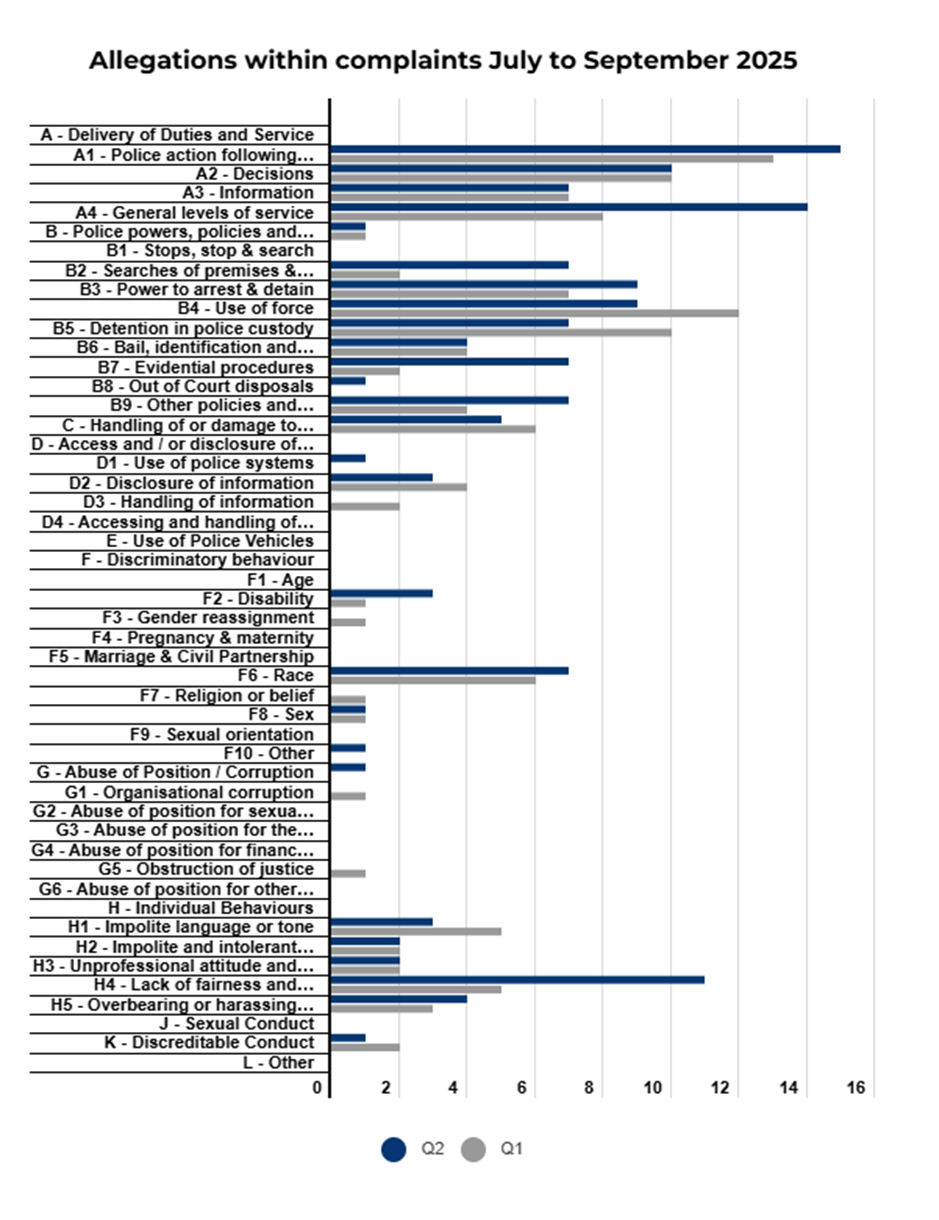
During July - September 2025 48 complaints were dip sampled with a total of 143 allegations made. This is one less complaint than the last quarter, but we’ve seen an increase in allegation (20).
Bedfordshire OPCC dip sampled 9 complaints in July 2025. Within the 9 complaints, 36 allegations were covered.
Bedfordshire OPCC dip sampled 19 complaints in August 2025. Within the 19 complaints, 60 allegations were covered.
Bedfordshire OPCC dip sampled 20 complaints in September 2025. Within the 20 complaints, 47 allegations were covered.
Bedfordshire OPCC believe that all PSD complaints dip sampled have been dealt with in a reasonable and proportionate manner.
Clarification or further information was required on 8 of the 48 PSD dip sampled. Overall, on average that dip sampled PSD took 2.5 months each (which is an improve by 2 weeks each case from the previous quarter) to complete the investigation, with the longest complaint taking 10 months. The average time to acknowledge the complaint was 21 days compared to the previous quarter of 58 days.
30% of those sampled found Service was not/partially not acceptable for all allegations.
The top three categories respectively (remaining same as the previous quarter):
- Police action following contact
- General Level of service
- Lack of fairness and impartiality
The Office of the Police and Crime Commissioner’s Office (OPCC) agreed with any learning identified within the complaint reports and identified additional points including the need to explain acronyms in correspondence to the public.
CRT/Lower Dissatisfaction – Dip Sample
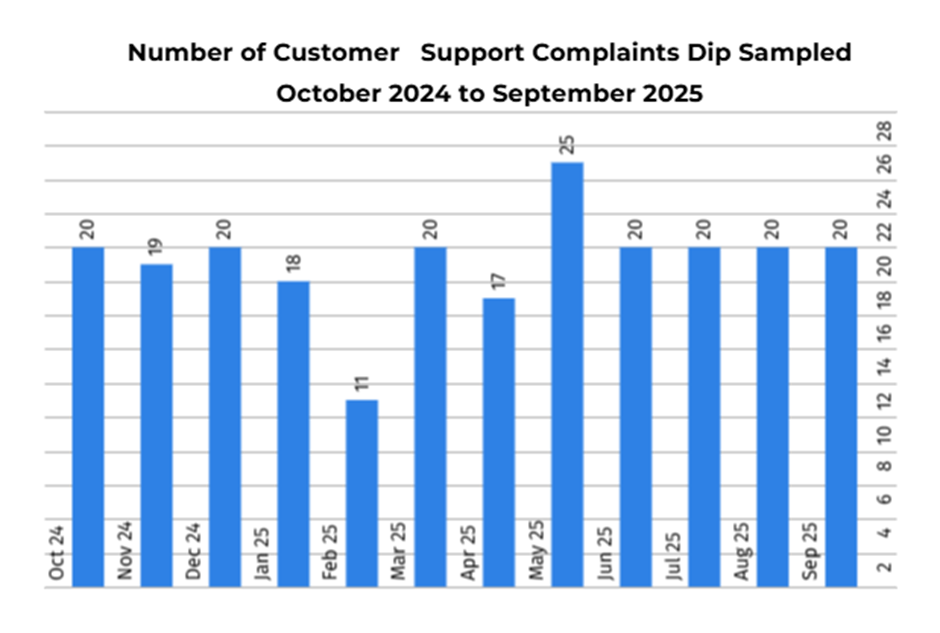
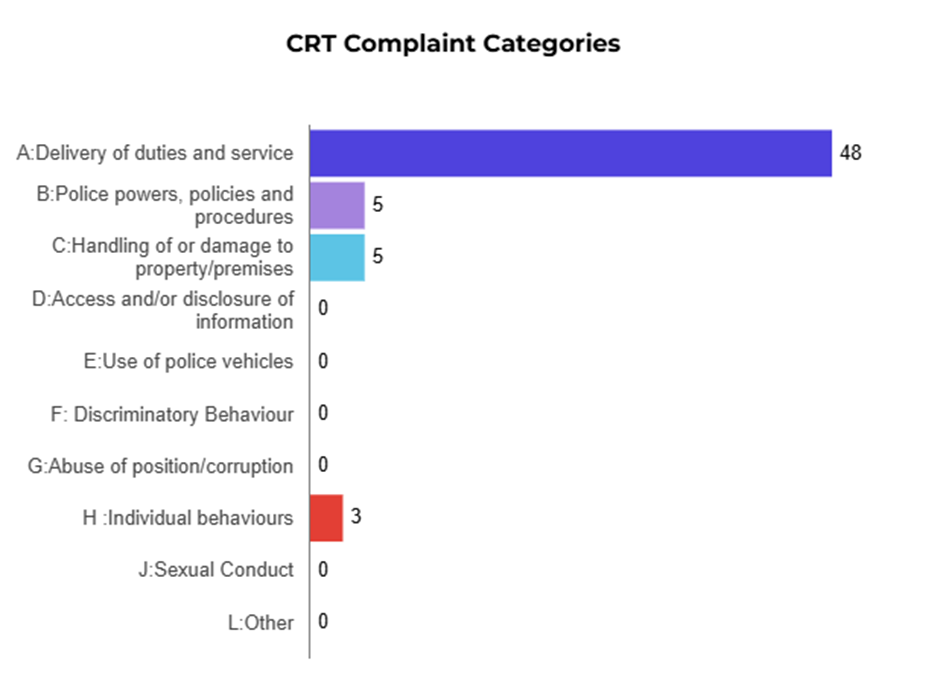
The Governance and Transparency team conduct monthly dip sampling of lower dissatisfaction complaints and hold a monthly meeting with the Customer Support Management team to discuss findings, to ensure feedback is given and fed into future learning.
The Customer Support and dissatisfaction dip sampling commenced in August 2021 and is completed monthly via access to the police force framework.
The OPCC will consider such aspects when completing the Dip Sampling:
- Complaint
- Allegations
- Victims Code of Practice
- Recommendations or actions
- Timescales
The process relates only to the Dip Sampling of closed complaints cases and does not cover those that remain an enquiry.
Chief Constable Complaints
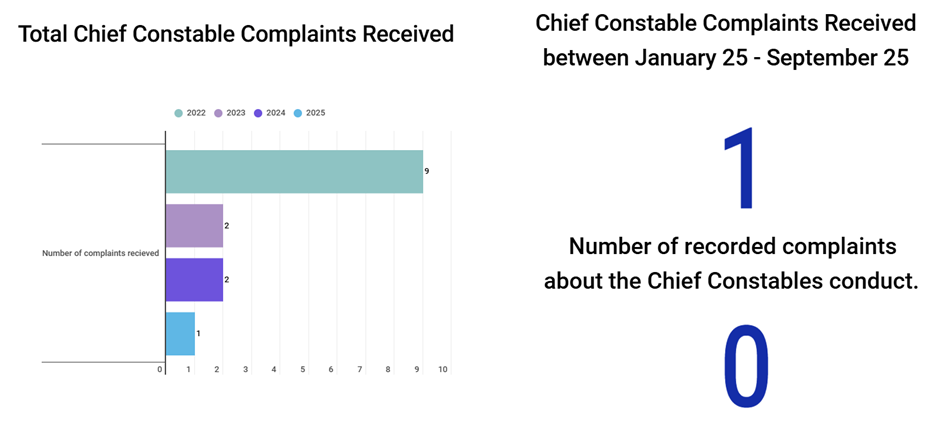
There have been no Chief Constable complaints recorded within the last quarter July to September 2025.
Complainants have contacted the OPCC regarding matters which they deemed to be a complaint against the Chief Constable, however if the complaint is not about the Chief Constables conduct directly, it is not a complaint against the Chief Constable. Complainants believe as the Chief Constable has overall responsibility for the Force, they believe he is accountable, and complaints can be made against him. However, if the OPCC reviews the allegations made against the Chief Constable Trevor Rodenhurst, and on immediate review of your complaint, the complaint is not regarding the conduct of the Chief Constable and that the Chief Constable has not had any personal involvement into the case and delegates such responsibilities to others within the organisation, a complaint will not be recorded.
The IOPC statutory guidance states ‘A.7 There will be times where a complaint names the chief officer or acting chief officer, but the complaint is about something where authority has been delegated to another officer or staff member within the force. Where the local policing body receives a complaint for which is it is not the appropriate authority, they must forward the complaint to the appropriate authority. Therefore, where it is immediately clear that the chief officer or acting chief officer has not been involved, the local policing body must take the steps outlined in paragraphs 6.5 – 6.7. They should explain the reasons for this to the complainant.’
So, all complaints of this nature are forwarded to the Customer Services team of Bedfordshire Police to review and allocate to individuals within the Force.
Reviews
From the 1st of February 2020, the Office of the Police and Crime Commissioner (OPCC) is the relevant review body in most cases, apart from those complaints or conduct matters listed below which the IOPC are responsible for reviewing where they relate to:
- Any incident or circumstance in or in consequence of which a person has died or suffered serious injury.
- A serious sexual assault or offence
- Serious corruption
- Criminal offence or behaviour which is liable to lead to disciplinary proceedings.
If a request to review is submitted to either the IOPC or the OPCC and they are not the correct review body, then they will forward it to the correct review body and notify the complainant that this has happened.
What a review means
A review offers the opportunity to consider whether the complaint outcome is reasonable and proportionate but not the handling of the incident leading to the complaint. Each review will be considered on a case-by-case basis. If the reviewer concludes that the outcome was not reasonable and proportionate, the review should be upheld i.e. the service provided by the police was not acceptable the OPCC will, where appropriate, make recommendation to the Chief Constable of Bedfordshire Police.
Requesting a complaint review
Complainants will have been advised by PSD in their complaint outcome letter if they have the right of review and who is the appropriate review body (either the OPCC or IOPC). The review can only be against the outcome of a formal complaint, i.e., a complaint that has been recorded under the legislation. The right of review does not apply to an informal complaint i.e., one that has not been recorded.
The time frame for requesting a review is 28 days from the date of the letter concluding the complaint.
Before a complaint can be reviewed by the OPCC it must be formally recorded by Bedfordshire Police’s Professional Standards Department (PSD) under Schedule 3 of the Police Reform Act 2002.
This is different to having an expression of dissatisfaction dealt with/logged by the Force through their Customer Support team and which has not been recorded under Schedule 3.
Complaints recorded under Schedule 3 will be handled and investigated by the Force or the IOPC (depending on the severity of the allegation).
The Police and Crime Commissioner nor the OPCC can get involved at this stage or investigate the original incident leading to the complaint being made as this could potentially compromise any future request by the complainant to review.
Bedfordshire Police having concluded their investigation of the complaint, will inform the complainant of the outcome, including information about the right to apply for a review, who is the appropriate review body (either the OPCC or IOPC).
Should the complainant wish to request a review, then an application for a review must be in writing and state the following:
- the details of the complaint.
- the date on which the complaint was made.
- the name of the force or local policing body whose decision is the subject of the application.
- the date on which the complainant was provided with the details about their right of review at the conclusion of the investigation or other handling of their complaint.
- the complaint reference number on the outcome letter from PSD.
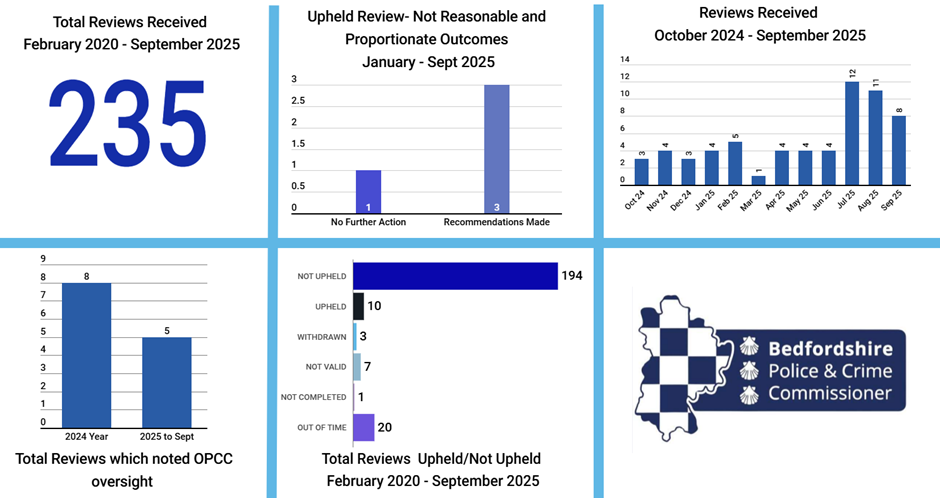
Due to the changes in the Specified information Order – the OPCC needs to ensure that review information is readily available.
Independent Custody Visitors
Under the Police Reform Act 2002, as amended by the Police Reform & Social Responsibility Act 2011, the Local Policing Body has a statutory duty to establish and maintain an Independent Custody Visiting Scheme, which involves volunteer members of the public visiting police stations to check and report on the treatment of detainees, the conditions in which they are held and that their rights and entitlements are being observed. The scheme offers protection and confidentiality to detainees, the police and provides reassurance to the wider community.
There are two dedicated Police Custody Suites in Bedfordshire. These are located in Kempston with 22 cells and Luton with 21 cells.
The purpose of Independent Custody Visiting is to provide assurance that detainees in Bedfordshire Police Custody are:
- Treated fairly and in accordance with the Police and Criminal Evidence Act 1984 (PACE) and associated codes of practice
- That the conditions detainees are kept in are clean and safe and any matters of concern are recorded and dealt with effectively.
- That the rights and entitlements of detainees in Bedfordshire Police Custody are observed and adhered to.
Independent Custody Visitors are members of the local community who, working in pairs, call at Police Stations unannounced at any time. With agreement, the visitors can speak to detainees about their treatment or conditions and take up any issues of concern with custody staff. A short report of their findings is made prior to leaving the station. Their work provides the PCC (and in turn the local community) with assurance that anyone arrested by the police and held in custody is treated fairly and has access to appropriate facilities.
Bedfordshire ICV Scheme has 23 ICVs as of June 2025. They conducted a total of 21 visits, checking the welfare of 103 detainees. Recruitment is on going.
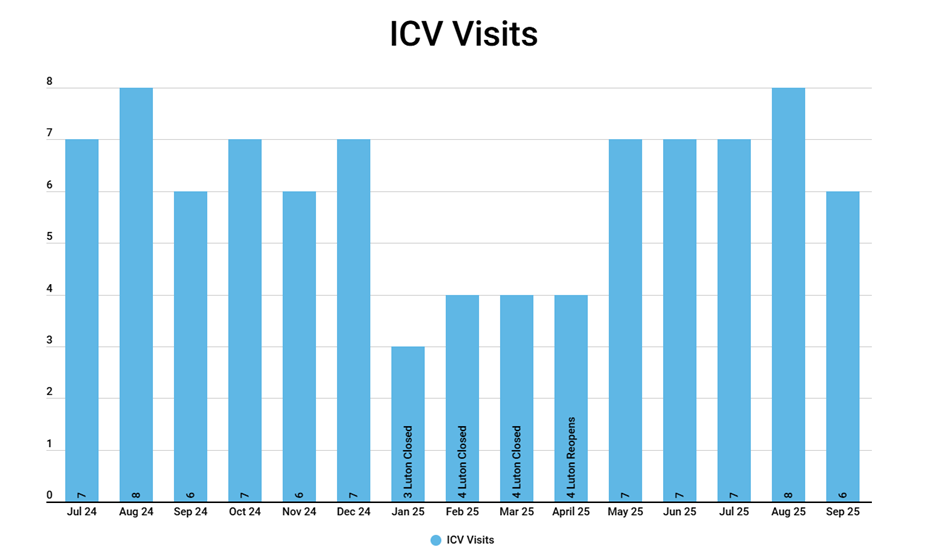
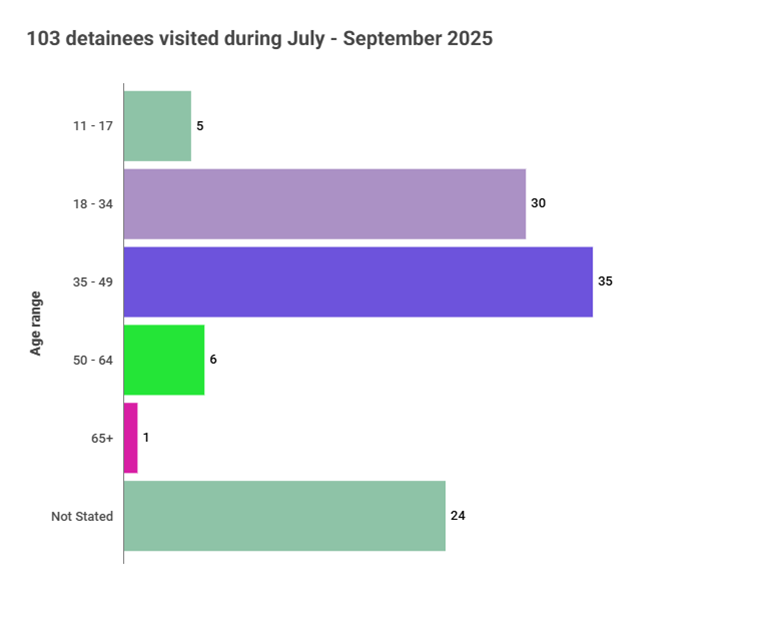
Showing the number of detainees
Points to note that have been raised during the visits:
- Highlighted estates issues.
- After speaking with detainees, ICVs found that some were unable to pray as they were unaware of the available shower facilities.
- Affray corridors are being treated again for infestations – Still under review
Good practice:
- ICVs have praised staff within custody as they are very helpful and responsive to requests.
- The suite was calm and orderly.
Legally Qualified Chairs and Current Legislation
Following a public consultation led by the Home Secretary in autumn 2014, reforms were introduced to the police disciplinary system to enhance transparency, independence, and justice. One key change was the requirement for police misconduct hearings to be held in public, effective from May 2015.
Purpose of Misconduct Hearings
Police Misconduct Hearing Panels are convened to consider serious allegations of misconduct by police officers. These may include:
- Criminal offences
- Serious road traffic matters (e.g., drink/driving)
- Significant breaches of the Standards of Professional Behaviour, such as neglect of duty
Panels may also be convened under performance regulations, where dismissal may result from unsatisfactory performance or attendance.
Governing Legislation
All misconduct hearings are governed by the Police (Conduct) Regulations 2020. However:
- Cases where investigations began before 1 February 2020 will be heard under the Police (Conduct) Regulations 2012, as amended in 2014 and 2015.
- In such cases, the Legally Qualified Chair (LQC) will be advised of the applicable regulations.
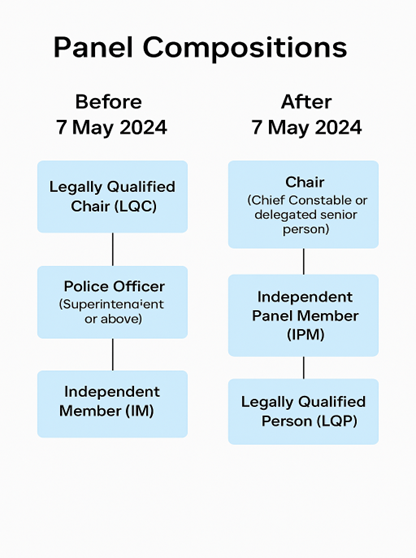
Panel Composition – Post 7 May 2024
For hearings commenced after 7 May 2024, the panel will consist of:
- Chair: Chief Constable or a delegated senior officer
- Two Independent Panel Members (IPMs): Both with relevant experience; no distinction in role or remuneration
- Legally Qualified Person (LQP): A non-decision-making advisor (also referred to as a Legally Qualified Advisor (LQA)) who provides legal guidance to the panel
This marks a shift from the previous model where the LQC was the decision-making chair.
Panel Composition – Pre 7 May 2024
For hearings formed prior to 7 May 2024, and during the transition period, panels will consist of:
- Legally Qualified Chair (LQC): Decision-making authority
- Police Officer: Of at least Superintendent rank
- Independent Panel Member (IPM)
Police Appeals Tribunal (PAT)
The PAT panel composition is governed by the Police (Conduct) (Amendment) Regulations 2024, Regulation 3(4B), and includes:
- Chair: Appointed from a list maintained by the Home Secretary
- Senior Officer: Assistant Chief Constable (ACC) or above
- Third Member: Either:
- A former senior officer (retired within the last 5 years)
- A police staff member deemed by the Chief Officer to be of equivalent seniority
Appointment Authority
The Office of the Police and Crime Commissioner (OPCC) is responsible for appointing:
- Legally Qualified Persons (LQPs)
- Independent Members (IMs)
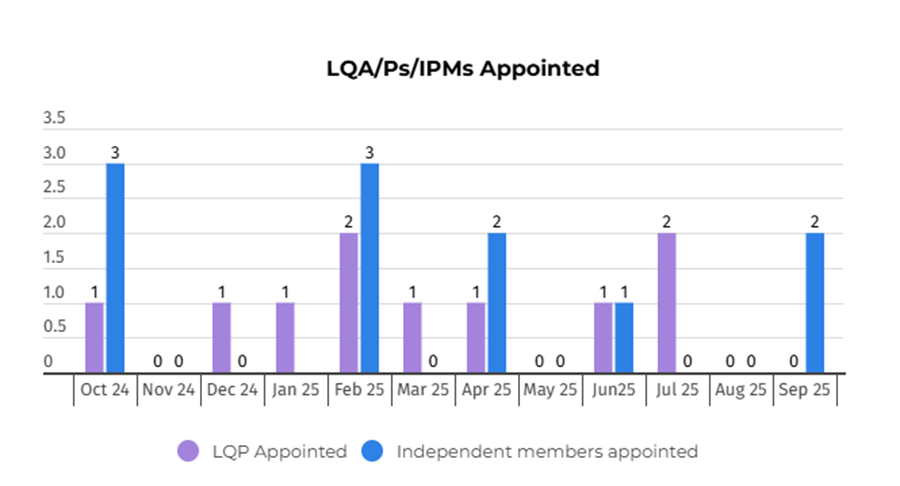
In line with the PCC’s transparency pledge, the OPCC publishes figures showing the number of appointments made.
Freedom of Information/Subject Access Requests
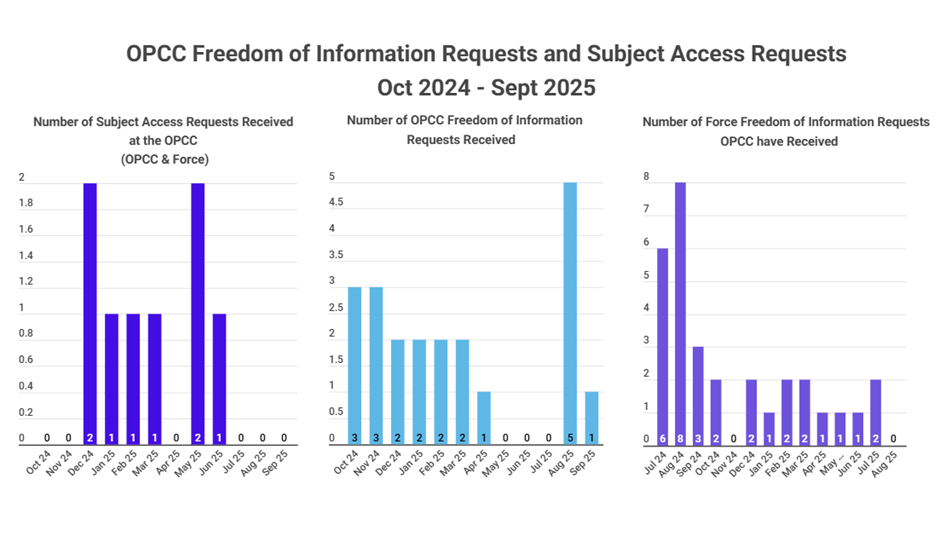
The OPCC have received several Freedom of Information and Subject Access Requests which were meant to be for the Force. The Governance and Transparency team respond to all requests for Force information, advising that we do not hold the information and that it must be requested from the Force directly, as well as providing the contact information.
The OPCC has a dedicated website page in which it clearly explains that the OPCC does not hold and cannot access Force data/information.
Consideration needs to be given regarding communication to the public as to the process on where information is requested from.
Trends/Patterns
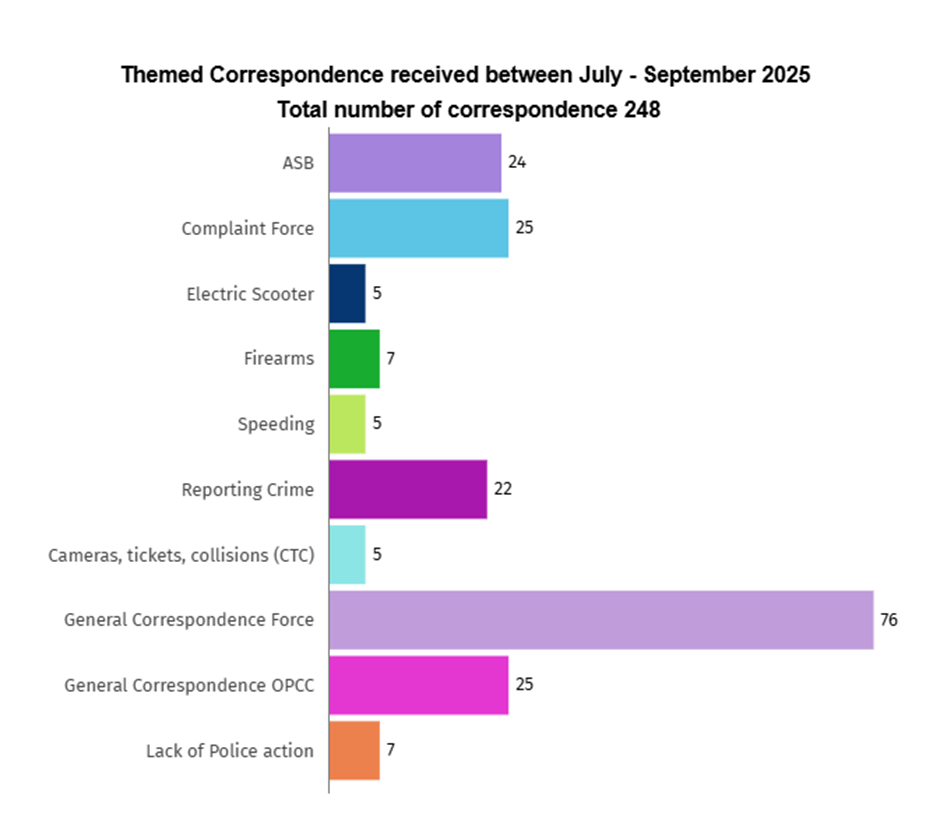
The OPCC had a total of 248 pieces of correspondence which were logged in last quarter July to September 2025 which is comparative as the previous quarter 1.
There have been overarching themes within the correspondence and a breakdown of most frequent contact trends/themes is shown below (excluding SAR/FOI/general correspondence requests).
All complaints are forwarded to Bedfordshire Police Customer Support Team. The role of the Customer Support Team is to initially handle the complaint. They will be in contact with the complainant at the earliest opportunity where they will gather information in regard to the complaint to fully understand it.
The Policing and Crime Act 2017: changes to the police complaints system
Legislation changed in February 2020 to ensure that matters can be dealt with at the most appropriate level, supporting both the efficiency and fairness of the complaints system. There is still provision for the most serious matters to be investigated independently. Below that level there are a wide range of complaints that are most appropriately dealt with by the police themselves. The changes allow for certain types of complaints to be resolved outside the requirements of Schedule 3 to the Police Reform Act 2002, while those that have been recorded may be handled reasonably and proportionately otherwise than by investigation, by investigation, or, in some circumstances, no further action may be taken. This allows for the police to quickly learn from, and make improvements based on, the complaints they handle.
All local policing bodies have certain duties in relation to the handling of complaints. They can also choose to take on responsibility for certain additional functions that would otherwise sit with the chief officer:
- Model 1 (mandatory): all local policing bodies have responsibility for carrying out reviews where they are the relevant review body.
- Model 2 (optional): in addition to the responsibilities under model 1, a local policing body can choose to assume responsibility for making initial contact with complainants, handling complaints outside of Schedule 3 to the Police Reform Act 2002 and recording complaints.
- Model 3 (optional): a local policing body that has adopted model 2 can additionally choose to assume responsibility for keeping complainants and interested persons properly informed of the progress of the handling and outcome of their complaint.
Local policing bodies do not become the appropriate authority for the complaint under any of the above models. Rather, in the case of models 2 and 3, they perform some of the functions that the chief officer would otherwise carry out as the appropriate authority.
Bedfordshire’s OPCC has adopted Model 1, which is the mandatory level.
All complaints functions will remain within the Police Force (except for complaints made against the Chief Constable which are reviewed by the OPCC). The Force has set up a Customer Support Team (CST) which is looking after the initial complaints function. No complaints will now be received directly to the Professional Standards Department (PSD), they will be triaged by the CST on the severity of the complaint.
If complaints meet the threshold for severity, they will be passed on to the PSD for investigation. However, if they are lower-level complaints which can be dealt with outside of the schedule 3 complaints legislation, the CST will deal with and log on to the CRT Database for complaints.
The Office of the Police and Crime Commissioner (OPCC) is unable to investigate complaints against Bedfordshire Police or individual members of staff. This falls to the operational management of Bedfordshire Police. Individual complaints should, therefore, be directed in the first instance to Bedfordshire Police.
Bedfordshire Police deal with all complaints against police officers below the rank of Chief Constable, all police staff, and the Special Constabulary. For minor matters that can be resolved quickly and simply, a supervisor can usually deal with your complaint. More serious matters, however, are referred to the Professional Standards Department, who will oversee the process. Some matters, due to their nature or seriousness, are referred to the Independent Office of Police Conduct (IOPC).
There is a reduction of correspondence being received from last year, however the OPCC believe this is due to the OPCC message being received that we are unable to influence operational policing decisions or investigate any complaints, except for the Chief Constable.
Quarterly Transparency/Compliance Report Q1 April - June 2025
This report is to inform the reader of the Transparency/Governance obligations of the Office of the Police and Crime Commissioner (OPCC). The OPCC will publish this information on a quarterly basis, to ensure that the public can review the functions of the OPCC. The areas of focus for this report are:
- Professional Standards Department (PSD) Dip Sampling
- Customer Services/Lower Dissatisfaction Dip Sampling
- Chief Constable Complaints
- Reviews
- Independent Custody Visitors (ICVs)
- Legally Qualified Chairs (LQCs)
- Freedom of Information / Subject Access Requests
- Trends/Patterns received by the OPCC.
Dip Sampling – Schedule 3 complaints – Professional Standards Department
The purpose of the OPCC Dip Sampling Schedule 3 complaints it that it is a critical function to the reputation of Bedfordshire Police that the public has confidence in the complaints system. To this end, both the Chief Constable and the Police and Crime Commissioner have arranged for ‘dip sampling’ to be undertaken of complaints. On a monthly basis, the OPCC will request categories of complaints from the Professional Standards Department and when the files have been received will review them in full.
The categories of complaint are:
|
Complaint Categories & Subcategories
|
|
|
A |
Delivery of Duties and Service |
|
A1 Police action following contact / A2 Decisions / A3 Information / A4 General level of service.
|
|
|
B |
Police powers, policies, and procedures |
|
B1 Stops, & stop & search / B2 Searches of premises & seizure of property / B3 Power to arrest & detain /
B4 Use of force / B5 Detention in police custody / B6 Bail, identification, and interview procedures /
B7 Evidential procedures / B8 Out of Court disposals / B9 Other policies and procedures
|
|
|
C |
Handling of or damage to property / premises |
|
D |
Access and / or disclosure of information |
|
D1 Use of police systems / D2 Disclosure of information / D3 Handling of information /
D4 Accessing and handling of information from other sources.
|
|
|
E |
Use of Police Vehicles |
|
F |
Discriminatory behaviour |
|
F1 Age / F2 Disability / F3 Gender Reassignment / F4 Pregnancy & Maternity / F5 Marriage & Civil Partnership /
F6 Race / F7 Religion or Belief / F8 Sex / F9 Sexual Orientation / F10 Other
|
|
|
G |
Abuse of Position / Corruption |
|
G1 Organisational corruption / G2 Abuse of position for sexual purpose /
G3 Abuse of position for the purpose of pursuing an inappropriate emotional relationship / G4 Abuse of position for financial purpose / G5 Obstruction of justice / G6 Abuse of position for other purpose
|
|
|
H |
Individual Behaviours |
|
H1 Impolite language or tone / H2 Impolite and intolerant actions / H3 Unprofessional attitude and disrespect
H4 Lack of fairness and impartiality / H5 Overbearing or harassing behaviours
|
|
|
J |
Sexual Conduct |
|
K |
Discreditable Conduct |
|
L |
Other |
The OPCC will consider such aspects when completing the Dip Sampling:
- Timescales for completion of investigations
- Learning Identified
- Were all allegations covered fully and appropriately?
- Satisfaction
- Was Body Worn Video (BWV) used and was it useful to the complaint?
- Other aspects are considered throughout the process.
The process relates only to the Dip Sampling of closed complaints cases and does not cover either the duty to oversee ongoing complaints or the new wider power of direction of the handling of complaints against the police.
The purpose of Dip Sampling is not to interfere with the review process and decisions made by the Relevant Review Body can only be overturned by the courts through the Judicial Review Process.
Q1 – PSD Dip Sample
During April – June 2025 49 complaints were dip sampled with a total of 123 allegations made.
Bedfordshire OPCC dip sampled 18 complaints in April 2025. Within the 18 complaints, 44 allegations were covered.
Bedfordshire OPCC dip sampled 17 complaints in May 2025. Within the 17 complaints, 60 allegations were covered.
Bedfordshire OPCC dip sampled 13 complaints in June 2025. Within the 13 complaints, 21 allegations were covered.
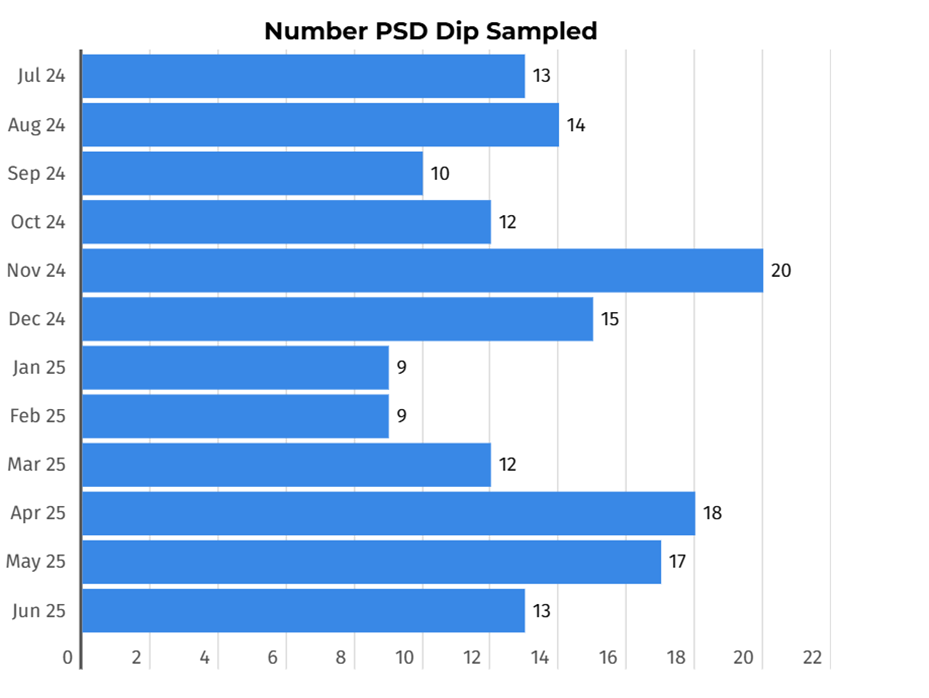
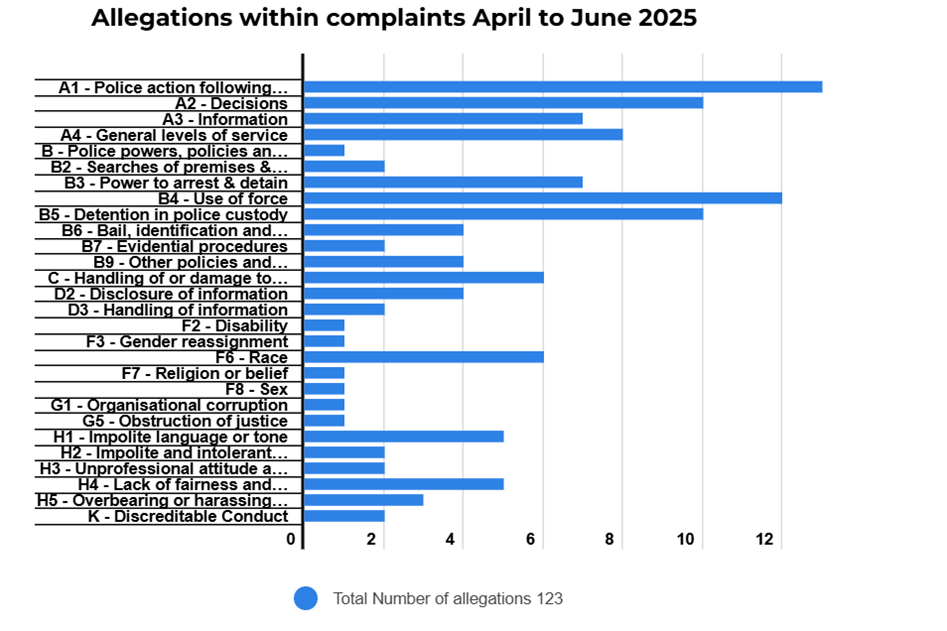
Bedfordshire OPCC believe that all PSD complaints dip sampled have been dealt with in a reasonable and proportionate manner.
Clarification or further information was required on 18 of the 49 PSD dip sampled. Overall, on average those dip sampled PSD took just over 3 months each (which is comparative from the previous quarter) to complete the investigation, with the longest complaint taking 11 months. The average time to acknowledge the complaint was 58 days compared to the previous quarter of 43 days.
30% of those sampled found Service was not/partially not acceptable for all allegations.
The top three categories respectively (remaining same as the previous quarter):
- General Level of service
- Use of Force
- Detention in police custody
The Office of the Police and Crime Commissioner’s Office (OPCC) agreed with any learning identified within the complaint reports and identified additional points including the need to explain acronyms in correspondence to the public.
CRT/Lower Dissatisfaction – Dip Sample
The Governance and Transparency team conduct monthly dip sampling of lower dissatisfaction complaints and hold a monthly meeting with the Customer Support Management team to discuss findings, to ensure feedback is given and fed into future learning.
The Customer Support and dissatisfaction dip sampling commenced in August 2021 and is completed monthly via access to the police force framework.
The OPCC will consider such aspects when completing the Dip Sampling:
- Complaint
- Allegations
- Victims Code of Practice
- Recommendations or actions
- Timescales
The process relates only to the Dip Sampling of closed complaints cases and does not cover those that remain an enquiry.
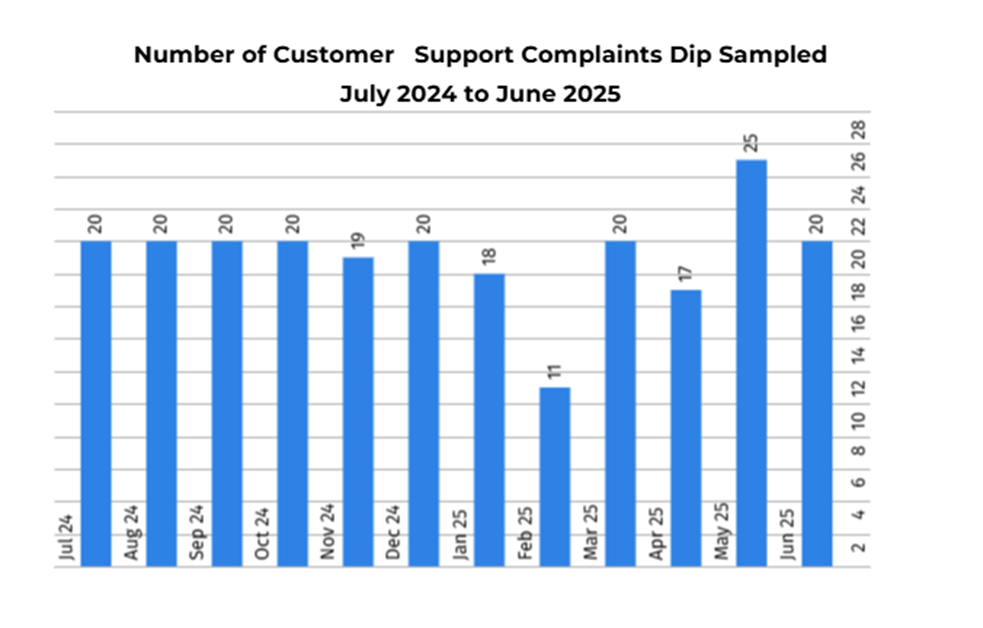
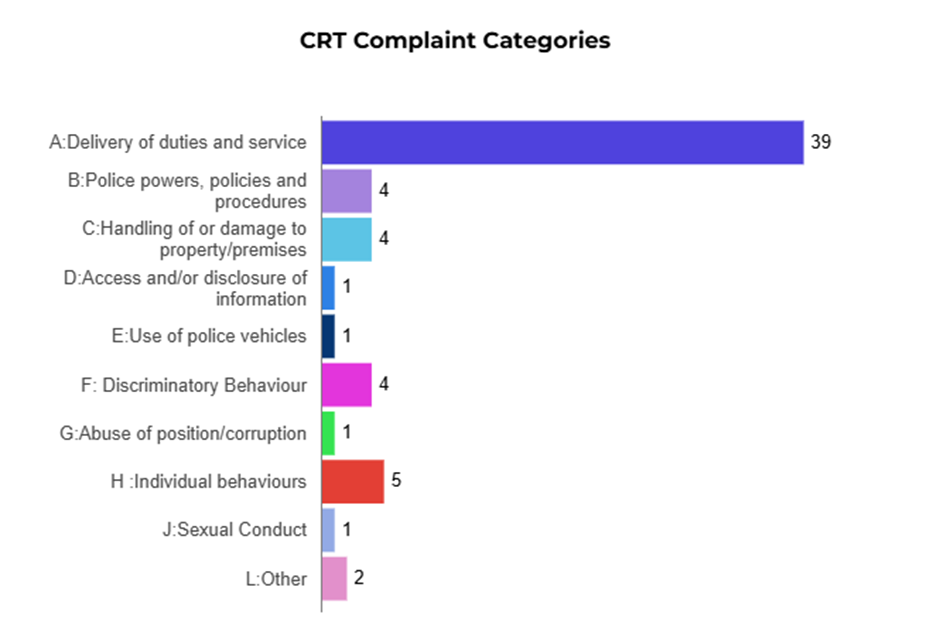
Chief Constable Complaints
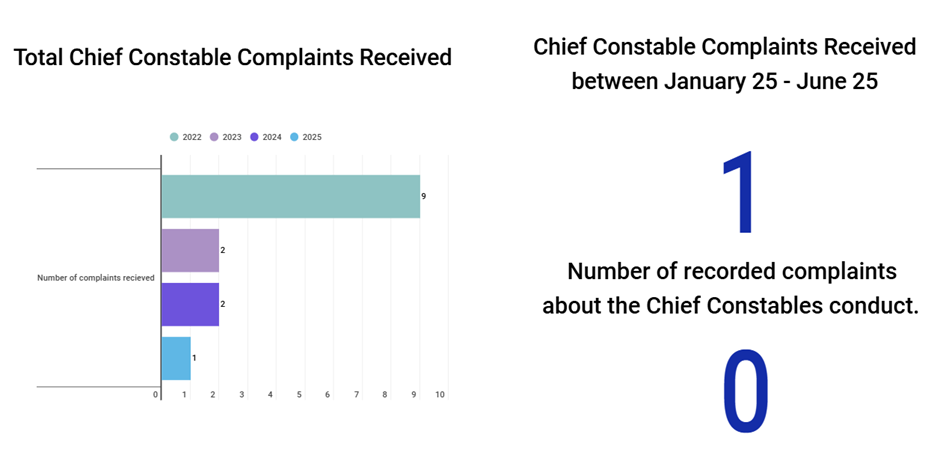
One Chief Constable complaints has been recorded within the last quarter: April to June 2025.
Complainants have contacted the OPCC regarding matters which they deemed to be a complaint against the Chief Constable, however if the complaint is not about the Chief Constables conduct directly, it is not a complaint against the Chief Constable. Complainants believe as the Chief Constable has overall responsibility for the Force, they believe he is accountable, and complaints can be made against him. However, if the OPCC reviews the allegations made against the Chief Constable Trevor Rodenhurst, and on immediate review of your complaint, the complaint is not regarding the conduct of the Chief Constable and that the Chief Constable has not had any personal involvement into the case and delegates such responsibilities to others within the organisation, a complaint will not be recorded.
The IOPC statutory guidance states ‘A.7 There will be times where a complaint names the chief officer or acting chief officer, but the complaint is about something where authority has been delegated to another officer or staff member within the force. Where the local policing body receives a complaint for which is it is not the appropriate authority, they must forward the complaint to the appropriate authority. Therefore, where it is immediately clear that the chief officer or acting chief officer has not been involved, the local policing body must take the steps outlined in paragraphs 6.5 – 6.7. They should explain the reasons for this to the complainant.’
So, all complaints of this nature are forwarded to the Customer Services team of Bedfordshire Police to review and allocate to individuals within the Force.
Reviews
From the 1st of February 2020, the Office of the Police and Crime Commissioner (OPCC) is the relevant review body in most cases, apart from those complaints or conduct matters listed below which the IOPC are responsible for reviewing where they relate to:
- Any incident or circumstance in or in consequence of which a person has died or suffered serious injury.
- A serious sexual assault or offence
- Serious corruption
- Criminal offence or behaviour which is liable to lead to disciplinary proceedings.
If a request to review is submitted to either the IOPC or the OPCC and they are not the correct review body, then they will forward it to the correct review body and notify the complainant that this has happened.
What a review means
A review offers the opportunity to consider whether the complaint outcome is reasonable and proportionate but not the handling of the incident leading to the complaint. Each review will be considered on a case-by-case basis. If the reviewer concludes that the outcome was not reasonable and proportionate, the review should be upheld i.e. the service provided by the police was not acceptable the OPCC will, where appropriate, make recommendation to the Chief Constable of Bedfordshire Police.
Requesting a complaint review
Complainants will have been advised by PSD in their complaint outcome letter if they have the right of review and who is the appropriate review body (either the OPCC or IOPC). The review can only be against the outcome of a formal complaint, i.e., a complaint that has been recorded under the legislation. The right of review does not apply to an informal complaint i.e., one that has not been recorded.
The time frame for requesting a review is 28 days from the date of the letter concluding the complaint.
Before a complaint can be reviewed by the OPCC it must be formally recorded by Bedfordshire Police’s Professional Standards Department (PSD) under Schedule 3 of the Police Reform Act 2002.
This is different to having an expression of dissatisfaction dealt with/logged by the Force through their Customer Support team and which has not been recorded under Schedule 3.
Complaints recorded under Schedule 3 will be handled and investigated by the Force or the IOPC (depending on the severity of the allegation).
The Police and Crime Commissioner nor the OPCC can get involved at this stage or investigate the original incident leading to the complaint being made as this could potentially compromise any future request by the complainant to review.
Bedfordshire Police having concluded their investigation of the complaint, will inform the complainant of the outcome, including information about the right to apply for a review, who is the appropriate review body (either the OPCC or IOPC).
Should the complainant wish to request a review, then an application for a review must be in writing and state the following:
- the details of the complaint.
- the date on which the complaint was made.
- the name of the force or local policing body whose decision is the subject of the application.
- the date on which the complainant was provided with the details about their right of review at the conclusion of the investigation or other handling of their complaint.
- the complaint reference number on the outcome letter from PSD.
Due to the changes in the Specified information Order – the OPCC needs to ensure that review information is readily available.
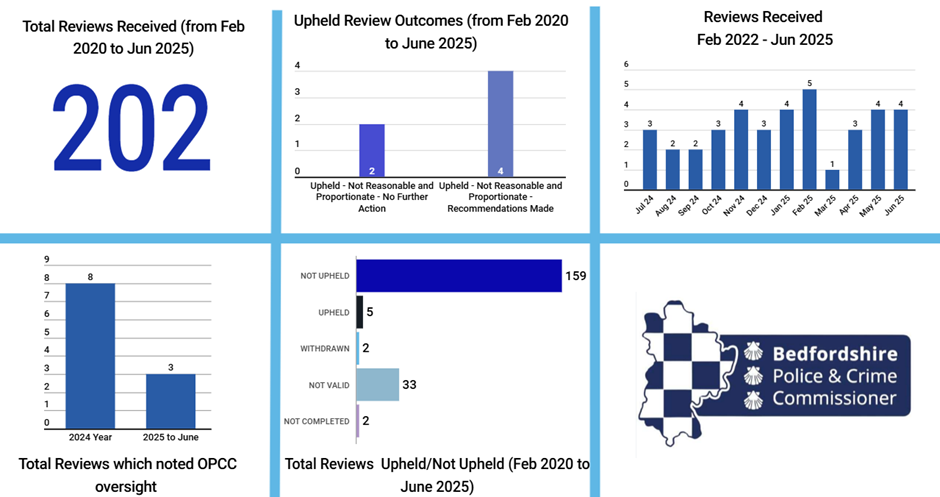
Independent Custody Visitors
Under the Police Reform Act 2002, as amended by the Police Reform & Social Responsibility Act 2011, the Local Policing Body has a statutory duty to establish and maintain an Independent Custody Visiting Scheme, which involves volunteer members of the public visiting police stations to check and report on the treatment of detainees, the conditions in which they are held and that their rights and entitlements are being observed. The scheme offers protection and confidentiality to detainees, the police and provides reassurance to the wider community.
There are two dedicated Police Custody Suites in Bedfordshire. These are located in Kempston with 22 cells and Luton with 21 cells.
The purpose of Independent Custody Visiting is to provide assurance that detainees in Bedfordshire Police Custody are:
- Treated fairly and in accordance with the Police and Criminal Evidence Act 1984 (PACE) and associated codes of practice
- That the conditions detainees are kept in are clean and safe and any matters of concern are recorded and dealt with effectively.
- That the rights and entitlements of detainees in Bedfordshire Police Custody are observed and adhered to.
Independent Custody Visitors are members of the local community who, working in pairs, call at Police Stations unannounced at any time. With agreement, the visitors can speak to detainees about their treatment or conditions and take up any issues of concern with custody staff. A short report of their findings is made prior to leaving the station. Their work provides the PCC (and in turn the local community) with assurance that anyone arrested by the police and held in custody is treated fairly and has access to appropriate facilities.
Bedfordshire ICV Scheme has 26 ICVs as of June 2025. They conducted a total of 21 visits, checking the welfare of 132 detainees.
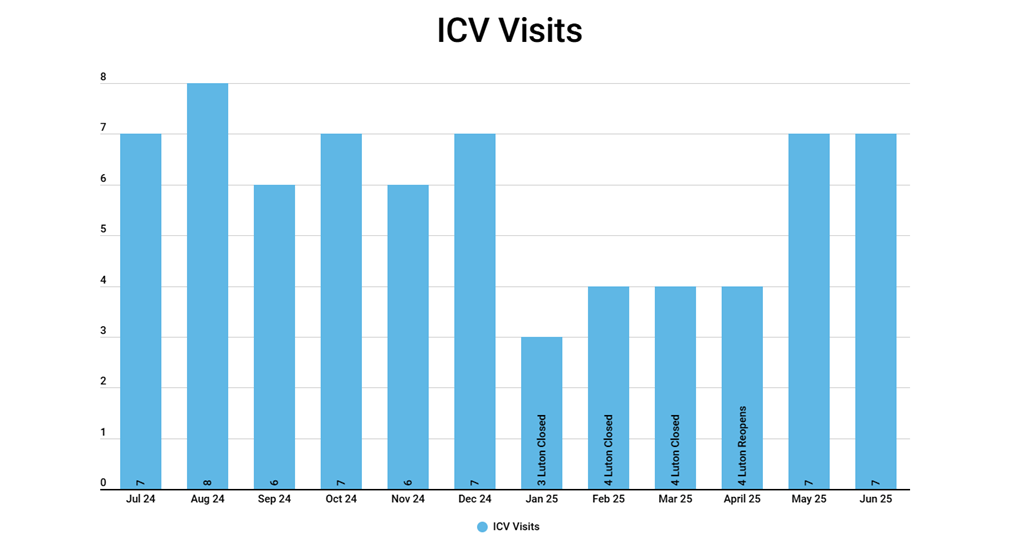
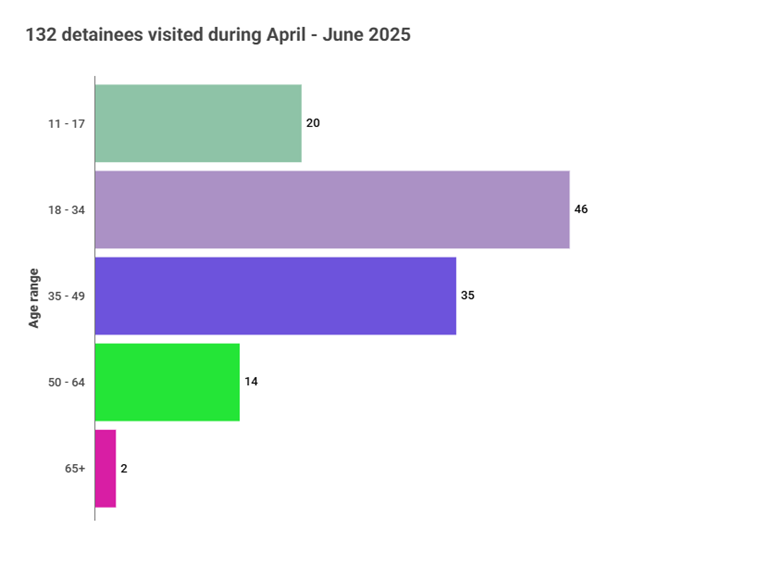
Points to note that have been raised during the visits:
- Religious materials not stored correctly in Kempston.
- Reading material required (various languages) as well as younger material.
- Affray corridors are being treated again for infestations.
Good practice:
- ICVs have praised staff within custody as they are very helpful and responsive to requests.
- The suite was calm and orderly. Everything was running smoothly despite the workload
Legally Qualified Chairs
Following a public consultation led by the Home Secretary in the autumn of 2014, changes were made to the police disciplinary system for the purposes of more transparency, independence, and justice. These included holding police misconduct hearings in public (from May 2015).
The Police Misconduct Hearing Panel is likely to be convened to hear allegations of serious cases of misconduct by police officers. The maximum outcome at this hearing would be dismissal from the police service without notice. Cases would include for example, allegations of criminal acts, serious road traffic matters such as drink/driving and other serious breaches of the standards of professional behaviour expected of police officers such as neglect of duty.
Misconduct Hearings could also be convened to consider the final stages of action under performance regulations, where police officers can be dismissed for unsatisfactory performance or attendance.
The Misconduct Hearing Panels will hear cases governed by the Police (Conduct) Regulations 2020. For the purposes of this Handbook, all references will be to the 2020 regulations. (It should be noted that cases where investigations commenced prior to 1st February 2020 will be heard under the Police (Conduct) Regulations 2012 (amended by Police (Conduct) (Amendment) Regulations 2014 and 2015). Should this be the case an LQC will be advised of the relevant regulations to be applied.)
For misconduct hearings[1] commenced after 7 May 2024, panels will consist of three persons: The Chair (Chief Constable or delegated senior person), an IPM with relevant experience, and a second IPM. There is no difference between the two IPMs in terms of responsibility or payments. There is also the appointment of a non-decision making Legally Qualified Person (LQP), sometimes referred to as a Legally Qualified Advisor (LQA) to provide guidance to the panel.
For those hearings that were formed prior to 7 May 2024, until the end of the transition period, they will consist of a Legally Qualified Chair (LQC), a police officer of at least Superintendent Rank and an IPM.
In relation to a Police Appeals Tribunal, the panel when formed, consists of a Chair drawn from a list appointed by the Home Secretary, a senior officer and above, and an
The Police (Conduct) (Amendment) Regulations 2024, Regulation 3 (4B) (a) a senior officer (ACC and above); (b) a former senior officer, who last served as a senior officer no more than five years, a police staff member who, in the opinion of the chief officer of police, is of at least a similar level of seniority to a senior officer.
The Hearing Panels consist of three persons: The Legally Qualified Chair (LQC), a police officer of the rank of superintendent or above, and an independent member (IM).
The OPCC is the authority to appoint LQCs and IMs and in line with the transparency pledge made by the PCC the OPCC the figures below show the numbers that have been appointed.
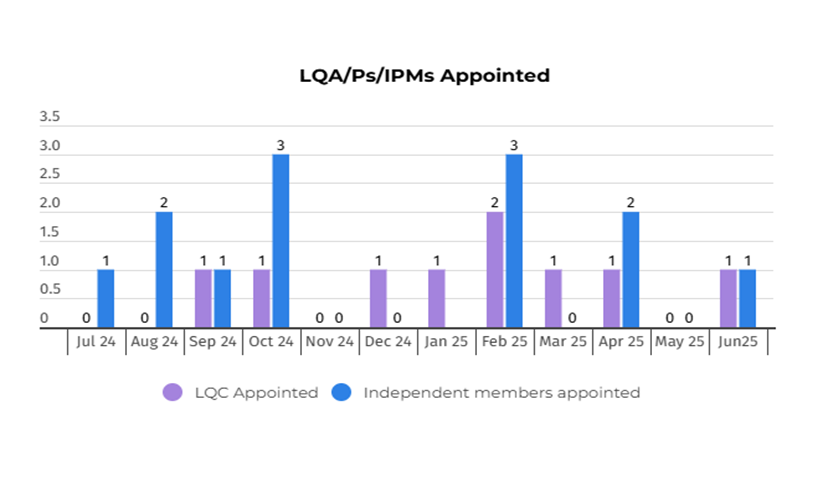
Freedom of Information/Subject Access Requests
The OPCC have received several Freedom of Information and Subject Access Requests which were meant to be for the Force. The Governance and Transparency team respond to all requests for Force information, advising that we do not hold the information and that it must be requested from the Force directly, as well as providing the contact information.
The OPCC has a dedicated website page in which it clearly explains that the OPCC does not hold and cannot access Force data/information.
Consideration needs to be given regarding communication to the public as to the process on where information is requested from.
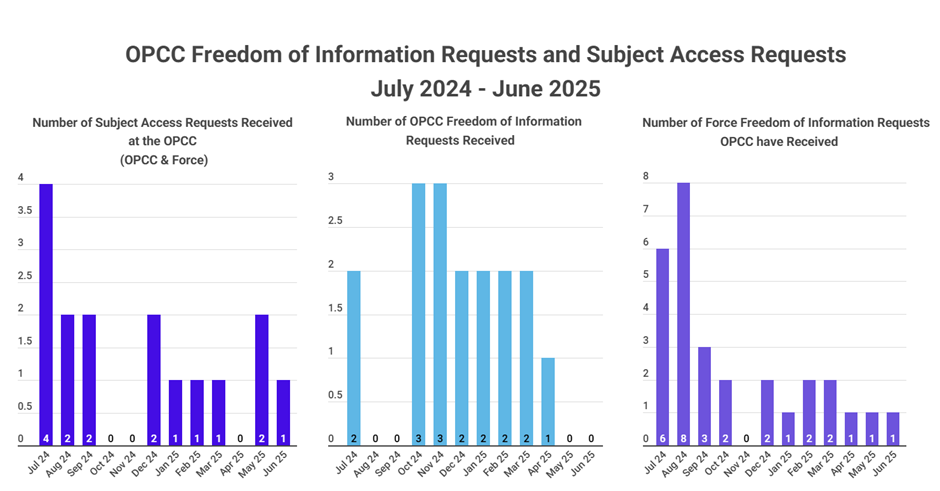
Trends/Patterns
The OPCC had a total of 245 pieces of correspondence which were logged in last quarter April to June 2025 which is the same as the previous quarter 4.
There have been overarching themes within the correspondence and a breakdown of most frequent contact trends/themes is shown below (excluding SAR/FOI/general correspondence requests).
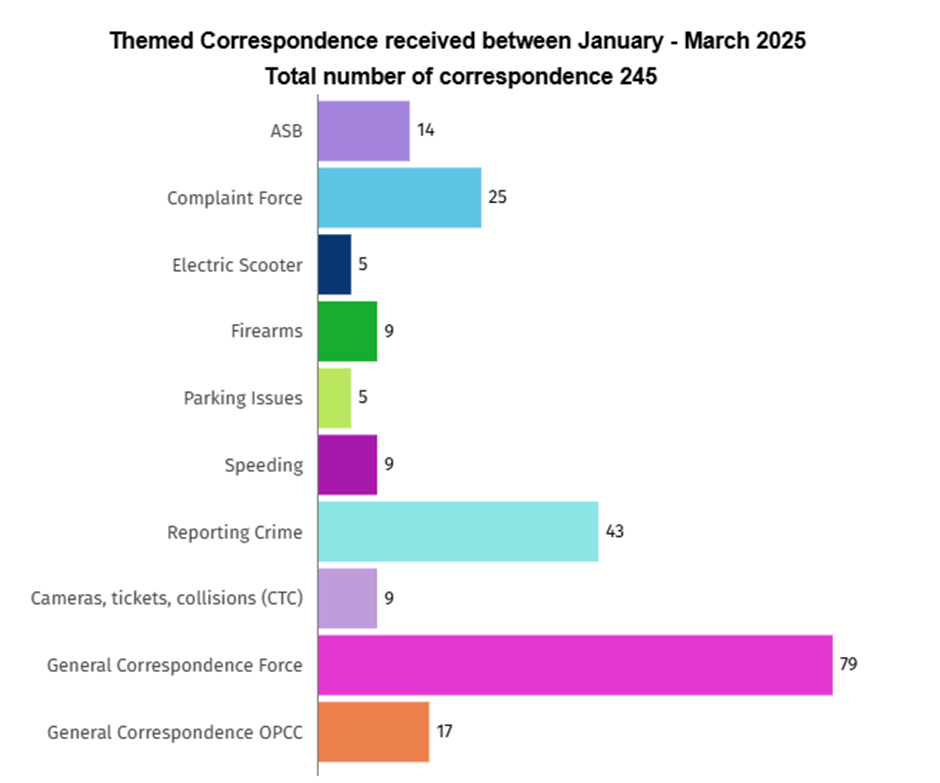
All complaints are forwarded to Bedfordshire Police Customer Support Team. The role of the Customer Support Team is to initially handle the complaint. They will be in contact with the complainant at the earliest opportunity where they will gather information in regard to the complaint to fully understand it.
The Policing and Crime Act 2017: changes to the police complaints system
Legislation changed in February 2020 to ensure that matters can be dealt with at the most appropriate level, supporting both the efficiency and fairness of the complaints system. There is still provision for the most serious matters to be investigated independently. Below that level there are a wide range of complaints that are most appropriately dealt with by the police themselves. The changes allow for certain types of complaints to be resolved outside the requirements of Schedule 3 to the Police Reform Act 2002, while those that have been recorded may be handled reasonably and proportionately otherwise than by investigation, by investigation, or, in some circumstances, no further action may be taken. This allows for the police to quickly learn from, and make improvements based on, the complaints they handle.
All local policing bodies have certain duties in relation to the handling of complaints. They can also choose to take on responsibility for certain additional functions that would otherwise sit with the chief officer:
- Model 1 (mandatory): all local policing bodies have responsibility for carrying out reviews where they are the relevant review body.
- Model 2 (optional): in addition to the responsibilities under model 1, a local policing body can choose to assume responsibility for making initial contact with complainants, handling complaints outside of Schedule 3 to the Police Reform Act 2002 and recording complaints.
- Model 3 (optional): a local policing body that has adopted model 2 can additionally choose to assume responsibility for keeping complainants and interested persons properly informed of the progress of the handling and outcome of their complaint.
Local policing bodies do not become the appropriate authority for the complaint under any of the above models. Rather, in the case of models 2 and 3, they perform some of the functions that the chief officer would otherwise carry out as the appropriate authority.
Bedfordshire’s OPCC has adopted Model 1, which is the mandatory level.
All complaints functions will remain within the Police Force (except for complaints made against the Chief Constable which are reviewed by the OPCC). The Force has set up a Customer Support Team (CST) which is looking after the initial complaints function. No complaints will now be received directly to the Professional Standards Department (PSD), they will be triaged by the CST on the severity of the complaint.
If complaints meet the threshold for severity, they will be passed on to the PSD for investigation. However, if they are lower-level complaints which can be dealt with outside of the schedule 3 complaints legislation, the CST will deal with and log on to the CRT Database for complaints.
The Office of the Police and Crime Commissioner (OPCC) is unable to investigate complaints against Bedfordshire Police or individual members of staff. This falls to the operational management of Bedfordshire Police. Individual complaints should, therefore, be directed in the first instance to Bedfordshire Police.
Bedfordshire Police deal with all complaints against police officers below the rank of Chief Constable, all police staff, and the Special Constabulary. For minor matters that can be resolved quickly and simply, a supervisor can usually deal with your complaint. More serious matters, however, are referred to the Professional Standards Department, who will oversee the process. Some matters, due to their nature or seriousness, are referred to the Independent Office of Police Conduct (IOPC).
There is a reduction of correspondence being received from last year, however the OPCC believe this is due to the OPCC message being received that we are unable to influence operational policing decisions or investigate any complaints, except for the Chief Constable.
[1] Guidance on Outcomes in Police Misconduct Proceedings 2022, 2.3 Police Misconduct Proceedings https://assets.production.copweb.aws.college.police.uk/s3fs-public/2022-08/Guidance-on-outcomes-inpolice-misconduct-proceedings.pdf
Q4 Quarterly Report Jan 25 - Mar 25.pdf
Transparency Quarterly Report January 2025 – March 2025
This report is to inform the reader of the Transparency/Governance obligations of the Office of the Police and Crime Commissioner (OPCC). The OPCC will publish this information on a quarterly basis, to ensure that the public can review the functions of the OPCC. The areas of focus for this report are:
- Professional Standards Department (PSD) Dip Sampling
- Customer Services/Lower Dissatisfaction Dip Sampling
- Chief Constable Complaints
- Reviews
- Independent Custody Visitors (ICVs)
- Legally Qualified Chairs (LQCs)
- Freedom of Information / Subject Access Requests
- Trends/Patterns received by the OPCC.
Dip Sampling – Schedule 3 complaints – Professional Standards Department
The purpose of the OPCC Dip Sampling Schedule 3 complaints it that it is a critical function to the reputation of Bedfordshire Police that the public has confidence in the complaints system. To this end, both the Chief Constable and the Police and Crime Commissioner have arranged for ‘dip sampling’ to be undertaken of complaints. On a monthly basis, the OPCC will request categories of complaints from the Professional Standards Department and when the files have been received will review them in full.
The categories of complaint are:
|
Complaint Categories & Subcategories
|
|
|
A |
Delivery of Duties and Service |
|
A1 Police action following contact / A2 Decisions / A3 Information / A4 General level of service.
|
|
|
B |
Police powers, policies, and procedures |
|
B1 Stops, & stop & search / B2 Searches of premises & seizure of property / B3 Power to arrest & detain /
B4 Use of force / B5 Detention in police custody / B6 Bail, identification, and interview procedures /
B7 Evidential procedures / B8 Out of Court disposals / B9 Other policies and procedures
|
|
|
C |
Handling of or damage to property / premises |
|
D |
Access and / or disclosure of information |
|
D1 Use of police systems / D2 Disclosure of information / D3 Handling of information /
D4 Accessing and handling of information from other sources.
|
|
|
E |
Use of Police Vehicles |
|
F |
Discriminatory behaviour |
|
F1 Age / F2 Disability / F3 Gender Reassignment / F4 Pregnancy & Maternity / F5 Marriage & Civil Partnership /
F6 Race / F7 Religion or Belief / F8 Sex / F9 Sexual Orientation / F10 Other
|
|
|
G |
Abuse of Position / Corruption |
|
G1 Organisational corruption / G2 Abuse of position for sexual purpose /
G3 Abuse of position for the purpose of pursuing an inappropriate emotional relationship / G4 Abuse of position for financial purpose / G5 Obstruction of justice / G6 Abuse of position for other purpose
|
|
|
H |
Individual Behaviours |
|
H1 Impolite language or tone / H2 Impolite and intolerant actions / H3 Unprofessional attitude and disrespect
H4 Lack of fairness and impartiality / H5 Overbearing or harassing behaviours
|
|
|
J |
Sexual Conduct |
|
K |
Discreditable Conduct |
|
L |
Other |
The OPCC will consider such aspects when completing the Dip Sampling:
- Timescales for completion of investigations
- Learning Identified
- Were all allegations covered fully and appropriately?
- Satisfaction
- Was Body Worn Video (BWV) used and was it useful to the complaint?
- Other aspects are considered throughout the process.
The process relates only to the Dip Sampling of closed complaints cases and does not cover either the duty to oversee ongoing complaints or the new wider power of direction of the handling of complaints against the police.
The purpose of Dip Sampling is not to interfere with the review process and decisions made by the Relevant Review Body can only be overturned by the courts through the Judicial Review Process.
Q4 – PSD Dip Sample
During January to March 2025 30 complaints were dip sampled with a total of 93 allegations made.
Bedfordshire OPCC dip sampled 9 complaints in January 2025. Within the 9 complaints, 26 allegations were covered.
Bedfordshire OPCC dip sampled 9 complaints in February 2025. Within the 9 complaints, 33 allegations were covered.
Bedfordshire OPCC dip sampled 12 complaints in March 2025. Within the 12 complaints, 34 allegations were covered.
Bedfordshire OPCC believe that all PSD complaints dip sampled have been dealt with in a reasonable and proportionate manner.
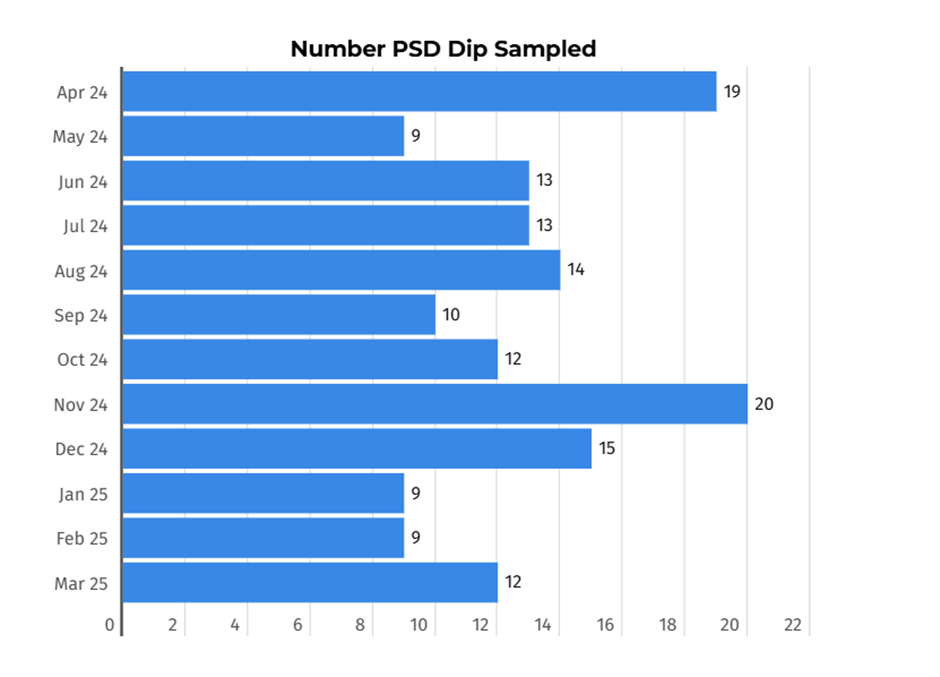
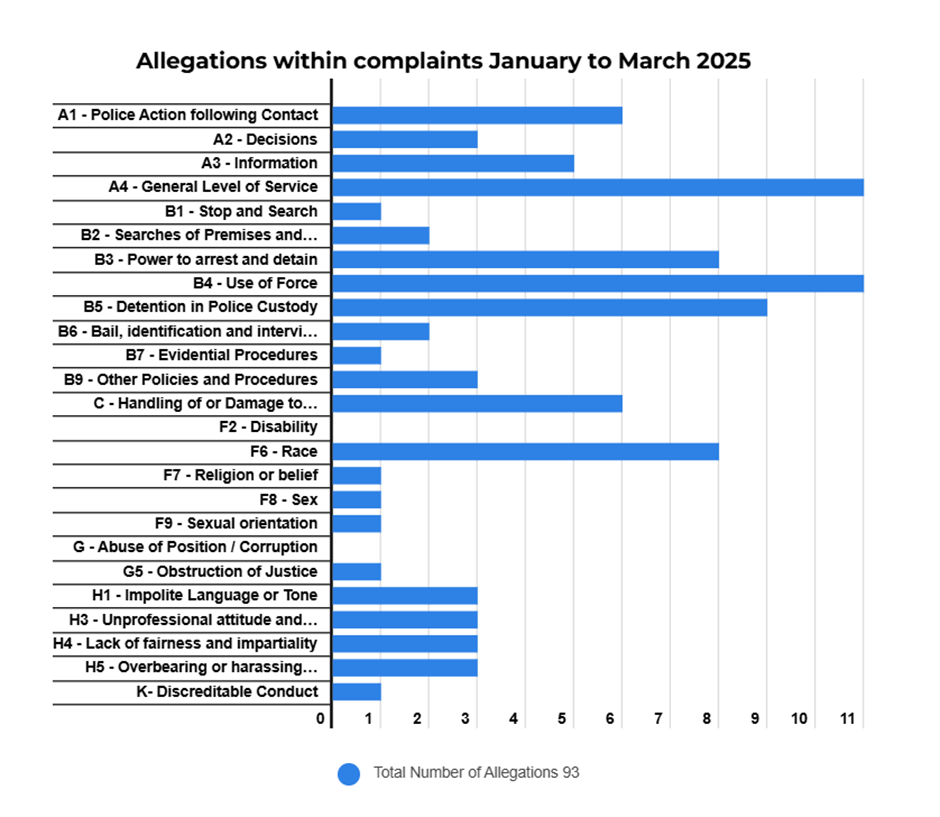
Clarification or further information was required on 11 of the 30 PSD dip sampled. Overall, on average those dip sampled PSD took just over 3 months each (which is comparative from the previous quarter) to complete the investigation and the average time to acknowledge the complaint was 43 days compared to the previous quarter of 47 days.
30% of those sampled found Service was not/partially not acceptable for all allegations.
The top three categories respectively have been:
- General Level of service
- Use of Force
- Detention in police custody
The Office of the Police and Crime Commissioner’s Office (OPCC) agreed with any learning identified within the complaint reports and identified additional points including the need to explain acronyms in correspondence to the public.
CRT/Lower Dissatisfaction – Dip Sample
The Governance and Transparency team conduct monthly dip sampling of lower dissatisfaction complaints and hold a monthly meeting with the Customer Support Management team to discuss findings, to ensure feedback is given and fed into future learning.
The Customer Support and dissatisfaction dip sampling commenced in August 2021 and is completed monthly via access to the police force framework.
The OPCC will consider such aspects when completing the Dip Sampling:
- Complaint
- Allegations
- Victims Code of Practice
- Recommendations or actions
- Timescales
The process relates only to the Dip Sampling of closed complaints cases and does not cover those that remain an enquiry.
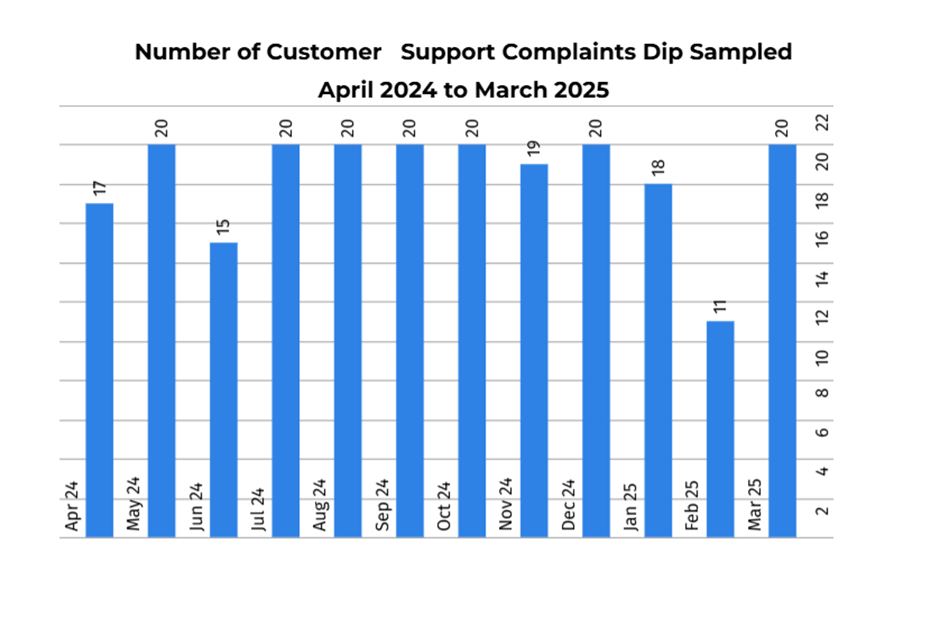
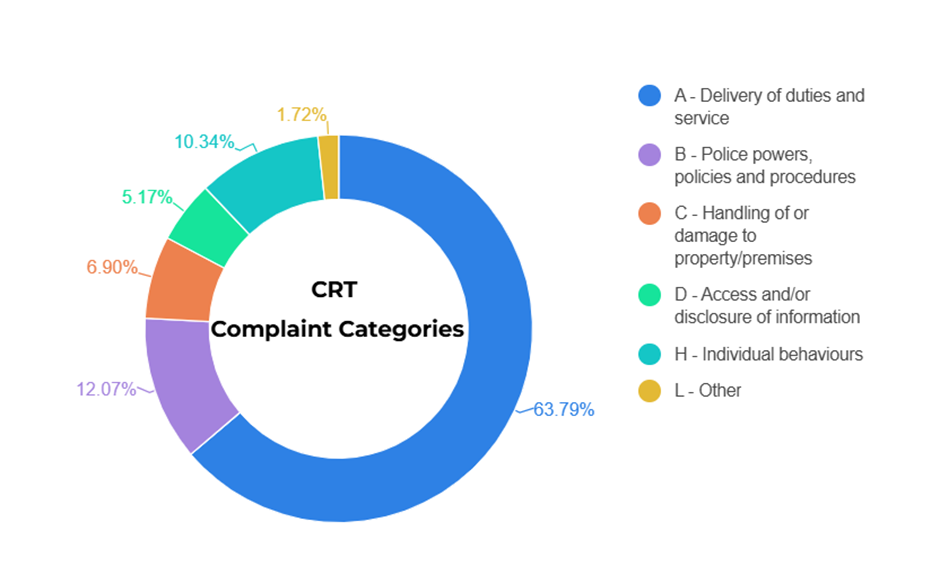
Chief Constable Complaints
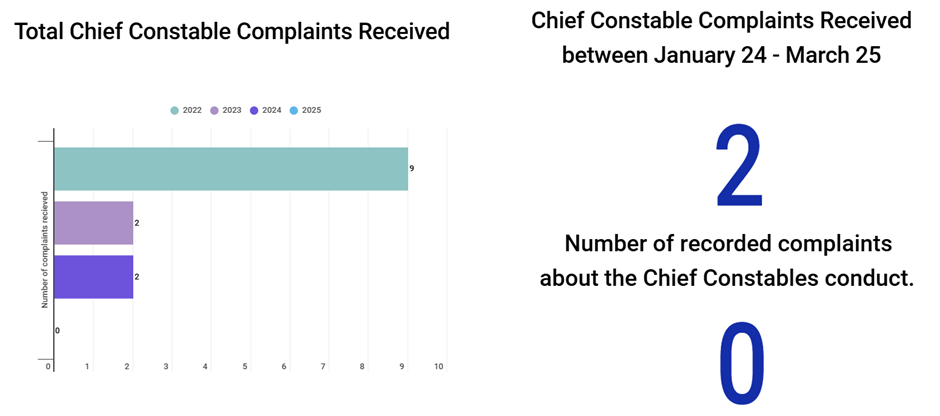
No Chief Constable complaints have been recorded within the last quarter: January – March 2025
Complainants have contacted the OPCC regarding matters which they deemed to be a complaint against the Chief Constable, however if the complaint is not about the Chief Constables conduct directly, it is not a complaint against the Chief Constable. Complainants believe as the Chief Constable has overall responsibility for the Force, they believe he is accountable, and complaints can be made against him. However, if the OPCC reviews the allegations made against the Chief Constable Trevor Rodenhurst, and on immediate review of your complaint, the complaint is not regarding the conduct of the Chief Constable and that the Chief Constable has not had any personal involvement into the case and delegates such responsibilities to others within the organisation, a complaint will not be recorded.
The IOPC statutory guidance states ‘A.7 There will be times where a complaint names the chief officer or acting chief officer, but the complaint is about something where authority has been delegated to another officer or staff member within the force. Where the local policing body receives a complaint for which is it is not the appropriate authority, they must forward the complaint to the appropriate authority. Therefore, where it is immediately clear that the chief officer or acting chief officer has not been involved, the local policing body must take the steps outlined in paragraphs 6.5 – 6.7. They should explain the reasons for this to the complainant.’
So, all complaints of this nature are forwarded to the Customer Services team of Bedfordshire Police to review and allocate to individuals within the Force.
Reviews
From the 1st of February 2020, the Office of the Police and Crime Commissioner (OPCC) is the relevant review body in most cases, apart from those complaints or conduct matters listed below which the IOPC are responsible for reviewing where they relate to:
- Any incident or circumstance in or in consequence of which a person has died or suffered serious injury.
- A serious sexual assault or offence
- Serious corruption
- Criminal offence or behaviour which is liable to lead to disciplinary proceedings.
If a request to review is submitted to either the IOPC or the OPCC and they are not the correct review body, then they will forward it to the correct review body and notify the complainant that this has happened.
What a review means
A review offers the opportunity to consider whether the complaint outcome is reasonable and proportionate but not the handling of the incident leading to the complaint. Each review will be considered on a case-by-case basis. If the reviewer concludes that the outcome was not reasonable and proportionate, the review should be upheld i.e. the service provided by the police was not acceptable the OPCC will, where appropriate, make recommendation to the Chief Constable of Bedfordshire Police.
Requesting a complaint review
Complainants will have been advised by PSD in their complaint outcome letter if they have the right of review and who is the appropriate review body (either the OPCC or IOPC). The review can only be against the outcome of a formal complaint, i.e., a complaint that has been recorded under the legislation. The right of review does not apply to an informal complaint i.e., one that has not been recorded.
The time frame for requesting a review is 28 days from the date of the letter concluding the complaint.
Before a complaint can be reviewed by the OPCC it must be formally recorded by Bedfordshire Police’s Professional Standards Department (PSD) under Schedule 3 of the Police Reform Act 2002.
This is different to having an expression of dissatisfaction dealt with/logged by the Force through their Customer Support team and which has not been recorded under Schedule 3.
Complaints recorded under Schedule 3 will be handled and investigated by the Force or the IOPC (depending on the severity of the allegation).
The Police and Crime Commissioner nor the OPCC can get involved at this stage or investigate the original incident leading to the complaint being made as this could potentially compromise any future request by the complainant to review.
Bedfordshire Police having concluded their investigation of the complaint, will inform the complainant of the outcome, including information about the right to apply for a review, who is the appropriate review body (either the OPCC or IOPC).
Should the complainant wish to request a review, then an application for a review must be in writing and state the following:
- the details of the complaint.
- the date on which the complaint was made.
- the name of the force or local policing body whose decision is the subject of the application.
- the date on which the complainant was provided with the details about their right of review at the conclusion of the investigation or other handling of their complaint.
- the complaint reference number on the outcome letter from PSD.
Due to the changes in the Specified information Order – the OPCC needs to ensure that review information is readily available.
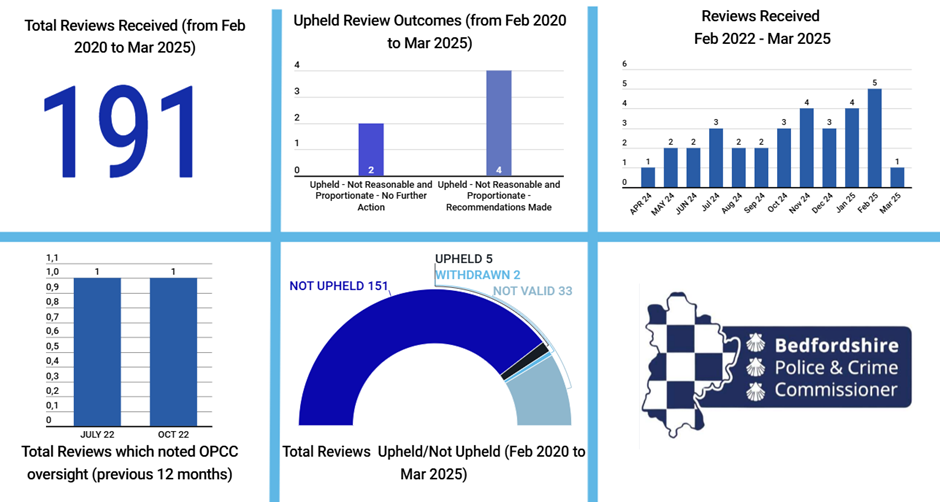
Independent Custody Visitors
Under the Police Reform Act 2002, as amended by the Police Reform & Social Responsibility Act 2011, the Local Policing Body has a statutory duty to establish and maintain an Independent Custody Visiting Scheme, which involves volunteer members of the public visiting police stations to check and report on the treatment of detainees, the conditions in which they are held and that their rights and entitlements are being observed. The scheme offers protection and confidentiality to detainees, the police and provides reassurance to the wider community.
There are two dedicated Police Custody Suites in Bedfordshire. These are located in Kempston with 22 cells and Luton with 21 cells.
The purpose of Independent Custody Visiting is to provide assurance that detainees in Bedfordshire Police Custody are:
- Treated fairly and in accordance with the Police and Criminal Evidence Act 1984 (PACE) and associated codes of practice
- That the conditions detainees are kept in are clean and safe and any matters of concern are recorded and dealt with effectively.
- That the rights and entitlements of detainees in Bedfordshire Police Custody are observed and adhered to.
Independent Custody Visitors are members of the local community who, working in pairs, call at Police Stations unannounced at any time. With agreement, the visitors can speak to detainees about their treatment or conditions and take up any issues of concern with custody staff. A short report of their findings is made prior to leaving the station. Their work provides the PCC (and in turn the local community) with assurance that anyone arrested by the police and held in custody is treated fairly and has access to appropriate facilities.
Bedfordshire ICV Scheme has 30 ICVs as of March 2025.
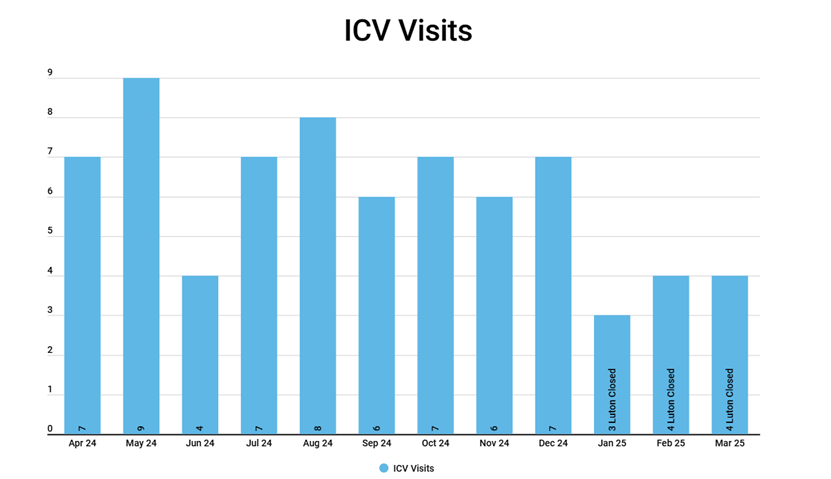
Points to note that have been raised during the visits:
- Religious materials not stored correctly in Kempston.
- Luton is currently under refurbishment.
Good practice:
- ICVs have praised staff within Kempston’s custody whilst they are experiencing an extremely busy custody due to the temporary closure of Luton.
Legally Qualified Chairs
Following a public consultation led by the Home Secretary in the autumn of 2014, changes were made to the police disciplinary system for the purposes of more transparency, independence, and justice. These included holding police misconduct hearings in public (from May 2015).
The Police Misconduct Hearing Panel is likely to be convened to hear allegations of serious cases of misconduct by police officers. The maximum outcome at this hearing would be dismissal from the police service without notice. Cases would include for example, allegations of criminal acts, serious road traffic matters such as drink/driving and other serious breaches of the standards of professional behaviour expected of police officers such as neglect of duty.
Misconduct Hearings could also be convened to consider the final stages of action under performance regulations, where police officers can be dismissed for unsatisfactory performance or attendance.
The Misconduct Hearing Panels will hear cases governed by the Police (Conduct) Regulations 2020. For the purposes of this Handbook, all references will be to the 2020 regulations. (It should be noted that cases where investigations commenced prior to 1st February 2020 will be heard under the Police (Conduct) Regulations 2012 (amended by Police (Conduct) (Amendment) Regulations 2014 and 2015). Should this be the case an LQC will be advised of the relevant regulations to be applied.)
For misconduct hearings commenced after 7 May 2024, panels will consist of three persons: The Chair (Chief Constable or delegated senior person), an IPM with relevant experience, and a second IPM. There is no difference between the two IPMs in terms of responsibility or payments. There is also the appointment of a non-decision making Legally Qualified Person (LQP), sometimes referred to as a Legally Qualified Advisor (LQA) to provide guidance to the panel.
For those hearings that were formed prior to 7 May 2024, until the end of the transition period, they will consist of a Legally Qualified Chair (LQC), a police officer of at least Superintendent Rank and an IPM.
In relation to a Police Appeals Tribunal, the panel when formed, consists of a Chair drawn from a list appointed by the Home Secretary, a senior officer and above, and an
The Police (Conduct) (Amendment) Regulations 2024, Regulation 3 (4B) (a) a senior officer (ACC and above); (b) a former senior officer, who last served as a senior officer no more than five years, a police staff member who, in the opinion of the chief officer of police, is of at least a similar level of seniority to a senior officer.
The Hearing Panels consist of three persons: The Legally Qualified Chair (LQC), a police officer of the rank of superintendent or above, and an independent member (IM).
The OPCC is the authority to appoint LQCs and IMs and in line with the transparency pledge made by the PCC the OPCC the figures below show the numbers that have been appointed.
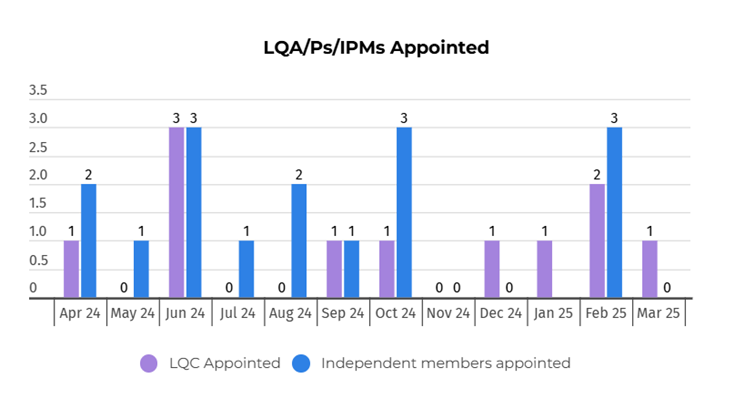
Freedom of Information/Subject Access Requests
The OPCC have received several Freedom of Information and Subject Access Requests which were meant to be for the Force. The Governance and Transparency team respond to all requests for Force information, advising that we do not hold the information and that it must be requested from the Force directly, as well as providing the contact information.
The OPCC has a dedicated website page in which it clearly explains that the OPCC does not hold and cannot access Force data/information.
Consideration needs to be given regarding communication to the public as to the process on where information is requested from.
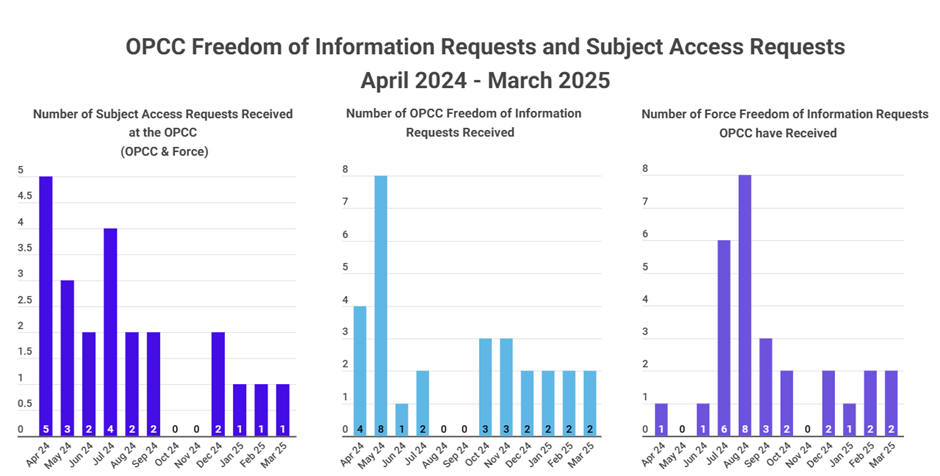
Trends/Patterns
The OPCC had a total of 245 pieces of correspondence which were logged in last quarter January to March 2025 which is a 9% (23) increase from the previous quarter 3.
There have been overarching themes within the correspondence and a breakdown of most frequent contact trends/themes is shown below (excluding SAR/FOI/general correspondence requests).
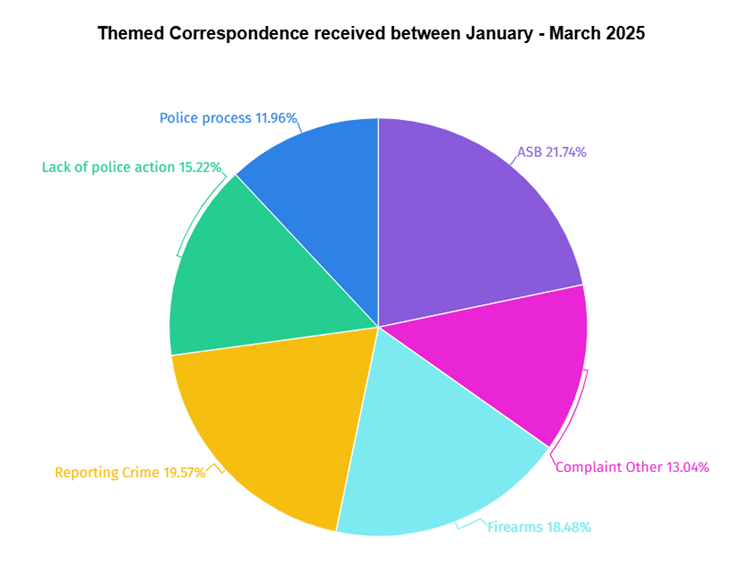
All complaints are forwarded to Bedfordshire Police Customer Support Team. The role of the Customer Support Team is to initially handle the complaint. They will be in contact with the complainant at the earliest opportunity where they will gather information in regard to the complaint to fully understand it.
The Policing and Crime Act 2017: changes to the police complaints system
Legislation changed in February 2020 to ensure that matters can be dealt with at the most appropriate level, supporting both the efficiency and fairness of the complaints system. There is still provision for the most serious matters to be investigated independently. Below that level there are a wide range of complaints that are most appropriately dealt with by the police themselves. The changes allow for certain types of complaints to be resolved outside the requirements of Schedule 3 to the Police Reform Act 2002, while those that have been recorded may be handled reasonably and proportionately otherwise than by investigation, by investigation, or, in some circumstances, no further action may be taken. This allows for the police to quickly learn from, and make improvements based on, the complaints they handle.
All local policing bodies have certain duties in relation to the handling of complaints. They can also choose to take on responsibility for certain additional functions that would otherwise sit with the chief officer:
- Model 1 (mandatory): all local policing bodies have responsibility for carrying out reviews where they are the relevant review body.
- Model 2 (optional): in addition to the responsibilities under model 1, a local policing body can choose to assume responsibility for making initial contact with complainants, handling complaints outside of Schedule 3 to the Police Reform Act 2002 and recording complaints.
- Model 3 (optional): a local policing body that has adopted model 2 can additionally choose to assume responsibility for keeping complainants and interested persons properly informed of the progress of the handling and outcome of their complaint.
Local policing bodies do not become the appropriate authority for the complaint under any of the above models. Rather, in the case of models 2 and 3, they perform some of the functions that the chief officer would otherwise carry out as the appropriate authority.
Bedfordshire’s OPCC has adopted Model 1, which is the mandatory level.
All complaints functions will remain within the Police Force (except for complaints made against the Chief Constable which are reviewed by the OPCC). The Force has set up a Customer Support Team (CST) which is looking after the initial complaints function. No complaints will now be received directly to the Professional Standards Department (PSD), they will be triaged by the CST on the severity of the complaint.
If complaints meet the threshold for severity, they will be passed on to the PSD for investigation. However, if they are lower-level complaints which can be dealt with outside of the schedule 3 complaints legislation, the CST will deal with and log on to the CRT Database for complaints.
The Office of the Police and Crime Commissioner (OPCC) is unable to investigate complaints against Bedfordshire Police or individual members of staff. This falls to the operational management of Bedfordshire Police. Individual complaints should, therefore, be directed in the first instance to Bedfordshire Police.
Bedfordshire Police deal with all complaints against police officers below the rank of Chief Constable, all police staff, and the Special Constabulary. For minor matters that can be resolved quickly and simply, a supervisor can usually deal with your complaint. More serious matters, however, are referred to the Professional Standards Department, who will oversee the process. Some matters, due to their nature or seriousness, are referred to the Independent Office of Police Conduct (IOPC).
There is a reduction of correspondence being received from last year, however the OPCC believe this is due to the OPCC message being received that we are unable to influence operational policing decisions or investigate any complaints, except for the Chief Constable.
Quarterly Transparency/Compliance Report Q3 October - December 2024
October - December 2024
This report is to inform the reader of the Transparency/Governance obligations of the Office of the Police and Crime Commissioner (OPCC). The OPCC will publish this information on a quarterly basis, to ensure that the public can review the functions of the OPCC. The areas of focus for this report are:
- Professional Standards Department (PSD) Dip Sampling
- Customer Services/Lower Dissatisfaction Dip Sampling
- Chief Constable Complaints
- Reviews
- Independent Custody Visitors (ICVs)
- Legally Qualified Chairs (LQCs)
- Freedom of Information / Subject Access Requests
- Trends/Patterns received by the OPCC.
Dip Sampling – Schedule 3 complaints – Professional Standards Department
The purpose of the OPCC Dip Sampling Schedule 3 complaints it that it is a critical function to the reputation of Bedfordshire Police that the public has confidence in the complaints system. To this end, both the Chief Constable and the Police and Crime Commissioner have arranged for ‘dip sampling’ to be undertaken of complaints. On a monthly basis, the OPCC will request categories of complaints from the Professional Standards Department and when the files have been received will review them in full.
The categories of complaint are:
|
Complaint Categories & Subcategories
|
|
|
A |
Delivery of Duties and Service |
|
A1 Police action following contact / A2 Decisions / A3 Information / A4 General level of service.
|
|
|
B |
Police powers, policies, and procedures |
|
B1 Stops, & stop & search / B2 Searches of premises & seizure of property / B3 Power to arrest & detain /
B4 Use of force / B5 Detention in police custody / B6 Bail, identification, and interview procedures /
B7 Evidential procedures / B8 Out of Court disposals / B9 Other policies and procedures
|
|
|
C |
Handling of or damage to property / premises |
|
D |
Access and / or disclosure of information |
|
D1 Use of police systems / D2 Disclosure of information / D3 Handling of information /
D4 Accessing and handling of information from other sources.
|
|
|
E |
Use of Police Vehicles |
|
F |
Discriminatory behaviour |
|
F1 Age / F2 Disability / F3 Gender Reassignment / F4 Pregnancy & Maternity / F5 Marriage & Civil Partnership /
F6 Race / F7 Religion or Belief / F8 Sex / F9 Sexual Orientation / F10 Other
|
|
|
G |
Abuse of Position / Corruption |
|
G1 Organisational corruption / G2 Abuse of position for sexual purpose /
G3 Abuse of position for the purpose of pursuing an inappropriate emotional relationship / G4 Abuse of position for financial purpose / G5 Obstruction of justice / G6 Abuse of position for other purpose
|
|
|
H |
Individual Behaviours |
|
H1 Impolite language or tone / H2 Impolite and intolerant actions / H3 Unprofessional attitude and disrespect
H4 Lack of fairness and impartiality / H5 Overbearing or harassing behaviours
|
|
|
J |
Sexual Conduct |
|
K |
Discreditable Conduct |
|
L |
Other |
The OPCC will consider such aspects when completing the Dip Sampling:
- Timescales for completion of investigations
- Learning Identified
- Were all allegations covered fully and appropriately?
- Satisfaction
- Was Body Worn Video (BWV) used and was it useful to the complaint?
- Other aspects are considered throughout the process.
The process relates only to the Dip Sampling of closed complaints cases and does not cover either the duty to oversee ongoing complaints or the new wider power of direction of the handling of complaints against the police.
The purpose of Dip Sampling is not to interfere with the review process and decisions made by the Relevant Review Body can only be overturned by the courts through the Judicial Review Process.
Q4 – PSD Dip Sample
Bedfordshire OPCC dip sampled 12 complaints in October 2024. Within the 12 complaints, 38 allegations were covered.
Bedfordshire OPCC dip sampled 20 complaints in November 2024. Within the 20 complaints, 97 allegations were covered.
Bedfordshire OPCC dip sampled 15 complaints in December 2024. Within the 15 complaints, 91 allegations were covered.
Bedfordshire OPCC believe that all PSD complaints dip sampled have been dealt with in a reasonable and proportionate manner.
Clarification or further information was required on 12 of the 47 PSD dip sampled. Overall, on average those dip sampled PSD took 3 months (which is a vast improvement from the 5 months of the previous quarter) to complete the investigation and the average time to acknowledge the complaint was 47 days compared to the previous quarter of 44 days. This increase was due to two particularly long lack of response.
43% of those sampled found Service was not/partially not acceptable for all allegations.
The top three categories respectively have been:
- Race
- Use of Force
- Power to arrest and detain
These supersede Use of Force, Race and General Levels of service from the previous quarter.
The Office of the Police and Crime Commissioner’s Office (OPCC) agreed with any learning identified within the complaint reports and identified additional points including the need to explain acronyms in correspondence to the public.
CRT/Lower Dissatisfaction – Dip Sample
The Governance and Transparency team conduct monthly dip sampling of lower dissatisfaction complaints and hold a monthly meeting with the Customer Support Management team to discuss findings, to ensure feedback is given and fed into future learning.
The Customer Support and dissatisfaction dip sampling commenced in August 2021 and is completed monthly via access to the police force framework.
The OPCC will consider such aspects when completing the Dip Sampling:
- Complaint
- Allegations
- Victims Code of Practice
- Recommendations or actions
- Timescales
The process relates only to the Dip Sampling of closed complaints cases and does not cover those that remain an enquiry.
Chief Constable Complaints
No Chief Constable complaints have been recorded within the third quarter – October 2024 to December 2024.
Complainants have contacted the OPCC regarding matters which they deemed to be a complaint against the Chief Constable, however if the complaint is not about the Chief Constables conduct directly, it is not a complaint against the Chief Constable. Complainants believe as the Chief Constable has overall responsibility for the Force, they believe he is accountable, and complaints can be made against him. However, if the OPCC reviews the allegations made against the Chief Constable Trevor Rodenhurst, and on immediate review of your complaint, the complaint is not regarding the conduct of the Chief Constable and that the Chief Constable has not had any personal involvement into the case and delegates such responsibilities to others within the organisation, a complaint will not be recorded.
The IOPC statutory guidance states ‘A.7 There will be times where a complaint names the chief officer or acting chief officer, but the complaint is about something where authority has been delegated to another officer or staff member within the force. Where the local policing body receives a complaint for which is it is not the appropriate authority, they must forward the complaint to the appropriate authority. Therefore, where it is immediately clear that the chief officer or acting chief officer has not been involved, the local policing body must take the steps outlined in paragraphs 6.5 – 6.7. They should explain the reasons for this to the complainant.’
So, all complaints of this nature are forwarded to the Customer Services team of Bedfordshire Police to review and allocate to individuals within the Force.
Reviews
From the 1st of February 2020, the Office of the Police and Crime Commissioner (OPCC) is the relevant review body in most cases, apart from those complaints or conduct matters listed below which the IOPC are responsible for reviewing where they relate to:
- Any incident or circumstance in or in consequence of which a person has died or suffered serious injury.
- A serious sexual assault or offence
- Serious corruption
- Criminal offence or behaviour which is liable to lead to disciplinary proceedings.
If a request to review is submitted to either the IOPC or the OPCC and they are not the correct review body, then they will forward it to the correct review body and notify the complainant that this has happened.
What a review means
A review offers the opportunity to consider whether the complaint outcome is reasonable and proportionate but not the handling of the incident leading to the complaint. Each review will be considered on a case-by-case basis. If the reviewer concludes that the outcome was not reasonable and proportionate, the review should be upheld i.e. the service provided by the police was not acceptable the OPCC will, where appropriate, make recommendation to the Chief Constable of Bedfordshire Police.
Requesting a complaint review
Complainants will have been advised by PSD in their complaint outcome letter if they have the right of review and who is the appropriate review body (either the OPCC or IOPC). The review can only be against the outcome of a formal complaint, i.e., a complaint that has been recorded under the legislation. The right of review does not apply to an informal complaint i.e., one that has not been recorded.
The time frame for requesting a review is 28 days from the date of the letter concluding the complaint.
Before a complaint can be reviewed by the OPCC it must be formally recorded by Bedfordshire Police’s Professional Standards Department (PSD) under Schedule 3 of the Police Reform Act 2002.
This is different to having an expression of dissatisfaction dealt with/logged by the Force through their Customer Support team and which has not been recorded under Schedule 3.
Complaints recorded under Schedule 3 will be handled and investigated by the Force or the IOPC (depending on the severity of the allegation).
The Police and Crime Commissioner nor the OPCC can get involved at this stage or investigate the original incident leading to the complaint being made as this could potentially compromise any future request by the complainant to review.
Bedfordshire Police having concluded their investigation of the complaint, will inform the complainant of the outcome, including information about the right to apply for a review, who is the appropriate review body (either the OPCC or IOPC).
Should the complainant wish to request a review, then an application for a review must be in writing and state the following:
- the details of the complaint.
- the date on which the complaint was made.
- the name of the force or local policing body whose decision is the subject of the application.
- the date on which the complainant was provided with the details about their right of review at the conclusion of the investigation or other handling of their complaint.
- the complaint reference number on the outcome letter from PSD.
Due to the changes in the Specified information Order – the OPCC needs to ensure that review information is readily available.
Independent Custody Visitors
Under the Police Reform Act 2002, as amended by the Police Reform & Social Responsibility Act 2011, the Local Policing Body has a statutory duty to establish and maintain an Independent Custody Visiting Scheme, which involves volunteer members of the public visiting police stations to check and report on the treatment of detainees, the conditions in which they are held and that their rights and entitlements are being observed. The scheme offers protection and confidentiality to detainees, the police and provides reassurance to the wider community.
There are two dedicated Police Custody Suites in Bedfordshire. These are located in Kempston with 22 cells and Luton with 21 cells.
The purpose of Independent Custody Visiting is to provide assurance that detainees in Bedfordshire Police Custody are:
- Treated fairly and in accordance with the Police and Criminal Evidence Act 1984 (PACE) and associated codes of practice
- That the conditions detainees are kept in are clean and safe and any matters of concern are recorded and dealt with effectively.
- That the rights and entitlements of detainees in Bedfordshire Police Custody are observed and adhered to.
Independent Custody Visitors are members of the local community who, working in pairs, call at Police Stations unannounced at any time. With agreement, the visitors can speak to detainees about their treatment or conditions and take up any issues of concern with custody staff. A short report of their findings is made prior to leaving the station. Their work provides the PCC (and in turn the local community) with assurance that anyone arrested by the police and held in custody is treated fairly and has access to appropriate facilities.
Bedfordshire ICV Scheme has 30 ICVs as of December 2024.
Points to note that have been raised during the visits:
- Drainage issue within Luton but this will be rectified when the refurbishment happens Jan 2025
- Out of date cereal packs but this has been rectified.
- Religious materials not stored correctly in Kempston.
- Walls need to be touched up within Kempston Custody showing signs of wear and tear.
Good practice:
- ICVs have noted on several occasions how helpful staff are, especially when Custody is busy. Staff are reported to be caring, professional and informative.
Note: Kempston custody will be operating at full capacity as Luton custody closes for refurbishment. Any additional spaces are being provided by Hatfield custody.
Legally Qualified Chairs
Following a public consultation led by the Home Secretary in the autumn of 2014, changes were made to the police disciplinary system for the purposes of more transparency, independence, and justice. These included holding police misconduct hearings in public (from May 2015).
The Police Misconduct Hearing Panel is likely to be convened to hear allegations of serious cases of misconduct by police officers. The maximum outcome at this hearing would be dismissal from the police service without notice. Cases would include for example, allegations of criminal acts, serious road traffic matters such as drink/driving and other serious breaches of the standards of professional behaviour expected of police officers such as neglect of duty.
Misconduct Hearings could also be convened to consider the final stages of action under performance regulations, where police officers can be dismissed for unsatisfactory performance or attendance.
The Misconduct Hearing Panels will hear cases governed by the Police (Conduct) Regulations 2020. For the purposes of this Handbook, all references will be to the 2020 regulations. (It should be noted that cases where investigations commenced prior to 1st February 2020 will be heard under the Police (Conduct) Regulations 2012 (amended by Police (Conduct) (Amendment) Regulations 2014 and 2015). Should this be the case an LQC will be advised of the relevant regulations to be applied.)
For misconduct hearings commenced after 7 May 2024, panels will consist of three persons: The Chair (Chief Constable or delegated senior person)2 , an IPM with relevant experience, and a second IPM. There is no difference between the two IPMs in terms of responsibility or payments. There is also the appointment of a non-decision making Legally Qualified Person (LQP), sometimes referred to as a Legally Qualified Advisor (LQA) to provide guidance to the panel.
For those hearings that were formed prior to 7 May 2024, until the end of the transition period, they will consist of a Legally Qualified Chair (LQC), a police officer of at least Superintendent Rank and an IPM.
In relation to a Police Appeals Tribunal, the panel when formed, consists of a Chair drawn from a list appointed by the Home Secretary, a senior officer and above, and an
The Police (Conduct) (Amendment) Regulations 2024, Regulation 3 (4B) (a) a senior officer (ACC and above); (b) a former senior officer, who last served as a senior officer no more than five years, a police staff member who, in the opinion of the chief officer of police, is of at least a similar level of seniority to a senior officer.
The Hearing Panels consist of three persons: The Legally Qualified Chair (LQC), a police officer of the rank of superintendent or above, and an independent member (IM).
The OPCC is the authority to appoint LQCs and IMs and in line with the transparency pledge made by the PCC the OPCC the figures below show the numbers that have been appointed.
Freedom of Information/Subject Access Requests
The OPCC have received several Freedom of Information and Subject Access Requests which were meant to be for the Force. The Governance and Transparency team respond to all requests for Force information, advising that we do not hold the information and that it must be requested from the Force directly, as well as providing the contact information.
The OPCC has a dedicated website page in which it clearly explains that the OPCC does not hold and cannot access Force data/information.
Consideration needs to be given regarding communication to the public as to the process on where information is requested from.
Trends/Patterns
The OPCC had a total of 222 pieces of correspondence which were logged in Quarter 3 Oct to Dec 2024 which is a 19% (47) decrease from the previous quarter.
There have been overarching themes within the correspondence and a breakdown of most frequent contact trends/themes is shown below (excluding SAR/FOI/general correspondence requests).
All complaints are forwarded to Bedfordshire Police Customer Support Team. The role of the Customer Support Team is to initially handle the complaint. They will be in contact with the complainant at the earliest opportunity where they will gather information in regard to the complaint to fully understand it.
The Policing and Crime Act 2017: changes to the police complaints system
Legislation changed in February 2020 to ensure that matters can be dealt with at the most appropriate level, supporting both the efficiency and fairness of the complaints system. There is still provision for the most serious matters to be investigated independently. Below that level there are a wide range of complaints that are most appropriately dealt with by the police themselves. The changes allow for certain types of complaints to be resolved outside the requirements of Schedule 3 to the Police Reform Act 2002, while those that have been recorded may be handled reasonably and proportionately otherwise than by investigation, by investigation, or, in some circumstances, no further action may be taken. This allows for the police to quickly learn from, and make improvements based on, the complaints they handle.
All local policing bodies have certain duties in relation to the handling of complaints. They can also choose to take on responsibility for certain additional functions that would otherwise sit with the chief officer:
- Model 1 (mandatory): all local policing bodies have responsibility for carrying out reviews where they are the relevant review body.
- Model 2 (optional): in addition to the responsibilities under model 1, a local policing body can choose to assume responsibility for making initial contact with complainants, handling complaints outside of Schedule 3 to the Police Reform Act 2002 and recording complaints.
- Model 3 (optional): a local policing body that has adopted model 2 can additionally choose to assume responsibility for keeping complainants and interested persons properly informed of the progress of the handling and outcome of their complaint.
Local policing bodies do not become the appropriate authority for the complaint under any of the above models. Rather, in the case of models 2 and 3, they perform some of the functions that the chief officer would otherwise carry out as the appropriate authority.
Bedfordshire’s OPCC has adopted Model 1, which is the mandatory level.
All complaints functions will remain within the Police Force (except for complaints made against the Chief Constable which are reviewed by the OPCC). The Force has set up a Customer Support Team (CST) which is looking after the initial complaints function. No complaints will now be received directly to the Professional Standards Department (PSD), they will be triaged by the CST on the severity of the complaint.
If complaints meet the threshold for severity, they will be passed on to the PSD for investigation. However, if they are lower-level complaints which can be dealt with outside of the schedule 3 complaints legislation, the CST will deal with and log on to the CRT Database for complaints.
The Office of the Police and Crime Commissioner (OPCC) is unable to investigate complaints against Bedfordshire Police or individual members of staff. This falls to the operational management of Bedfordshire Police. Individual complaints should, therefore, be directed in the first instance to Bedfordshire Police.
Bedfordshire Police deal with all complaints against police officers below the rank of Chief Constable, all police staff, and the Special Constabulary. For minor matters that can be resolved quickly and simply, a supervisor can usually deal with your complaint. More serious matters, however, are referred to the Professional Standards Department, who will oversee the process. Some matters, due to their nature or seriousness, are referred to the Independent Office of Police Conduct (IOPC).
There is a reduction of correspondence being received from last year, however the OPCC believe this is due to the OPCC message being received that we are unable to influence operational policing decisions or investigate any complaints, except for the Chief Constable.
Quarterly Transparency/Compliance Report Q2 July - September 2024
July 2024 – September 2024
Office of the Police and Crime Commissioner
This report is to inform the reader of the Transparency/Governance obligations of the Office of the Police and Crime Commissioner (OPCC). The OPCC will publish this information on a quarterly basis, to ensure that the public can review the functions of the OPCC. The areas of focus for this report are:
- Professional Standards Department (PSD) Dip Sampling
- Customer Services/Lower Dissatisfaction Dip Sampling
- Chief Constable Complaints
- Reviews
- Independent Custody Visitors (ICVs)
- Legally Qualified Chairs (LQCs)
- Freedom of Information / Subject Access Requests
- Trends/Patterns received by the OPCC.
Dip Sampling – Schedule 3 complaints – Professional Standards Department
The purpose of the OPCC Dip Sampling Schedule 3 complaints it that it is a critical function to the reputation of Bedfordshire Police that the public has confidence in the complaints system. To this end, both the Chief Constable and the Police and Crime Commissioner have arranged for ‘dip sampling’ to be undertaken of complaints. On a monthly basis, the OPCC will request categories of complaints from the Professional Standards Department and when the files have been received will review them in full.
The categories of complaint are:
|
Complaint Categories & Subcategories
|
|
|
A |
Delivery of Duties and Service |
|
A1 Police action following contact / A2 Decisions / A3 Information / A4 General level of service.
|
|
|
B |
Police powers, policies, and procedures |
|
B1 Stops, & stop & search / B2 Searches of premises & seizure of property / B3 Power to arrest & detain /
B4 Use of force / B5 Detention in police custody / B6 Bail, identification, and interview procedures /
B7 Evidential procedures / B8 Out of Court disposals / B9 Other policies and procedures |
|
|
C |
Handling of or damage to property / premises |
|
D |
Access and / or disclosure of information |
|
D1 Use of police systems / D2 Disclosure of information / D3 Handling of information / D4 Accessing and handling of information from other sources. |
|
|
E |
Use of Police Vehicles |
|
F |
Discriminatory behaviour |
|
F1 Age / F2 Disability / F3 Gender Reassignment / F4 Pregnancy & Maternity / F5 Marriage & Civil Partnership / F6 Race / F7 Religion or Belief / F8 Sex / F9 Sexual Orientation / F10 Other |
|
|
G |
Abuse of Position / Corruption |
|
G1 Organisational corruption / G2 Abuse of position for sexual purpose / G3 Abuse of position for the purpose of pursuing an inappropriate emotional relationship / G4 Abuse of position for financial purpose / G5 Obstruction of justice / G6 Abuse of position for other purpose |
|
|
H |
Individual Behaviours |
|
H1 Impolite language or tone / H2 Impolite and intolerant actions / H3 Unprofessional attitude and disrespect H4 Lack of fairness and impartiality / H5 Overbearing or harassing behaviours |
|
|
J |
Sexual Conduct |
|
K |
Discreditable Conduct |
|
L |
Other |
The OPCC will consider such aspects when completing the Dip Sampling:
- Timescales for completion of investigations
- Learning Identified
- Were all allegations covered fully and appropriately?
- Satisfaction
- Was Body Worn Video (BWV) used and was it useful to the complaint?
- Other aspects are considered throughout the process.
The process relates only to the Dip Sampling of closed complaints cases and does not cover either the duty to oversee ongoing complaints or the new wider power of direction of the handling of complaints against the police.
The purpose of Dip Sampling is not to interfere with the review process and decisions made by the Relevant Review Body can only be overturned by the courts through the Judicial Review Process.
Q3 – PSD Dip Sample
Bedfordshire OPCC dip sampled 13 complaints in July 2024. Within the 13 complaints, 54 allegations were covered.
Bedfordshire OPCC dip sampled 14 complaints in August 2024. Within the 14 complaints, 56 allegations were covered.
Bedfordshire OPCC dip sampled 10 complaints in September 2024. Within the 10 complaints, 44 allegations were covered.
Bedfordshire OPCC believe that all PSD complaints dip sampled have been dealt with in a reasonable and proportionate manner.
Of the 37 PSD dip sampled there were 19 requiring additional information or clarification. Overall, on average those dip sampled PSD took 5 months (same as previous quarter) to complete the investigation and the average time to acknowledge the complaint was 44 days compared to the previous quarter of 23 days. This increase was due to one particularly long lack of response.
24% of those sampled found Service was not/partially not acceptable for all allegations which accounted for the 41% found to have additional learning identified.
The top three categories respectively have been:
- Evidential procedures
- Other policies and procedures
- General Levels of Service
These supersede Use of Force, Race and General Levels of service from the previous quarter.
The Police and Crime Commissioner’s Office (PCCO) agreed with any learning identified within the complaint reports and identified additional points including the need to explain acronyms in correspondence to the public.
CRT/Lower Dissatisfaction – Dip Sample
The Governance and Transparency team conduct monthly dip sampling of lower dissatisfaction complaints and hold a monthly meeting with the Customer Support Management team to discuss findings, to ensure feedback is given and fed into future learning.
The Customer Support and dissatisfaction dip sampling commenced in August 2021 and is completed monthly via access to the police force framework.
The OPCC will consider such aspects when completing the Dip Sampling:
- Complaint
- Allegations
- Victims Code of Practice
- Recommendations or actions
- Timescales
The process relates only to the Dip Sampling of closed complaints cases and does not cover those that remain an enquiry.
Chief Constable Complaints
No Chief Constable complaints have been recorded within the second quarter – July 2024 to September 2024
Complainants have contacted the OPCC regarding matters which they deemed to be a complaint against the Chief Constable, however if the complaint is not about the Chief Constables conduct directly, it is not a complaint against the Chief Constable. Complainants believe as the Chief Constable has overall responsibility for the Force, they believe he is accountable, and complaints can be made against him. However, if the OPCC reviews the allegations made against the Chief Constable Trevor Rodenhurst, and on immediate review of your complaint, the complaint is not regarding the conduct of the Chief Constable and that the Chief Constable has not had any personal involvement into the case and delegates such responsibilities to others within the organisation, a complaint will not be recorded.
The IOPC statutory guidance states ‘A.7 There will be times where a complaint names the chief officer or acting chief officer, but the complaint is about something where authority has been delegated to another officer or staff member within the force. Where the local policing body receives a complaint for which is it is not the appropriate authority, they must forward the complaint to the appropriate authority. Therefore, where it is immediately clear that the chief officer or acting chief officer has not been involved, the local policing body must take the steps outlined in paragraphs 6.5 – 6.7. They should explain the reasons for this to the complainant.’
So, all complaints of this nature are forwarded to the Customer Services team of Bedfordshire Police to review and allocate to individuals within the Force.
Reviews
From the 1st of February 2020, the Office of the Police and Crime Commissioner (OPCC) is the relevant review body in most cases, apart from those complaints or conduct matters listed below which the IOPC are responsible for reviewing where they relate to:
- Any incident or circumstance in or in consequence of which a person has died or suffered serious injury.
- A serious sexual assault or offence
- Serious corruption
- Criminal offence or behaviour which is liable to lead to disciplinary proceedings.
If a request to review is submitted to either the IOPC or the OPCC and they are not the correct review body, then they will forward it to the correct review body and notify the complainant that this has happened.
What a review means
A review offers the opportunity to consider whether the complaint outcome is reasonable and proportionate but not the handling of the incident leading to the complaint. Each review will be considered on a case-by-case basis. If the reviewer concludes that the outcome was not reasonable and proportionate, the review should be upheld i.e. the service provided by the police was not acceptable the OPCC will, where appropriate, make recommendation to the Chief Constable of Bedfordshire Police.
Requesting a complaint review
Complainants will have been advised by PSD in their complaint outcome letter if they have the right of review and who is the appropriate review body (either the OPCC or IOPC). The review can only be against the outcome of a formal complaint, i.e., a complaint that has been recorded under the legislation. The right of review does not apply to an informal complaint i.e., one that has not been recorded.
The timeframe for requesting a review is 28 days from the date of the letter concluding the complaint.
Before a complaint can be reviewed by the OPCC it must be formally recorded by Bedfordshire Police’s Professional Standards Department (PSD) under Schedule 3 of the Police Reform Act 2002.
This is different to having an expression of dissatisfaction dealt with/logged by the Force through their Customer Support team and which has not been recorded under Schedule 3.
Complaints recorded under Schedule 3 will be handled and investigated by the Force or the IOPC (depending on the severity of the allegation).
The Police and Crime Commissioner nor the OPCC can get involved at this stage or investigate the original incident leading to the complaint being made as this could potentially compromise any future request by the complainant to review.
Bedfordshire Police having concluded their investigation of the complaint, will inform the complainant of the outcome, including information about the right to apply for a review, who is the appropriate review body (either the OPCC or IOPC).
Should the complainant wish to request a review, then an application for a review must be in writing and state the following:
- the details of the complaint.
- the date on which the complaint was made.
- the name of the force or local policing body whose decision is the subject of the application.
- the date on which the complainant was provided with the details about their right of review at the conclusion of the investigation or other handling of their complaint.
- the complaint reference number on the outcome letter from PSD.
Due to the changes in the Specified information Order – the OPCC needs to ensure that review information is readily available.
Independent Custody Visitors
Under the Police Reform Act 2002, as amended by the Police Reform & Social Responsibility Act 2011, the Local Policing Body has a statutory duty to establish and maintain an Independent Custody Visiting Scheme, which involves volunteer members of the public visiting police stations to check and report on the treatment of detainees, the conditions in which they are held and that their rights and entitlements are being observed. The scheme offers protection and confidentiality to detainees, the police and provides reassurance to the wider community.
There are two dedicated Police Custody Suites in Bedfordshire. These are located in Kempston with 22 cells and Luton with 21 cells.
The purpose of Independent Custody Visiting is to provide assurance that detainees in Bedfordshire Police Custody are:
- Treated fairly and in accordance with the Police and Criminal Evidence Act 1984 (PACE) and associated codes of practice
- That the conditions detainees are kept in are clean and safe and any matters of concern are recorded and dealt with effectively.
- That the rights and entitlements of detainees in Bedfordshire Police Custody are observed and adhered to.
Independent Custody Visitors are members of the local community who, working in pairs, call at Police Stations unannounced at any time. With agreement, the visitors can speak to detainees about their treatment or conditions and take up any issues of concern with custody staff. A short report of their findings is made prior to leaving the station. Their work provides the PCC (and in turn the local community) with assurance that anyone arrested by the police and held in custody is treated fairly and has access to appropriate facilities.
Bedfordshire ICV Scheme has 30 ICVs as at September 2024.
Points to note that have been raised during the visits:
- Concerns raised over availability of HCP, this is discussed at Performance Board and is being monitored.
- Detention Officers on shift are not at full capacity, so causing a knock effect within custody however recruitment is still ongoing.
- Infestation of bugs in array corridors at Kempston reported and later dealt with by estates.
Good practice:
- ICVs have noted on several occasions how helpful staff are, especially when Custody is busy. Staff are reported to be caring, professional and informative.
- Female packs have been improved and menopausal items available.
- Books and reading material well stocked as distractions for those detained.
Note: Kempston custody have been providing shared custody facilities for Stevenage detainees due to custody upgrades. Stevenage will be replaced with Hertford detainees for a further period. This will be reciprocated in January when Luton custody is refurbished.
Legally Qualified Chairs
Following a public consultation led by the Home Secretary in the autumn of 2014, changes were made to the police disciplinary system for the purposes of more transparency, independence, and justice. These included holding police misconduct hearings in public (from May 2015).
The Police Misconduct Hearing Panel is likely to be convened to hear allegations of serious cases of misconduct by police officers. The maximum outcome at this hearing would be dismissal from the police service without notice. Cases would include for example, allegations of criminal acts, serious road traffic matters such as drink/driving and other serious breaches of the standards of professional behaviour expected of police officers such as neglect of duty.
Misconduct Hearings could also be convened to consider the final stages of action under performance regulations, where police officers can be dismissed for unsatisfactory performance or attendance.
The Misconduct Hearing Panels will hear cases governed by the Police (Conduct) Regulations 2020. For the purposes of this Handbook, all references will be to the 2020 regulations. (It should be noted that cases where investigations commenced prior to 1st February 2020 will be heard under the Police (Conduct) Regulations 2012 (amended by Police (Conduct) (Amendment) Regulations 2014 and 2015). Should this be the case an LQC will be advised of the relevant regulations to be applied.)
For misconduct hearings commenced after 7 May 2024, panels will consist of three persons: The Chair (Chief Constable or delegated senior person)2 , an IPM with relevant experience, and a second IPM. There is no difference between the two IPMs in terms of responsibility or payments. There is also the appointment of a non-decision making Legally Qualified Person (LQP), sometimes referred to as a Legally Qualified Advisor (LQA) to provide guidance to the panel.
For those hearings that were formed prior to 7 May 2024, until the end of the transition period, they will consist of a Legally Qualified Chair (LQC), a police officer of at least Superintendent Rank and an IPM.
In relation to a Police Appeals Tribunal, the panel when formed, consists of a Chair drawn from a list appointed by the Home Secretary, a senior officer and above, and an
2 The Police (Conduct) (Amendment) Regulations 2024, Regulation 3 (4B) (a) a senior officer (ACC and above); (b) a former senior officer, who last served as a senior officer no more than five years, a police staff member who, in the opinion of the chief officer of police, is of at least a similar level of seniority to a senior officer.
The Hearing Panels consist of three persons: The Legally Qualified Chair (LQC), a police officer of the rank of superintendent or above, and an independent member (IM).
The PCCO is the authority to appoint LQCs and IMs and in line with the transparency pledge made by the PCC the PCCO the figures below show the numbers that have been appointed.
Freedom of Information/Subject Access Requests
The OPCC have received several Freedom of Information and Subject Access Requests which were meant to be for the Force. The Governance and Transparency team respond to all requests for Force information, advising that we do not hold the information and that it must be requested from the Force directly, as well as providing the contact information.
The OPCC has a dedicated website page in which it clearly explains that the OPCC does not hold and cannot access Force data/information.
Consideration needs to be given regarding communication to the public as to the process on where information is requested from.
Trends/Patterns
The OPCC had a total of 270 pieces of correspondence which were logged in Quarter 2 Jul 24 – Sep 24, which is a 20% (69) decrease from the previous quarter.
There have been overarching themes within the correspondence and a breakdown of most frequent contact trends/themes is shown below (excluding SAR/FOI/general correspondence requests).
All complaints are forwarded to Bedfordshire Police Customer Support Team. The role of the Customer Support Team is to initially handle the complaint. They will be in contact with the complainant at the earliest opportunity where they will gather information in regard to the complaint to fully understand it.
The Policing and Crime Act 2017: changes to the police complaints system
Legislation changed in February 2020 to ensure that matters can be dealt with at the most appropriate level, supporting both the efficiency and fairness of the complaints system. There is still provision for the most serious matters to be investigated independently. Below that level there are a wide range of complaints that are most appropriately dealt with by the police themselves. The changes allow for certain types of complaints to be resolved outside the requirements of Schedule 3 to the Police Reform Act 2002, while those that have been recorded may be handled reasonably and proportionately otherwise than by investigation, by investigation, or, in some circumstances, no further action may be taken. This allows for the police to quickly learn from, and make improvements based on, the complaints they handle.
All local policing bodies have certain duties in relation to the handling of complaints. They can also choose to take on responsibility for certain additional functions that would otherwise sit with the chief officer:
- Model 1 (mandatory): all local policing bodies have responsibility for carrying out reviews where they are the relevant review body.
- Model 2 (optional): in addition to the responsibilities under model 1, a local policing body can choose to assume responsibility for making initial contact with complainants, handling complaints outside of Schedule 3 to the Police Reform Act 2002 and recording complaints.
- Model 3 (optional): a local policing body that has adopted model 2 can additionally choose to assume responsibility for keeping complainants and interested persons properly informed of the progress of the handling and outcome of their complaint.
Local policing bodies do not become the appropriate authority for the complaint under any of the above models. Rather, in the case of models 2 and 3, they perform some of the functions that the chief officer would otherwise carry out as the appropriate authority.
Bedfordshire’s OPCC has adopted Model 1, which is the mandatory level.
All complaints functions will remain within the Police Force (except for complaints made against the Chief Constable which are reviewed by the OPCC). The Force has set up a Customer Support Team (CST) which is looking after the initial complaints function. No complaints will now be received directly to the Professional Standards Department (PSD), they will be triaged by the CST on the severity of the complaint.
If complaints meet the threshold for severity, they will be passed on to the PSD for investigation. However, if they are lower-level complaints which can be dealt with outside of the schedule 3 complaints legislation, the CST will deal with and log on to the CRT Database for complaints.
The Office of the Police and Crime Commissioner (OPCC) is unable to investigate complaints against Bedfordshire Police or individual members of staff. This falls to the operational management of Bedfordshire Police. Individual complaints should, therefore, be directed in the first instance to Bedfordshire Police.
Bedfordshire Police deal with all complaints against police officers below the rank of Chief Constable, all police staff, and the Special Constabulary. For minor matters that can be resolved quickly and simply, a supervisor can usually deal with your complaint. More serious matters, however, are referred to the Professional Standards Department, who will oversee the process. Some matters, due to their nature or seriousness, are referred to the Independent Office of Police Conduct (IOPC).
There is a reduction of correspondence being received from last year, however the OPCC believe this is due to the OPCC message being received that we are unable to influence operational policing decisions or investigate any complaints, except for the Chief Constable.
Guidance on Outcomes in Police Misconduct Proceedings 2022
Graphs and Data are available in the above PDF.
Quarterly Transparency/Compliance Report Q1 April - June 2024
April 2024 – June 2024
Office of the Police and Crime Commissioner
This report is to inform the reader of the Transparency/Governance obligations of the Office of the Police and Crime Commissioner (OPCC). The OPCC will publish this information on a quarterly basis, to ensure that the public can review the functions of the OPCC. The areas of focus for this report are:
- Professional Standards Department (PSD) Dip Sampling
- Customer Services/Lower Dissatisfaction Dip Sampling
- Chief Constable Complaints
- Reviews
- Independent Custody Visitors (ICVs)
- Legally Qualified Chairs (LQCs)
- Freedom of Information / Subject Access Requests
- Trends/Patterns received by the
Dip Sampling – Schedule 3 complaints – Professional Standards Department
The purpose of the OPCC Dip Sampling Schedule 3 complaints it that it is a critical function to the reputation of Bedfordshire Police that the public has confidence in the complaints system. To this end, both the Chief Constable and the Police and Crime Commissioner have arranged for ‘dip sampling’ to be undertaken of complaints. On a monthly basis, the OPCC will request categories of complaints from the Professional Standards Department and when the files have been received will review them in full.
The categories of complaint are:
|
Complaint Categories & Subcategories |
|
|
A |
Delivery of Duties and Service |
|
A1 Police action following contact / A2 Decisions / A3 Information / A4 General level of service. |
|
|
B |
Police powers, policies, and procedures |
|
B1 Stops, & stop & search / B2 Searches of premises & seizure of property / B3 Power to arrest & detain / B4 Use of force / B5 Detention in police custody / B6 Bail, identification, and interview procedures / B7 Evidential procedures / B8 Out of Court disposals / B9 Other policies and procedures |
|
|
C |
Handling of or damage to property / premises |
|
D |
Access and / or disclosure of information |
|
D1 Use of police systems / D2 Disclosure of information / D3 Handling of information / D4 Accessing and handling of information from other sources. |
|
|
|
|
|
E |
Use of Police Vehicles |
|
F |
Discriminatory behaviour |
|
F1 Age / F2 Disability / F3 Gender Reassignment / F4 Pregnancy & Maternity / F5 Marriage & Civil Partnership / F6 Race / F7 Religion or Belief / F8 Sex / F9 Sexual Orientation / F10 Other |
|
|
G |
Abuse of Position / Corruption |
|
G1 Organisational corruption / G2 Abuse of position for sexual purpose / G3 Abuse of position for the purpose of pursuing an inappropriate emotional relationship / G4 Abuse of position for financial purpose / G5 Obstruction of justice / G6 Abuse of position for other purpose |
|
|
H |
Individual Behaviours |
|
H1 Impolite language or tone / H2 Impolite and intolerant actions / H3 Unprofessional attitude and disrespect H4 Lack of fairness and impartiality / H5 Overbearing or harassing behaviours |
|
|
J |
Sexual Conduct |
|
K |
Discreditable Conduct |
|
L |
Other |
The OPCC will consider such aspects when completing the Dip Sampling:
- Timescales for completion of investigations
- Learning Identified
- Were all allegations covered fully and appropriately?
- Satisfaction
- Was Body Worn Video (BWV) used and was it useful to the complaint?
- Other aspects are considered throughout the
The process relates only to the Dip Sampling of closed complaints cases and does not cover either the duty to oversee ongoing complaints or the new wider power of direction of the handling of complaints against the police.
The purpose of Dip Sampling is not to interfere with the review process and decisions made by the Relevant Review Body can only be overturned by the courts through the Judicial Review Process.
Q3 – PSD Dip Sample
Bedfordshire OPCC dip sampled 20 complaints in April 2024. Within the 20 complaints, 79 allegations were covered.
Bedfordshire OPCC dip sampled 9 complaints in May 2024. Within the 9 complaints, 27 allegations were covered.
Bedfordshire OPCC dip sampled 13 complaints in June 2024. Within the 13 complaints, 54 allegations were covered.
Bedfordshire OPCC believe that all PSD complaints dip sampled have been dealt with in a reasonable and proportionate manner.
Of the 31 PSD dip sampled there were 9 requiring additional information or clarification. Overall, on average those dip sampled PSD took 4.5 months to complete the investigation and the average time to acknowledge the complaint was 25 days. The top three categories have been Use of Force (same as previous quarter), Police Action after Contact and General Levels of service respectively. None of the complaints were subject to a review by the OPCC and the OPCC agree with any learning identified within the complaint reports.
CRT/Lower Dissatisfaction – Dip Sample
The Governance and Transparency team conduct monthly dip sampling of lower dissatisfaction complaints and hold a monthly meeting with the Customer Support Management team to discuss findings, to ensure feedback is given and fed into future learning.
The Customer Support and dissatisfaction dip sampling commenced in August 2021 and is completed monthly via access to the police force framework.
The OPCC will consider such aspects when completing the Dip Sampling:
- Complaint
- Allegations
- Victims Code of Practice
- Recommendations or actions
- Timescales
The process relates only to the Dip Sampling of closed complaints cases and does not cover those that remain an enquiry.
Chief Constable Complaints
No Chief Constable complaints have been recorded within the first quarter – January 2024 to June 2024
Complainants have contacted the OPCC regarding matters which they deemed to be a complaint against the Chief Constable, however if the complaint is not about the Chief Constables conduct directly, it is not a complaint against the Chief Constable. Complainants believe as the Chief Constable has overall responsibility for the Force, they believe he is accountable, and complaints can be made against him. However, if the OPCC reviews the allegations made against the Chief Constable Trevor Rodenhurst, and on immediate review of your complaint, the complaint is not regarding the conduct of the Chief Constable and that the Chief Constable has not had any personal involvement into the case and delegates such responsibilities to others within the organisation, a complaint will not be recorded.
The IOPC statutory guidance states ‘A.7 There will be times where a complaint names the chief officer or acting chief officer, but the complaint is about something where authority has been delegated to another officer or staff member within the force. Where the local policing body receives a complaint for which is it is not the appropriate authority, they must forward the complaint to the appropriate authority. Therefore, where it is immediately clear that the chief officer or acting chief officer has not been involved, the local policing body must take the steps outlined in paragraphs 6.5 – 6.7. They should explain the reasons for this to the complainant.’
So, all complaints of this nature are forwarded to the Customer Services team of Bedfordshire Police to review and allocate to individuals within the Force.
Reviews
From the 1st of February 2020, the Office of the Police and Crime Commissioner (OPCC) is the relevant review body in most cases, apart from those complaints or conduct matters listed below which the IOPC are responsible for reviewing where they relate to:
- Any incident or circumstance in or in consequence of which a person has died or suffered serious injury.
- A serious sexual assault or offence
- Serious corruption
- Criminal offence or behaviour which is liable to lead to disciplinary
If a request to review is submitted to either the IOPC or the OPCC and they are not the correct review body, then they will forward it to the correct review body and notify the complainant that this has happened.
What a review means
A review offers the opportunity to consider whether the complaint outcome is reasonable and proportionate but not the handling of the incident leading to the complaint. Each review will be considered on a case-by-case basis. If the reviewer concludes that the outcome was not reasonable and proportionate, the review should be upheld i.e. the service provided by the police was not acceptable the OPCC will, where appropriate, make recommendation to the Chief Constable of Bedfordshire Police.
Requesting a complaint review
Complainants will have been advised by PSD in their complaint outcome letter if they have the right of review and who is the appropriate review body (either the OPCC or IOPC). The review can only be against the outcome of a formal complaint, i.e., a complaint that has been recorded under the legislation. The right of review does not apply to an informal complaint i.e., one that has not been recorded.
The timeframe for requesting a review is 28 days from the date of the letter concluding the complaint.
Before a complaint can be reviewed by the OPCC it must be formally recorded by Bedfordshire Police’s Professional Standards Department (PSD) under Schedule 3 of the Police Reform Act 2002.
This is different to having an expression of dissatisfaction dealt with/logged by the Force through their Customer Support team and which has not been recorded under Schedule 3.
Complaints recorded under Schedule 3 will be handled and investigated by the Force or the IOPC (depending on the severity of the allegation).
The Police and Crime Commissioner nor the OPCC can get involved at this stage or investigate the original incident leading to the complaint being made as this could potentially compromise any future request by the complainant to review.
Bedfordshire Police having concluded their investigation of the complaint, will inform the complainant of the outcome, including information about the right to apply for a review, who is the appropriate review body (either the OPCC or IOPC).
Should the complainant wish to request a review, then an application for a review must be in writing and state the following:
- the details of the
- the date on which the complaint was
- the name of the force or local policing body whose decision is the subject of the
- the date on which the complainant was provided with the details about their right of review at the conclusion of the investigation or other handling of their complaint.
- the complaint reference number on the outcome letter from
Due to the changes in the Specified information Order – the OPCC needs to ensure that review information is readily available.
Independent Custody Visitors
Under the Police Reform Act 2002, as amended by the Police Reform & Social Responsibility Act 2011, the Local Policing Body has a statutory duty to establish and maintain an Independent Custody Visiting Scheme, which involves volunteer members of the public visiting police stations to check and report on the treatment of detainees, the conditions in which they are held and that their rights and entitlements are being observed. The scheme offers protection and confidentiality to detainees, the police and provides reassurance to the wider community.
There are two dedicated Police Custody Suites in Bedfordshire. These are in Kempston with 22 cells and Luton with 21 cells.
The purpose of Independent Custody Visiting is to provide assurance that detainees in Bedfordshire Police Custody are:
- Treated fairly and in accordance with the Police and Criminal Evidence Act 1984 (PACE) and associated codes of practice
- That the conditions detainees are kept in are clean and safe and any matters of concern are recorded and dealt with effectively.
- That the rights and entitlements of detainees in Bedfordshire Police Custody are observed and adhered to.
Independent Custody Visitors are members of the local community who, working in pairs, call at Police Stations unannounced at any time. With agreement, the visitors can speak to detainees about their treatment or conditions and take up any issues of concern with custody staff. A short report of their findings is made prior to leaving the station. Their work provides the PCC (and in turn the local community) with assurance that anyone arrested by the police and held in custody is treated fairly and has access to appropriate facilities.
Bedfordshire ICV Scheme has 29 ICVs with 1 completing vetting as of June 2024.
Points to note that have been raised during the visits:
- Concerns raised over availability of HCP and escalated to Bedfordshire Police; this
- Maintenance issues within Luton custody (due a refit later in 2024).
- Concerns raised over insufficient Detention
Good practice:
- ICVs have noted on several occasions how helpful staff are, especially when Custody is busy. Staff are reported to be caring, professional and informative.
- ICV now have translations books
Legally Qualified Advisors/Person (LQA/LQP)
Recent high-profile cases and concerning reviews, including Baroness Casey’s review of culture and standards in the Metropolitan Police Service (MPS) and His Majesty’s Inspectorate of Constabulary and Fire & Rescue Services’ inspection report on vetting, misconduct, and misogyny, raised questions regarding the effectiveness of the existing system in ensuring effective accountability in the police. This led to the then Secretary of State for the Home Department (Home Secretary) launching an internal review into the process
of police officer dismissals in January 2023 (originally in place since May 2015, which replaced Chief Police Officers who chaired hearings, with Legally Qualified Chairs (LQC), later strengthened in 2020). The review concluded that the police disciplinary system requires action to strengthen standards and improve public confidence.
There are two types of misconduct hearings, standard misconduct hearings and accelerated misconduct hearings. Misconduct hearings are heard by a misconduct panel. The current structure of misconduct panels means that the main responsibility – that of the chair – is a non- police role, instead held by a LQC, appointed by the local policing body. The panel also comprises of an officer of at least Superintendent rank, appointed by the force, and an independent panel member, also appointed by the local policing body. Where the officer concerned is a senior officer (that is, above the rank of Chief Superintendent), the police panel member is instead His Majesty’s Chief Inspector of Constabulary (HMCIC) or a nominated His Majesty’s Inspector (HMI).
The chair will in future be supported on the misconduct panel by two IPMs, ensuring that misconduct panels retain independence and that decisions continue to be on a majority basis. One of those panel members will also be required to have specific experience or qualifications which are relevant for the purposes of disciplinary proceedings.
The Police Misconduct Hearing Panel is likely to be convened to hear allegations of serious cases of misconduct by police officers. The maximum outcome at this hearing would be dismissal from the police service without notice. Cases would include for example, allegations of criminal acts, serious road traffic matters such as drink/driving and other serious breaches of the standards of professional behaviour expected of police officers such as neglect of duty.
Misconduct Hearings could also be convened to consider the final stages of action under performance regulations, where police officers can be dismissed for unsatisfactory performance or attendance.
The Hearing Panels consist of four persons: The Legally Qualified Advisor/Person (LQA/P), a police officer of the rank of superintendent or above, and two independent members (IPM).
The OPCC is the authority to appoint LQA/Ps and IPMs and in line with the transparency pledge made by the PCC the OPCC will be releasing the figures of the numbers that have been appointed.
Freedom of Information/Subject Access Requests
The OPCC have received several Freedom of Information and Subject Access Requests which were meant to be for the Force. The Governance and Transparency team respond to all requests for Force information, advising that we do not hold the information and that it must be requested from the Force directly, as well as providing the contact information.
The OPCC has a dedicated website page in which it clearly explains that the OPCC does not hold and cannot access Force data/information.
Consideration needs to be given regarding communication to the public as to the process on where information is requested from.
Trends/Patterns
The OPCC had a total of 339 pieces of correspondence which were logged in Quarter 1 April 24 – June 24, showing same level as the previous quarter.
There have been overarching themes within the correspondence and a breakdown of most frequent contact trends/themes is shown below (excluding SAR/FOI/general correspondence requests).
The OPCC has receive low volume local complaints covering the following areas (excluding SAR/FOI/general correspondence requests):
All complaints are forwarded to Bedfordshire Police Customer Support Team. The role of the Customer Support Team is to initially handle the complaint. They will be in contact with the complainant at the earliest opportunity where they will gather information in regard to the complaint to fully understand it.
The Policing and Crime Act 2017: changes to the police complaints system
Legislation changed in February 2020 to ensure that matters can be dealt with at the most appropriate level, supporting both the efficiency and fairness of the complaints system. There is still provision for the most serious matters to be investigated independently. Below that level there are a wide range of complaints that are most appropriately dealt with by the police themselves. The changes allow for certain types of complaints to be resolved outside the requirements of Schedule 3 to the Police Reform Act 2002, while those that have been recorded may be handled reasonably and proportionately otherwise than by investigation, by investigation, or, in some circumstances, no further action may be taken. This allows for the police to quickly learn from, and make improvements based on, the complaints they handle.
All local policing bodies have certain duties in relation to the handling of complaints. They can also choose to take on responsibility for certain additional functions that would otherwise sit with the chief officer:
- Model 1 (mandatory): all local policing bodies have responsibility for carrying out reviews where they are the relevant review body.
- Model 2 (optional): in addition to the responsibilities under model 1, a local policing body can choose to assume responsibility for making initial contact with complainants, handling complaints outside of Schedule 3 to the Police Reform Act 2002 and recording
- Model 3 (optional): a local policing body that has adopted model 2 can additionally choose to assume responsibility for keeping complainants and interested persons properly informed of the progress of the handling and outcome of their complaint.
Local policing bodies do not become the appropriate authority for the complaint under any of the above models. Rather, in the case of models 2 and 3, they perform some of the functions that the chief officer would otherwise carry out as the appropriate authority.
Bedfordshire’s OPCC has adopted Model 1, which is the mandatory level.
All complaints functions will remain within the Police Force (except for complaints made against the Chief Constable which are reviewed by the OPCC). The Force has set up a Customer Support Team (CST) which is looking after the initial complaints function. No complaints will now be received directly to the Professional Standards Department (PSD), they will be triaged by the CST on the severity of the complaint.
If complaints meet the threshold for severity, they will be passed on to the PSD for investigation. However, if they are lower-level complaints which can be dealt with outside of the schedule 3 complaints legislation, the CST will deal with and log on to the CRT Database for complaints.
The Office of the Police and Crime Commissioner (OPCC) is unable to investigate complaints against Bedfordshire Police or individual members of staff. This falls to the operational management of Bedfordshire Police. Individual complaints should, therefore, be directed in the first instance to Bedfordshire Police.
Bedfordshire Police deal with all complaints against police officers below the rank of Chief Constable, all police staff, and the Special Constabulary. For minor matters that can be resolved quickly and simply, a supervisor can usually deal with your complaint. More serious matters, however, are referred to the Professional Standards Department, who will oversee the process. Some matters, due to their nature or seriousness, are referred to the Independent Office of Police Conduct (IOPC).
There is a reduction of correspondence being received from last year, however the OPCC believe this is due to the OPCC message being received that we are unable to influence operational policing decisions or investigate any complaints, except for the Chief Constable.
Graphs and Data are available in the above PDF.